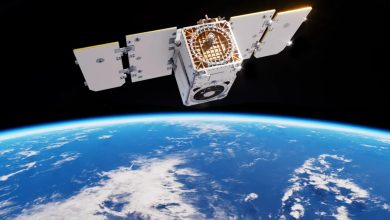
Raytheon has announced a strategic collaboration with Amazon Web Services (AWS) to improve satellite data processing and mission control operations.
The collaboration focuses on deploying scalable cloud-based solutions using AWS’s artificial intelligence (AI) and machine learning (ML) services.
Under the initiative, the two companies will integrate mission engineering and data collection capabilities with cloud services to support decision-making, operational coordination, and flexibility.
The partnership is expected to provide Raytheon’s customers, government and commercial, with the tools needed to meet national security and space operational goals more efficiently.
Erich Hernandez-Baquero, Raytheon’s VP of Space Intelligence, Surveillance, and Reconnaissance, said the partnership will help the company “accelerate responsible AI innovation, increase agility while maintaining the highest levels of security, optimize resources, and strengthen systems to drive effective results for our customers.”
Focus Areas
The partnership enables mission data to be processed and reported using Raytheon systems running on AWS Outposts.
AWS Outposts is a set of fully managed services and hardware that extends AWS infrastructure to on-premises or edge locations, allowing cloud-based applications to run locally with consistent management and operations.
It also supports command and control of satellite constellations through modular, software-defined systems for task scheduling and asset coordination.
Mission management can be scaled to add new capabilities using AWS serverless technologies, which enable applications to run without dedicated servers.
Additionally, the collaboration incorporates advanced AI and ML services from AWS, including Amazon SageMaker and Amazon Bedrock.
Amazon SageMaker is a fully managed service that helps developers build, train, and deploy ML models at scale.
Amazon Bedrock provides access to foundation models through application programming interfaces, enabling organizations to integrate AI capabilities into applications without managing the underlying infrastructure.