California-based power generation company Radiant has signed an agreement to provide a mass-produced nuclear microreactor for a US military installation under the Advanced Nuclear Power for Installations (ANPI) program.
ANPI, a collaboration between the Defense Innovation Unit and the US Air Force, is an ongoing effort to deploy portable nuclear energy for base resilience and operational security.
The initiative supports the Pentagon’s push to rapidly adopt dual-use technologies through a competitive process that prioritizes microreactors, focusing on safety, scalability, and warfighter needs.
It is intended to strengthen bases at home and abroad while giving US forces an advantage over near-peer adversaries.
Radiant plans to deliver the reactor to the program within three years.
Testing in 2026
The firm said the agreement follows the US Department of Energy’s recent selection of its flagship reactor, called Kaleidos, for testing next year at Idaho National Laboratory’s Demonstration of Microreactor Experiments facility — the first new US reactor design to be tested there in nearly five decades.
Kaleidos is a high-temperature gas-cooled reactor that produces approximately 1 megawatt of electricity, sufficient to power a small military base, or around 3 megawatts of thermal energy.
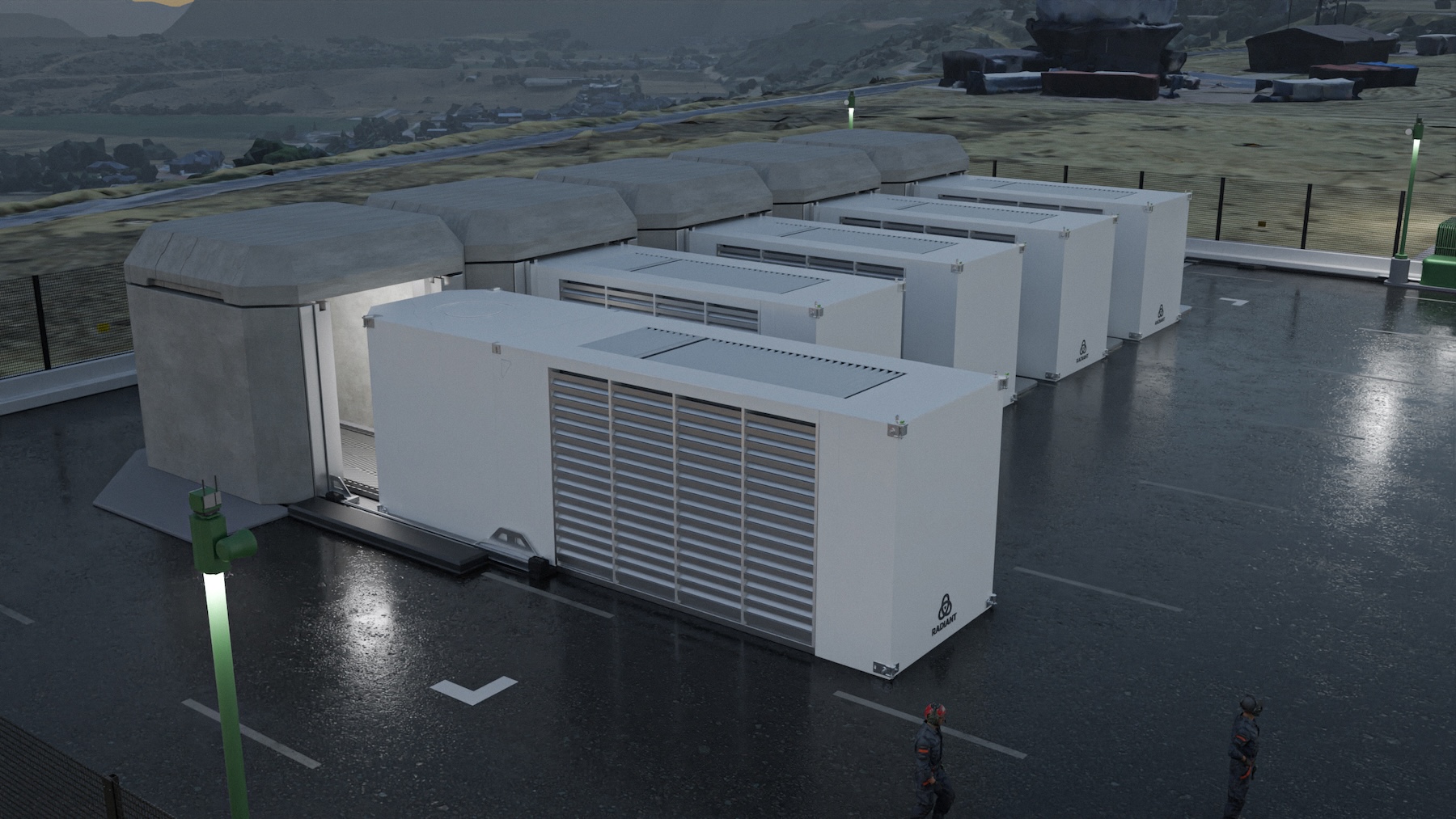
Designed for mobility, the entire system fits in a shipping container, can be moved between sites, and is ready to run within 48 hours. Once online, it can deliver years of cyber-secure power without refueling.
Radiant did not confirm if the ANPI program will use Kaleidos directly, but the design is expected to serve as the foundation for the solution.
About the Kaleidos Microreactor
Radiant’s Kaleidos runs on TRISO fuel or ceramic-coated uranium particles that are effectively meltdown-proof, with helium gas for cooling, a combination that eliminates water requirements and reduces contamination risks.
Inside the platform, graphite blocks with a zinc-hydride moderator form the reactor core, while a supercritical carbon dioxide Brayton cycle efficiently converts heat into electricity.
For safety, Kaleidos features passive air-jacket cooling that draws heat away naturally, even in emergencies. The system can shut down and cool itself in just 300 milliseconds.
A single unit of the microreactor runs for five years before the sealed container is returned for refueling. Over its 20-year lifespan, it can be refueled four times, leaving no waste or infrastructure behind.
Radiant plans for hundreds of Kaleidos units to operate autonomously, each monitored through a centralized 24/7 control network.