Modern artillery demands mobility, flexibility, and precision. Traditional towed systems are often too slow to deploy, while older multiple rocket launchers struggle with range and modularity.
South Korea’s K239 Chunmoo addresses these gaps, delivering a versatile, rapid-response rocket artillery system that can engage multiple targets at varying ranges with high accuracy.
In this guide, we explore the system’s origin, capabilities, variants, operational use, and future outlook.
What Is the K239 Chunmoo?
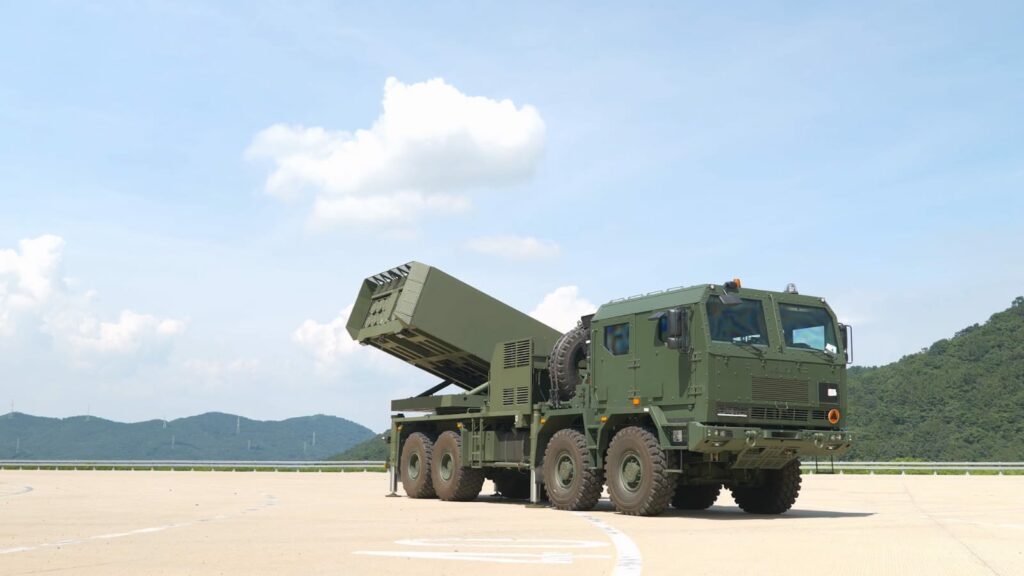
The K239 Chunmoo is a South Korean multiple launch rocket system (MLRS) capable of firing rockets of different calibers and ranges.
It combines modular design with mobility and precision, enabling forces to engage targets across both tactical and long-range missions.
Developed by Hanwha Aerospace for the Republic of Korea Army, the Chunmoo provides a modern artillery capability optimized for rapid deployment and networked targeting.
The system supports unguided and guided rockets, as well as smart munitions, giving commanders flexibility in how they plan and execute strikes.
How the K239 Chunmoo Came to Be
The K239 Chunmoo emerged from South Korea’s desire to modernize its artillery capabilities while maintaining compatibility with legacy rocket munitions.
During the 2010s, Seoul sought a modular, mobile, and precision-capable MLRS to replace older systems.
The K239 Chunmoo was designed as a modular rocket launcher capable of firing multiple calibers, including 130mm and 239mm munitions.
Following operational testing in the late 2010s, it quickly entered service with the Republic of Korea Army, where it now equips frontline artillery brigades. Chunmoo was designed not only for domestic defense but also with export potential in mind, demonstrating South Korea’s growing defense manufacturing capabilities.
How the K239 Chunmoo Works
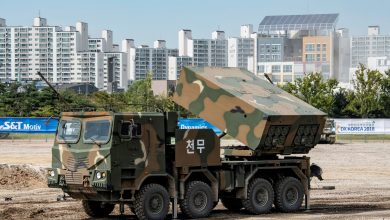
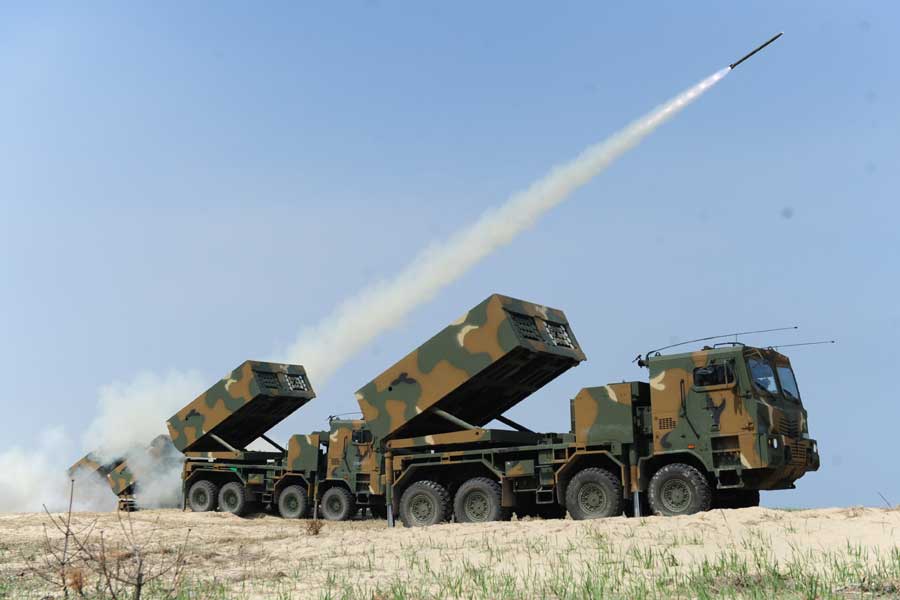
The K239 Chunmoo operates from a mobile, truck-mounted launcher designed for rapid deployment and flexible fire missions. Each launcher carries modular rocket pods depending on mission needs.
This modularity allows units to configure the system for precision strikes, area suppression, or extended-range engagements.
Once in position, the crew programs targeting data through the onboard fire control computer or via a networked command system that integrates GPS, inertial navigation, and digital fire control.
A full salvo of up to eight rockets can be fired in under a minute, delivering rapid battlefield firepower.
After firing, Chunmoo’s mobility allows it to relocate quickly, reducing exposure to counter-battery attacks. Its advanced fire control supports coordinated strikes, letting multiple launchers synchronize salvos on single or multiple targets.
Additional features include automated reloads, networked coordination with other artillery, and compatibility with extended-range munitions capable of reaching over 100 kilometers (62 miles).
| Category: | Details: |
| Type | Multiple Launch Rocket System |
| Country of Origin | South Korea |
| Manufacturer | Hanwha Aerospace |
| Crew | 3 (commander, driver, operator) |
| Chassis | 8×8 wheeled vehicle |
| Launch System | Modular dual-pod launcher |
| Rocket Types | 130mm, 227mm (MLRS-compatible), 239mm guided rockets |
| Range | ~36 kilometers (22 miles) up to ~290 kilometers (180 miles) depending on variant |
| Guidance | GPS/INS (for guided munitions) |
| Reload Time | Fast reload via pre-packaged pods |
| Mobility | High-speed road mobility, off-road capable |
| Key Feature | Multi-caliber modular launch capability |
Strengths of the K239 Chunmoo
- Modular design: Can switch between short- and long-range rockets, including smart munitions.
- High mobility: Wheeled chassis allows rapid deployment and relocation.
- Precision capability: GPS-guided rockets reduce collateral damage and improve strike accuracy.
- Rapid salvo: Can fire multiple rockets in under a minute.
- Networked operations: Compatible with modern command-and-control systems for coordinated artillery strikes.
Limitations of the K239 Chunmoo
- Dependence on GPS: Accuracy of guided rockets relies on GPS signals, potentially vulnerable to jamming.
- Limited rocket capacity: Each launcher can only carry a finite number of rockets (8 to 12), requiring frequent resupply for sustained operations.
- Crew and maintenance needs: Requires trained operators and logistics support for effective deployment and upkeep.
- Wheeled chassis constraints: While highly mobile, off-road terrain may limit rapid movement compared to tracked systems.
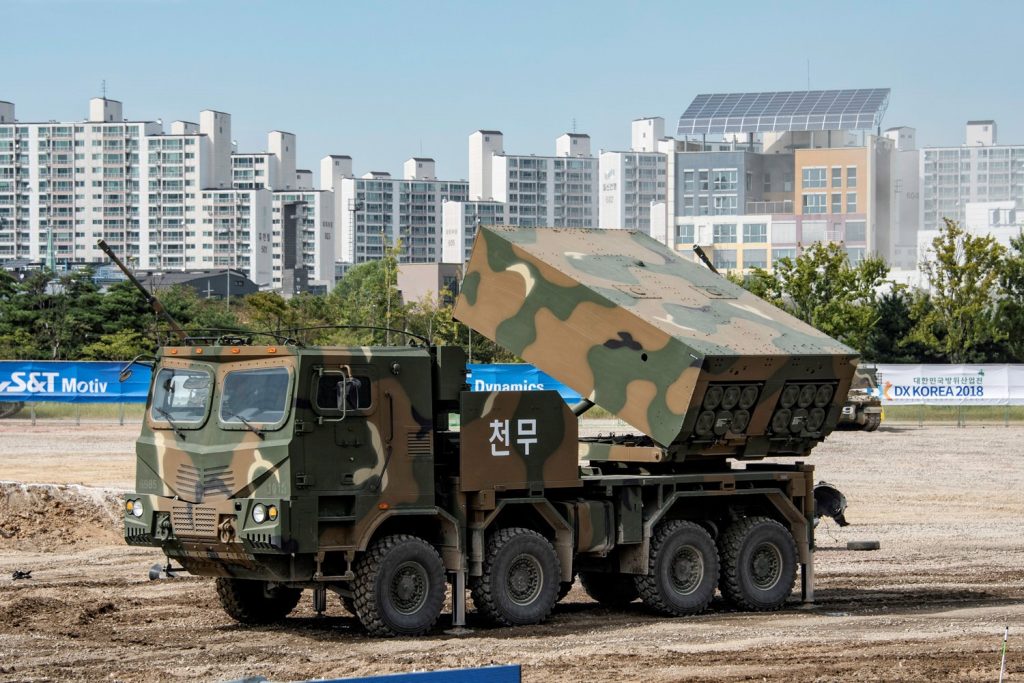
Global Use and Operational Deployment
The K239 Chunmoo has drawn international interest thanks to its modular design, precision capabilities, and extended range.
Beyond its deployment with the Republic of Korea Army, several countries are exploring the system for their own artillery modernization programs.
Norway has reportedly evaluated Chunmoo for its long-range strike needs, while Poland is considering it to complement existing rocket artillery units. Estonia has also expressed interest.
Future Outlook
The K239 Chunmoo is expected to continue evolving with:
- Extended-range rockets exceeding 100 kilometers (62 miles)
- Enhanced network integration with allied forces and battlefield management systems
- Development of autonomous or semi-autonomous targeting modules for reduced crew workload
- Potential adoption of next-generation precision munitions
With these upgrades, Chunmoo is poised to remain a cornerstone of South Korea’s mobile artillery and a competitive option in the global MLRS market.