Fincantieri has launched the Italian Navy’s new hydro-oceanographic vessel, “Quirinale,” at its shipyard in Riva Trigoso, northwestern Italy.
The ship is designed for mapping and scientific monitoring and will support the Italian Hydrographic Institute’s operations.
Capable of accommodating up to 140 personnel including crew and scientific staff, the vessel is approximately 110 meters (361 feet) long and displaces around 6,000 tons.
The vessel is designed to operate in temperatures down to –16 degrees Celsius (3 degrees Fahrenheit) and is equipped with hydrographic, oceanographic, and geophysical instruments, as well as autonomous underwater and surface vehicles.
Additional technical features include lifting systems for scientific operations and a dynamic positioning system for precise and stable positioning during research activities.
The design incorporates emission reduction measures, diesel-electric propulsion, optimized hull forms, and low-impact materials.
“A new unit, designed with the utmost attention to environmental sustainability, that confirms our role as a strategic partner of the Italian Navy, underscoring our commitment towards a safer, more innovative, and more sustainable future,” stated the company.

Latest Projects
In recent months, Fincantieri has advanced naval capabilities with a series of new vessels and systems.
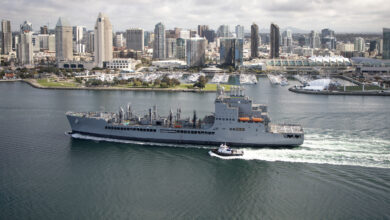
Last month, the company delivered a supply ship to the Italian Navy, capable of performing a range of missions, including underwater operations.
The vessel will undergo refitting at Fincantieri’s Palermo shipyard through the Underwater Technology Hub to support a range of mission profiles, from logistical support to specialized tasks.
In October 2025, Fincantieri unveiled DEEP, a new underwater drone system designed to protect seabed infrastructure and secure ports and coastal areas.
The system includes an underwater early-warning sensor network and a command-and-control hub for real-time data.
It also features a squad of autonomous underwater vehicles for missions ranging from deep-water reconnaissance to environmental monitoring.