The US Navy has contracted Leonardo UK to deliver an undisclosed quantity of active expendable decoys (AED) to enhance the survivability of its fighter jet fleet against advanced radar-guided threats.
The sole-source contract includes a base year and up to one option year, covering the supply of the decoys as well as initial spare impulse cartridges and associated support equipment.
While the contract value and exact quantity were not disclosed, the service has previously indicated a requirement for between 3,000 and 6,000 decoys per year.
Sole-Source Award
Explaining the decision to proceed with a sole-source award, the navy stated that selecting an alternative supplier would have delayed fielding the capability by up to eight years.
According to the Naval Air Systems Command contract notice, “approximately 14 years of research and development have been completed through a partnership between Leonardo UK and the UK Ministry of Defence to develop and test the AED.”
“These efforts include laboratory hardware in the loop testing, software development testing and validation, safe separation, and effectiveness testing to qualify the AED on the F-35.
A new source would require at least four years to achieve the desired product maturity, three years to qualify an alternate device and one year for manufacturing readiness in preparation for a low-rate production line.”
In addition to Leonardo UK, the service received responses from Elbit America and Raytheon, while submissions from BHPE and Kastel Enterprises were deemed inadequate.
Additional Layer of Protection
Designated AN/ALQ-260(V) by the US military, the AED’s 2×1×8-inch (5×2.5×20-centimeter) form factor corresponds to the BriteCloud 218, a compact variant of Leonardo’s 55-millimeter cylindrical BriteCloud decoy.
The design allows compatibility with US-standard chaff and flare dispensers, including the widely used AN/ALE-47 installed on many US aircraft.
The BriteCloud 218 is intended primarily for the F-35, augmenting the stealth aircraft’s existing radio-frequency countermeasure capabilities, according to The Aviationist.
These include the BAE Systems AN/ASQ-239 onboard self-protection suite, which also incorporates a limited number of ALE-70 fiber-optic towed decoys.
Active Expendable Decoy
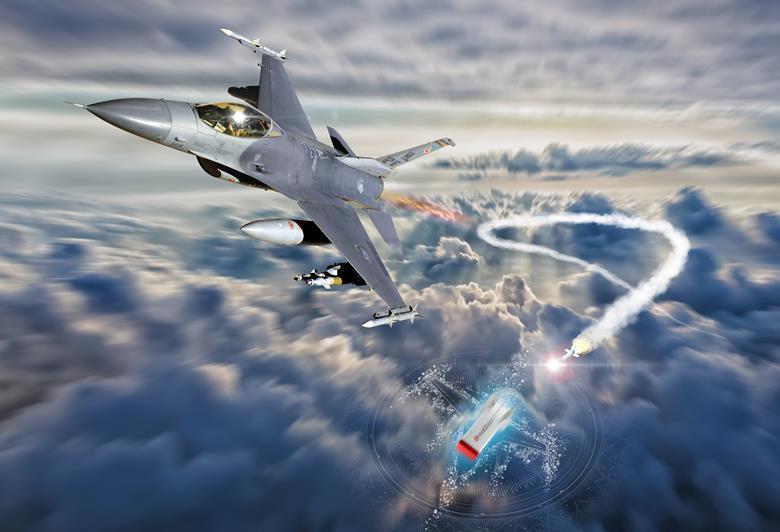
The BriteCloud 218 is a battery-powered, self-contained anti-missile countermeasure that protects against radio-frequency-guided missiles and fire-control radars.
Launched from standard chaff and flare dispensers, the miniaturized system is designed to defeat both surface-to-air and air-to-air threats.
As an off-board capability, BriteCloud avoids the “home-on-jam” vulnerability associated with onboard jammers, where the jamming signal itself can cue a missile to track the aircraft.
The decoy also employs Doppler and range obscuration techniques to defeat the chaff-discrimination features of modern missile seekers.
“Effectively, BriteCloud creates a false target so convincing that technologies designed to spot decoys are rendered ineffective, allowing a much wider range of threat systems to be defeated,” Leonardo explained.