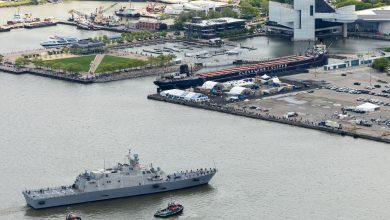
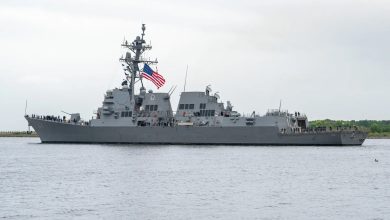
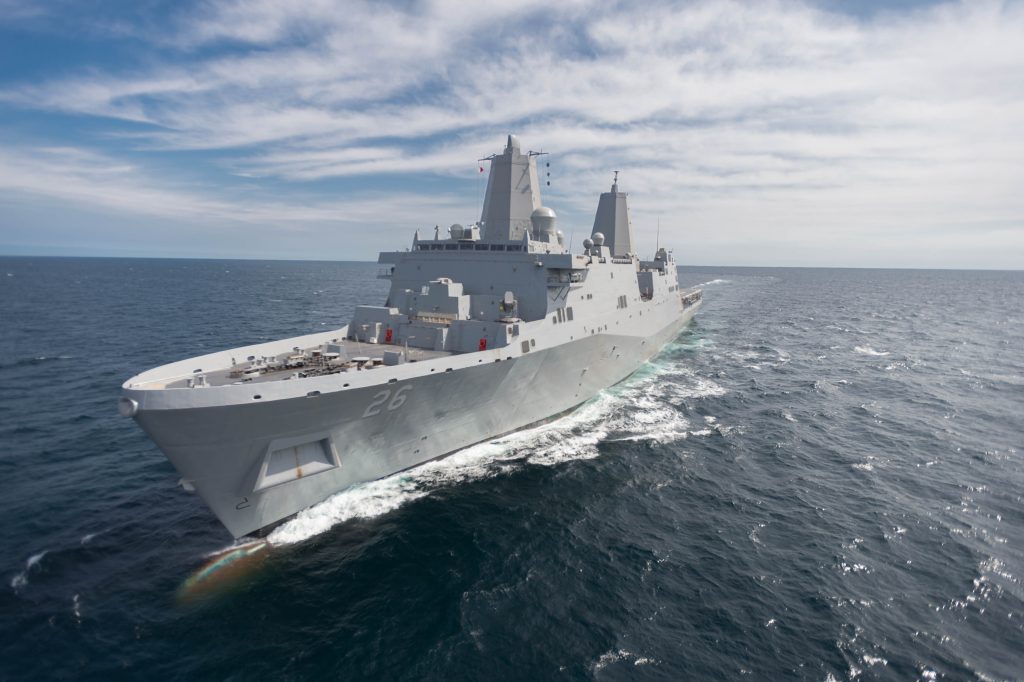
At first glance, the San Antonio-class amphibious transport dock looks like just another gray hull on the horizon. But beneath its angular stealth lines is something far more versatile, a floating gateway for modern expeditionary warfare.
Designed to move US Marines, aircraft, landing craft, and command elements in a single platform, this class has become central to how the US Navy projects power from sea to shore.
As amphibious operations evolve, understanding the San Antonio-class is key to understanding the future of naval warfare, so let’s break it down.
An Overview
The San Antonio-class amphibious transport dock is built to support expeditionary warfare, humanitarian missions, and joint operations. It combines troop transport, aviation support, and amphibious assault capabilities into a single platform.
In practice, it serves as a seaborne staging hub, delivering Marines, vehicles, supplies, and equipment from offshore positions directly into contested environments without established ports.
Beyond assault operations, the platform functions as a command-and-control node, coordinating joint and coalition forces through advanced communications systems.
The same capabilities translate into humanitarian assistance and disaster relief, where the ship can deliver aid, restore access to affected coastal areas, and support evacuation efforts — all without needing functioning infrastructure ashore.
| Category: | Details: |
| Type | Amphibious transport dock (landing platform dock or LPD) |
| Role | Expeditionary amphibious transport and support vessel |
| Propulsion | Four sequentially turbocharged marine Colt-Pielstick Diesels, two shafts, 41,600 shaft horsepower |
| Length | 684 feet (208.5 meters) |
| Beam | 105 feet (32 meters) |
| Displacement | Approx. 24,900 long tons full load |
| Draft | 23 feet (7 meters) |
| Speed | 22 knots (25.3 miles/40.7 kilometers per hour) |
| Crew | Flight I: 699 with a surge capacity of 800LPD; 28/29: 650; Flight II: 631 |
| Armament | Two Mk 46 30mm Close in Guns, fore and aft; two Rolling Airframe Missile launchers, fore and aft; 10 .50 caliber machine guns |
| Aircraft | Launch or land two CH-53E Super Stallion helicopters or two MV-22 Osprey tilt rotor aircraft; or up to four AH-1Z, UH-1Y, or MH-60 helicopters |
| Landing/Attack Craft | Two LCACs or one LCU; and 14 Amphibious Assault Vehicles |
Where It Started
The program emerged as a replacement for aging classes like the Austin and Newport ships.
Huntington Ingalls Industries (then Northrop Grumman Ship Systems) led the development, with construction centered in Pascagoula, Mississippi.
The goal was to create a survivable, networked amphibious platform with reduced radar signature and enhanced command-and-control capabilities.
The lead ship, USS San Antonio (LPD-17), was commissioned in 2006, marking a generational leap in amphibious ship design.
Flights
While the class shares a common baseline, improvements have been introduced over time:
- Flight I (LPD-17 to LPD-28): Baseline design with incremental upgrades
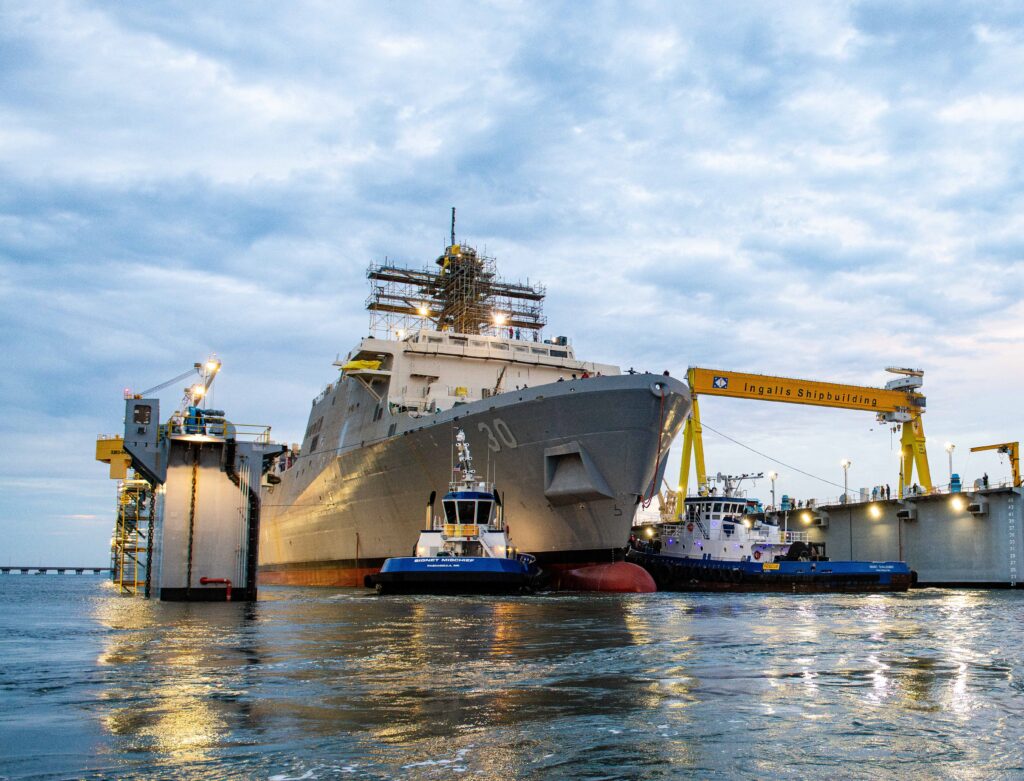
- Flight II (LPD-30 onward): Optimized for cost and intended to replace older dock landing ships, with revised systems and simplified design
How the San Antonio-Class Amphibious Transport Dock Works
Deployment Process
1. Transit: Ship moves to operational area with embarked Marines and equipment
2. Positioning: Holds offshore beyond direct threat range
3. Launch phase:
- Landing craft deploy from the well deck
- Aircraft launch from the flight deck
4. Sustainment: Ship provides logistics, medical, and command support
Key Features
- Well deck operations: Enables launch/recovery of LCAC hovercraft and landing craft
- Aviation facilities: Supports tiltrotor and rotary-wing aircraft
- Stealth design: Reduced radar cross-section compared to legacy ships
- C4ISR integration: Advanced command, control, communications, computers, intelligence, surveillance, and reconnaissance systems
Strengths
- Multirole flexibility: Combines transport, assault, and command roles
- Survivability: Improved armor, redundancy, and damage control systems
- Joint operations: Designed for integration with naval, air, and ground forces
Limitations
- High cost: Advanced systems increase procurement and maintenance expenses
- Limited armament: Relies on escorts for high-threat environments
- Complex systems: Maintenance and logistics demands are significant
Global Use and Operations
San Antonio-class ships have been widely deployed in both combat and non-combat roles. They supported operations during the Iraq War and the war in Afghanistan, primarily in expeditionary and support roles.
Beyond combat, they’ve played a critical role in disaster relief, delivering aid, medical support, and evacuation capabilities after hurricanes and global crises.
Future Outlook
The San Antonio-class remains central to US amphibious strategy. The Flight II variant signals a shift toward affordability while maintaining operational capability, ensuring continued relevance as older platforms retire.
Looking ahead, integration with unmanned systems, expanded aviation capabilities, and network-centric warfare concepts will likely define the next evolution.
As amphibious doctrine adapts to contested environments, the San Antonio-class is expected to remain a backbone of expeditionary operations, bridging sea control with power projection ashore.