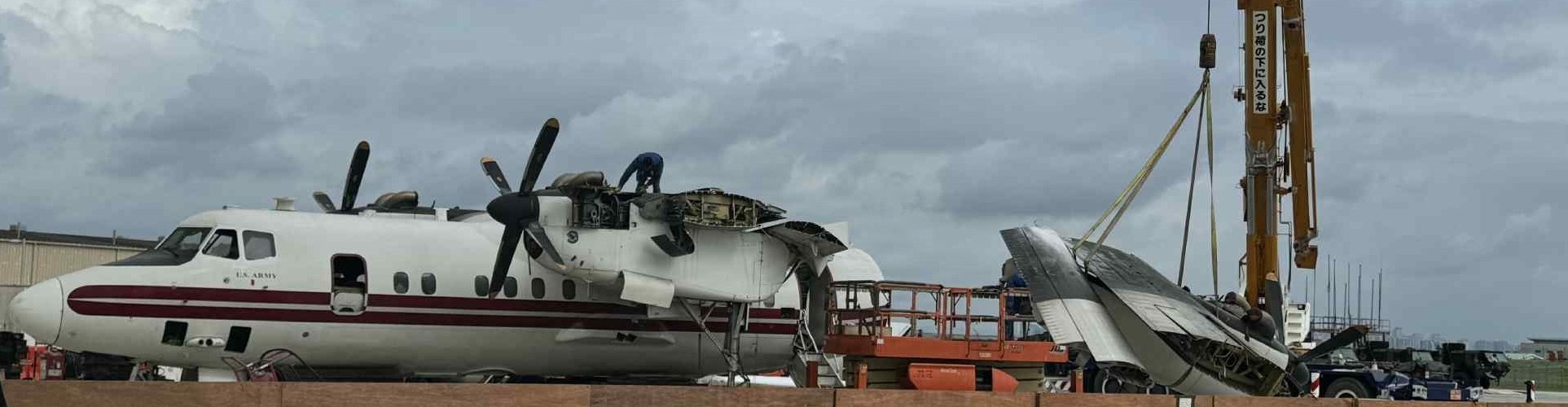
The US Army has retired its legacy fleet of aerial intelligence, surveillance, and reconnaissance (A-ISR) turboprops, ending more than five decades of operations.
This shift moves the service from platforms including the RC-12 Guardrail, EO-5C ARL-M, and EMARSS toward modern spy planes built for higher altitude sensing.
Guardrail, introduced in the 1970s for American units in Germany, supported warfighters during the Cold War, Operations Desert Shield, Desert Storm, Iraqi Freedom, and Enduring Freedom.
It also conducted intelligence gathering over the Middle East and supported missions near the Korean Demilitarized Zone.
ARL-M was then added to the army’s A-ISR arsenal in the 1990s to replace the Vietnam War-era OV-1D Mohawk, enhancing surveillance and targeting with advanced avionics, including a moving target indicator and synthetic aperture radar.
Meanwhile, EMARSS was commissioned in 2016 to provide global ISR support across multiple theaters, including Iraq, Afghanistan, Latin America, and Africa.
Strategic Shift
Despite various upgrades, including the service-wide RC-12X Guardrail Common Sensor to extend the fleet’s operational life by 20 years, the army concluded that the turboprops no longer met operational requirements.
The divestment of ARL-M and Guardrail was completed with their final flights in Korea in July, concluding 54 years of continuous A-ISR support.
The last EMARSS aircraft retired in September, formally ending the fleet’s service.
“In 2022, the Army made a deliberate funding decision to prioritize aerial modernization to focus on deep sensing capabilities, aligning with future Army strategies,” said Julie Isaac, project director for sensors and aerial intelligence at the US Army.
“As the Army shifts its focus … to align with the Multi-Domain Operations [MDO] fight, legacy systems … had to be divested to re-align taxpayer funding to modernized aircraft systems.”
As part of its effort to address future requirements, the army is evaluating jet-based ISR systems such as the Advanced Radar Technology Insertion for Multi-domain Operations (ARTEMIS) and Airborne Reconnaissance and Electronic Warfare System (ARES) aircraft.
The military is also working on newer platforms, including Aerial Theater-level High-altitude Expeditionary Next Airborne (ATHENA) and High Accuracy Detection and Exploitation System (HADES) spy planes, designed to meet evolving needs in the A-ISR field.