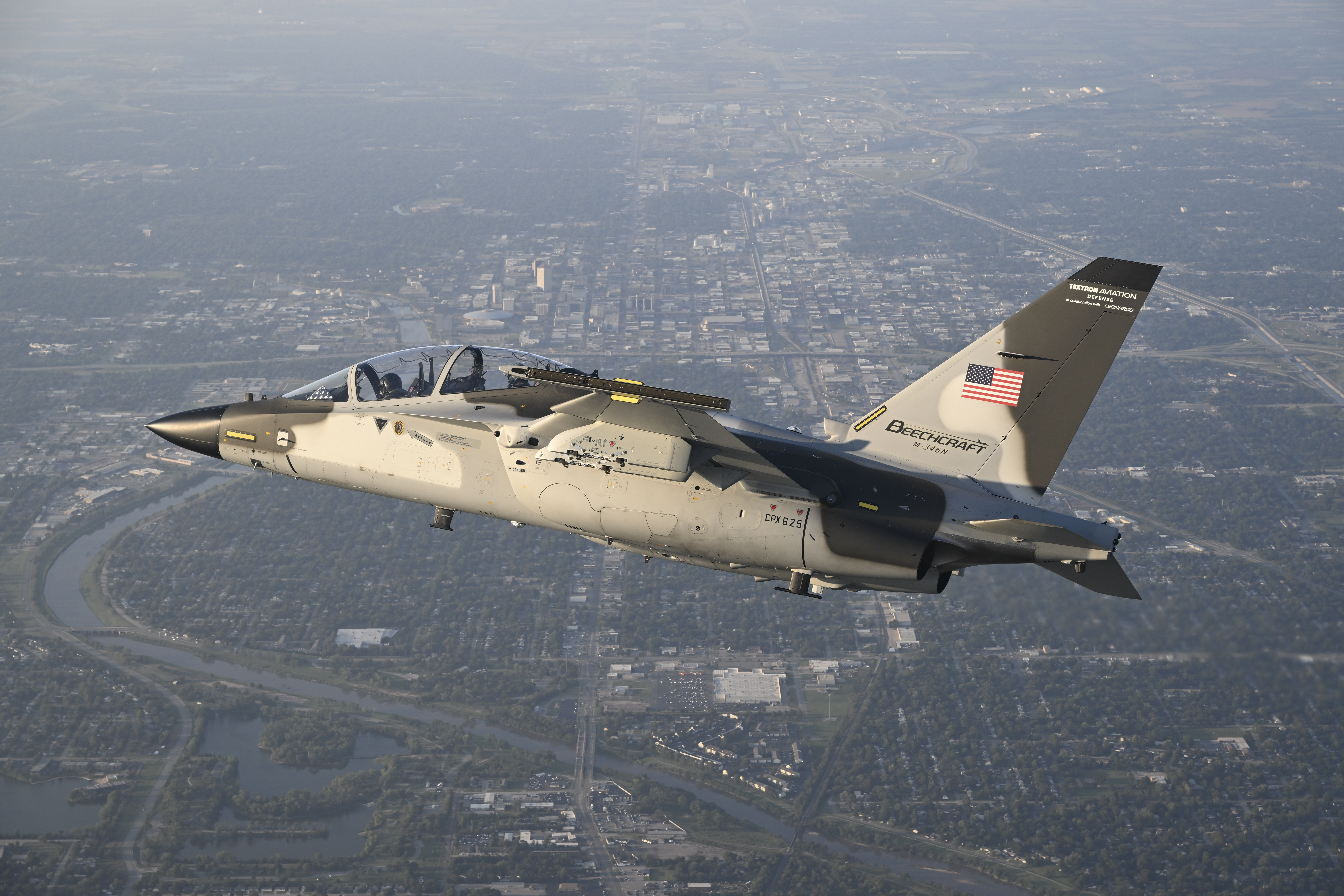
Textron Aviation Defense announced plans to build its Beechcraft M-346N light aircraft in Wichita, Kansas, if it wins the US Navy’s Undergraduate Jet Training System (UJTS) competition.
The company said it would invest more than $38 million to upgrade 50,000 square feet (4,645 square meters) of its east Wichita campus for the initiative.
The project would create about 100 new factory jobs, with more work expected across local suppliers and support industries.
“Wichita has long been the center of innovation for Beechcraft, and we’re proud to continue that tradition as we prepare to support the Navy’s next-generation training needs,” said Travis Tyler, president and CEO of Textron Aviation Defense.
“This announcement underscores our 85-year legacy of supporting the US government with training aircraft from the American heartland.”
Regional officials have also voiced support for the plan, citing its potential impact on the state’s aerospace industry.
Kansas Senator Jerry Moran called the proposal a reflection of Kansas’ “world-class aviation workforce,” and pledged to continue supporting military pilot training programs.
Meanwhile, Wichita Mayor Lily Wu said the possible win highlights the city’s continuing role in US aviation. “This is more than a business decision,” KAKE-ABC quoted Wu as saying. “It shows confidence in Wichita’s people and its future in aerospace manufacturing.”
Deal by 2027
Textron, in partnership with Leonardo, announced its intent to offer the M-346N system for the UJTS program in July 2025.
The effort aims to replace the T-45 Goshawk trainers that have been in service for decades.
The consortium’s proposed airframe would join the force’s existing Textron-built T-6 Texan II and T-54A Marlin aircraft, creating what the company said would be a smoother progression for student aviators moving from basic flight to jet operations.
The US Navy is expected to release formal bidding documents for the UJTS program soon, with a contract award anticipated in January 2027.
The Beechcraft M-346N
The M-346N is modeled after the original Leonardo M-346 airframe launched in the 2000s to train international pilots for next-generation fighter aircraft.
The plane offers a two-seat design, advanced avionics, and an embedded tactical training system to support its primary flight simulation capability.
It is 11 meters (36 feet) in length, has a wingspan of 10 meters (33 feet), and is powered by two Honeywell F124 engines.
The aircraft has a maximum speed of 590 knots (1,093 kilometers/679 miles per hour), a range of about 1,300 nautical miles (2,407 kilometers/1,496 miles), and an operational altitude of 13,715 meters (44,997 feet).