The US Army has awarded BAE Systems Land & Armaments a $145.83-million contract for the production of 155mm M776 cannon tubes in support of the M777A2 howitzer.
The award brings the total cumulative value of the contract to $462.77 million.
Work locations and funding will be determined with each order, with completion expected by March 2031.
The contract supports efforts to ramp up M777 production in response to heightened demand, particularly following the war in Ukraine.
An additional production line was required despite the US Army’s Watervliet Arsenal — the sole producer of M776 tubes — nearly tripling its output since 2022.
Citing a December 17, 2024 Pentagon budget document, Militarnyi reported that the US military aims to increase monthly barrel production from 10 to 30. The target includes M776 tubes for the M777 and M284 barrels for the M109 self-propelled howitzer.
M777 Production Ramp Up
The revival of towed howitzer production has been driven by its performance in Ukraine.
Its relatively compact, lightweight design enhances agility and ease of use, while compatibility with GPS-guided munitions offsets its lower rate of fire compared with self-propelled systems.
Contracts for the howitzer’s major structures were awarded in January 2024 and April 2025. These components are produced at BAE Systems’ artillery facility in Sheffield, as well as across the US supply chain.
Lightweight Cannon
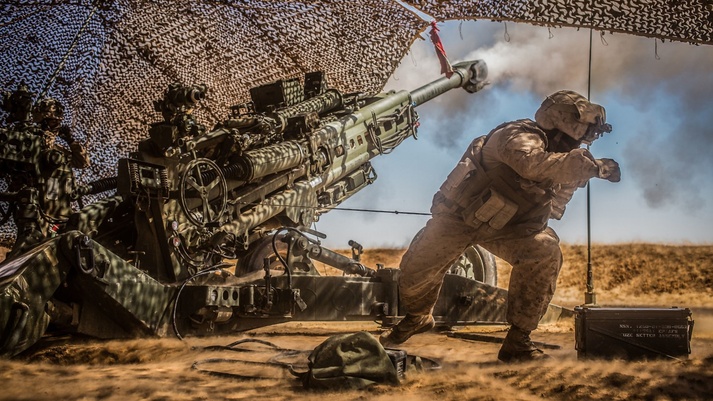
The M777 weighs roughly half as much as conventional 155mm guns, improving mobility and rapid deployment while maintaining sustained firepower.
It fires up to four rounds per minute, with a range of 13 to 25 miles (21 to 40 kilometers) depending on ammunition. Compatible rounds include the M107, M549, M712 Copperhead, and precision-guided M982 Excalibur.
At about four tons, the system can be towed, sling-loaded by helicopter, or airlifted by aircraft such as the Lockheed C-130 Hercules and Lockheed C-5 Galaxy.
Introduced in 2005, roughly 1,000 units have been fielded by the US Army and US Marine Corps, with additional operators including Canada, Australia, India, and Ukraine.