When jets thunder off a carrier deck and vanish toward the horizon, they don’t fly alone. High above the fleet, the E-2D Hawkeye is already on station — scanning, tracking, and orchestrating the fight.
More than an aircraft, the Hawkeye is an airborne nerve center that turns scattered assets into a coordinated, combat-ready network.
Step inside the E-2D and see how it works, how it evolved, and why it remains indispensable to modern naval power.
What Is the E-2D Hawkeye?
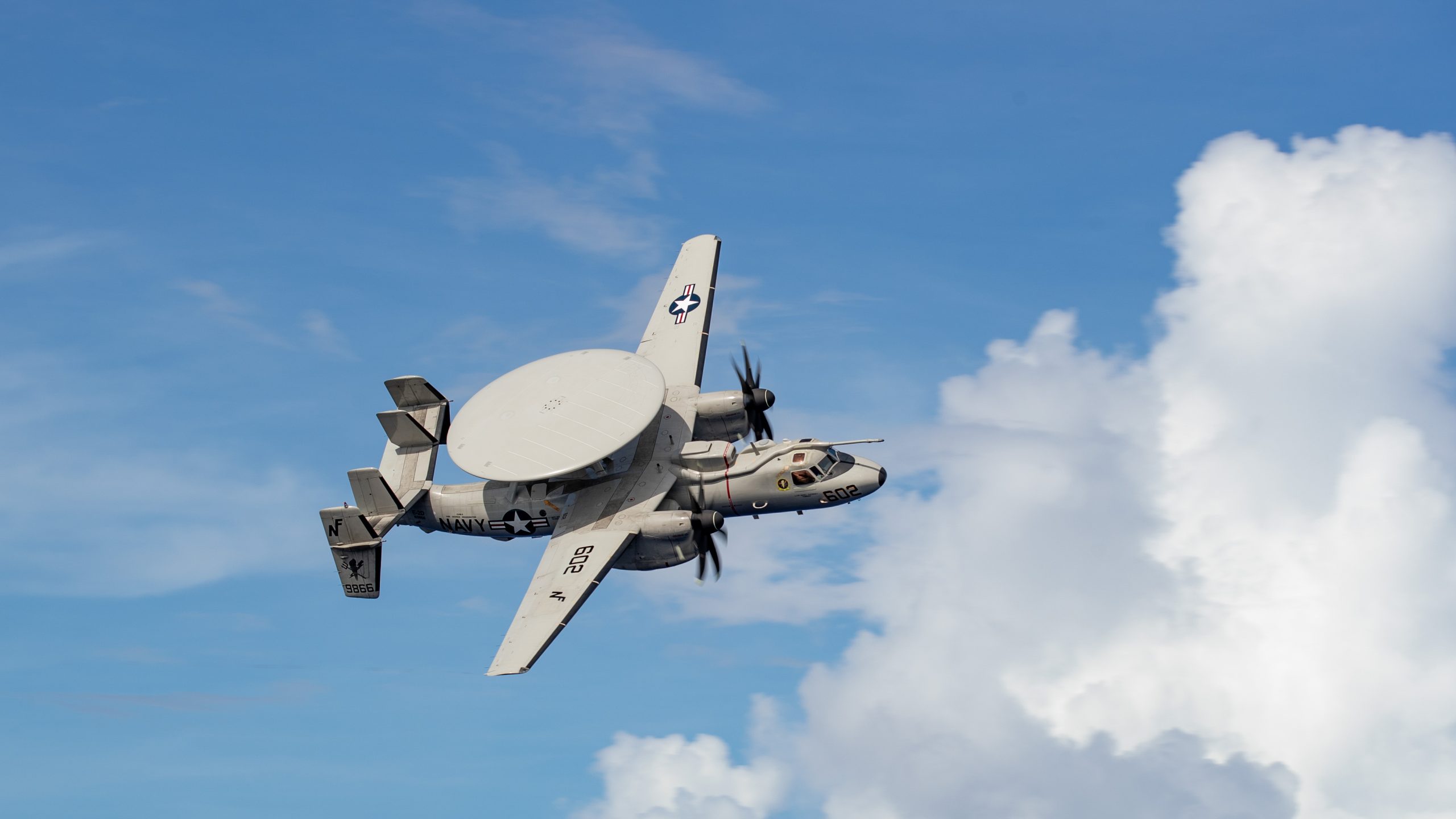
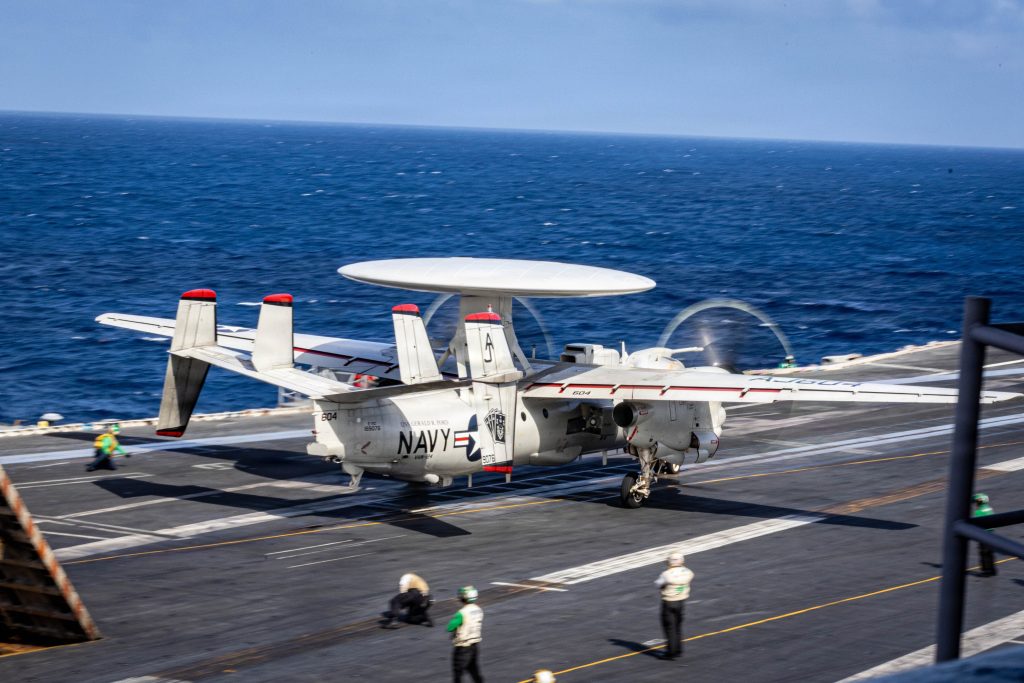
The E-2D Advanced Hawkeye is a carrier-based early warning and airborne command-and-control aircraft, built to extend the fleet’s vision far beyond the horizon.
Taking shape under Northrop Grumman, it is an upgraded version of the classic E-2C, featuring next-generation radar, avionics, and communication systems.
The Hawkeye functions as the eyes of the fleet, providing situational awareness far beyond the visual horizon, detecting aircraft, missiles, and surface vessels, and coordinating fleet responses in real time.
| Category: | Details: |
| Manufacturer | Northrop Grumman |
| Type | Airborne early warning and control |
| Variants | E-2A, E-2B, E-2C Hawkeye |
| Crew | 5 (2 pilots, 3 mission operators) |
| Length | 17.5 meters (57.6 feet) |
| Wingspan | 28 meters (80.7 feet) |
| Weight | Maximum takeoff weight: 53,000 pounds (23,850 kilograms); basic: 40,200 pounds (18,090 kilograms) |
| Powerplant | 2 × Allison T56-A-427 turboprop engines; 5,100 shaft horsepower each |
| Speed | 300+ knots (345 miles/552 kilometers per hour) |
| Service Ceiling | 30,000 feet (9,100 meters) |
| Radar | AN/APY-9 with multi-function AESA |
| Operators | US Navy, planned exports to allies |
How It Came to Be: Evolution of the Hawkeye
The Hawkeye’s journey began in the 1960s, as the US Navy sought a carrier-based aircraft that could spot threats beyond the horizon and orchestrate fleet operations in real time.
The E-2A debuted in 1964, introducing airborne early warning but revealing reliability limits in its analog systems.
The E-2B brought improved avionics and processing, stabilizing performance, yet sensors remained constrained by Cold War-era technology.
The E-2C transformed the platform, adding powerful radar, expanded tracking, and robust battle management capabilities, establishing the Hawkeye as the fleet’s airborne command center.
By the 2000s, rising missile threats and networked warfare demanded more.
Enter the E-2D Advanced Hawkeye: armed with the AN/APY-9 AESA radar, digital glass cockpit, and advanced data links, it delivers sharper detection, faster target tracking, and seamless integration across ships, aircraft, and joint forces.
Key Features
- Next-generation radar: AN/APY-9 AESA provides long-range detection of air and surface threats.
- Multi-domain communication: Real-time link to ships, aircraft, and command centers.
- Advanced mission systems: Operators can track hundreds of contacts simultaneously and manage complex air and maritime operations.
- All-weather operation: Capable of functioning in adverse weather conditions and low visibility.
Strengths
- Force multiplier: Extends fleet situational awareness beyond visual and radar horizons.
- Networked command: Coordinates multiple assets for defense, strike, and ISR operations.
- Proven reliability: Decades of operational use validate effectiveness in real-world scenarios.
Limitations
- Vulnerability: Limited speed and maneuverability make it reliant on escort protection in contested airspace.
- High cost: Acquisition and maintenance expenses are significant, amounting to $80 million per unit as of 2021.
- Carrier dependence: Designed primarily for carrier operations; limited flexibility for land-based deployment without modification.
Global Use and Operational Deployment
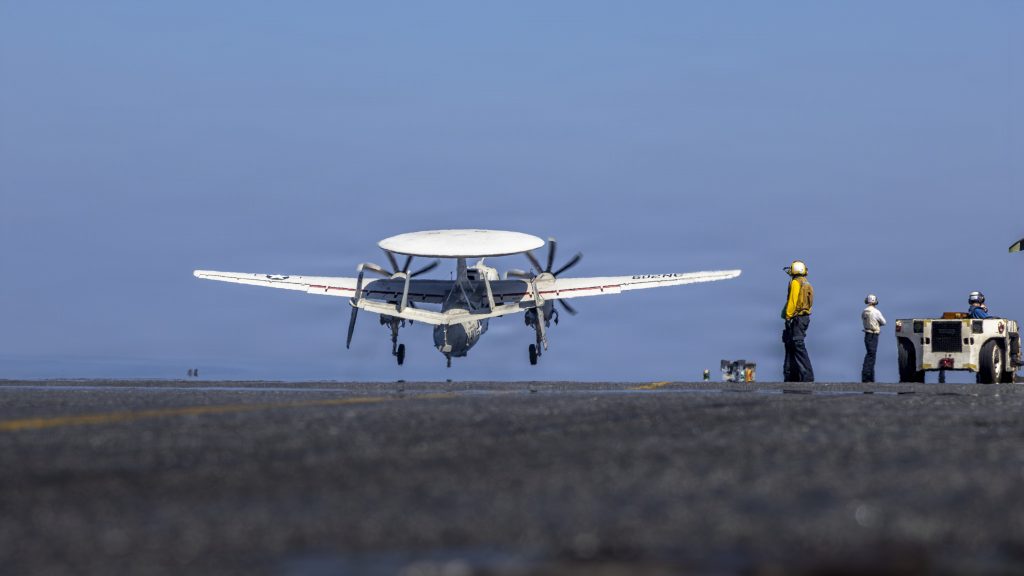
Operating primarily with the US Navy’s carrier strike groups, the E‑2D has become a central battle management node.
Across multiple theaters, Hawkeyes, both legacy and advanced variants, have played pivotal roles in real operations:
- Operation Inherent Resolve (Iraq/Syria): Carrier‑based E‑2C and E‑2D aircraft provided airborne command and control and Defensive Counter‑Air coordination during coalition strikes against ISIS from 2014 onward.
- Indo‑Pacific forward deployments: Forward‐deployed E‑2Ds with Carrier Air Wing 5 in Japan enhance US presence and partner integration in the Asia‑Pacific region.
- Coalition and interoperability training: Exercises such as ANNUALEX, Malabar, and Valiant Shield regularly feature Hawkeye airborne surveillance and data fusion alongside allied navies and air forces.
Beyond wartime missions, Hawkeyes have supported disaster relief coordination and maritime security patrols.
Planned exports, including orders from France and Japan, underscore growing allied demand for persistent airborne command and control capability, expanding the platform’s footprint in coalition operations and multinational exercises.
Future Outlook
The E‑2D Hawkeye is set to remain the backbone of carrier-based operations.
Future upgrades could include tighter integration with unmanned systems, improved software configuration, AI-assisted target tracking, and seamless connectivity to space-based sensors.
Sustainment support will also be present to bolster resiliency and extend the life expectancy of the aircraft.
As threats grow faster and airspace becomes more contested, the Hawkeye’s blend of radar, communications, and command capabilities ensures it will continue to direct naval operations and protect fleets well into the next decade.