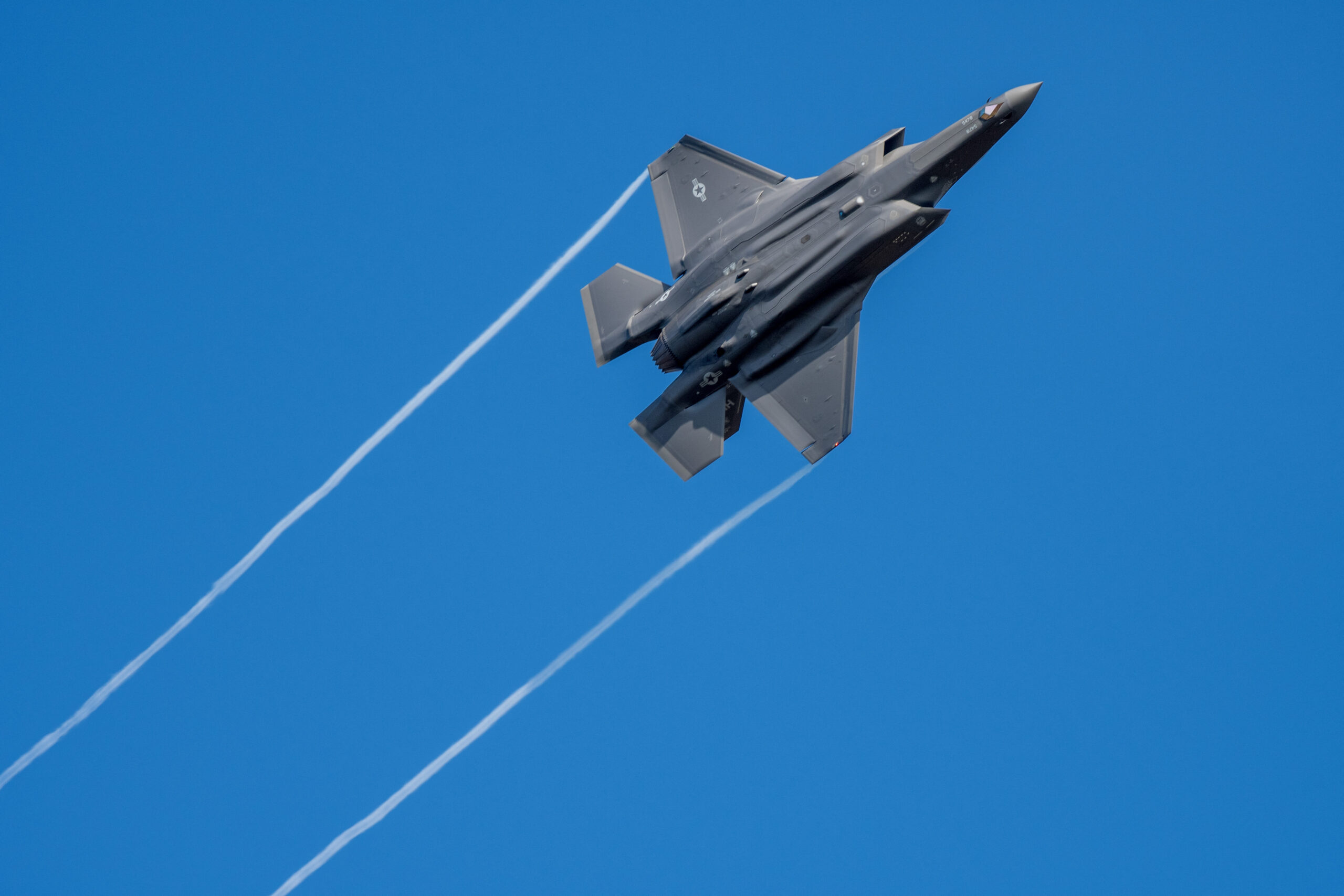
With stealthy design, advanced sensors, and unmatched networked combat capabilities, the F-35 Lightning II has redefined modern air power.
Developed under the Joint Strike Fighter program, this fifth-generation multirole fighter excels across air-to-air, strike, and intelligence missions.
This guide breaks down the F-35’s development, features, mission roles, and global impact.
Origins and Design Philosophy
The F-35 program emerged in the early 2000s to address the need for a versatile fighter capable of replacing multiple legacy aircraft across the US Air Force, Navy, and Marine Corps.
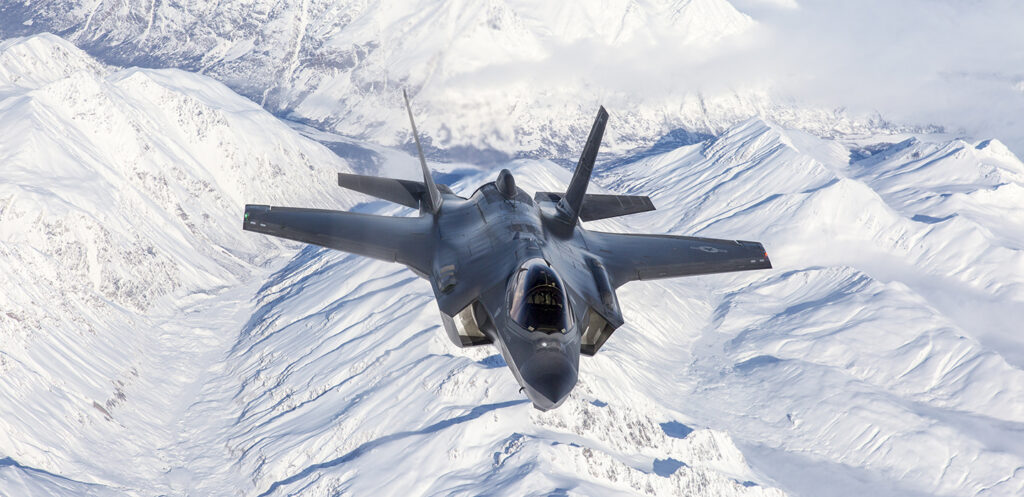
The program produced three variants that share a common airframe, avionics suite, and stealth features despite differing operating environments: the F-35A for conventional takeoff and landing, the F-35B for short takeoff and vertical landing, and the F-35C for carrier operations.
Stealth and Situational Awareness
Stealth is at the core of the F-35’s design. Its angular airframe, internal weapons bays, and radar-absorbent materials minimize radar signature, allowing it to operate in heavily contested airspace.
This low-observable profile is paired with advanced electronic warfare capabilities, which enable the F-35 to detect, track, and jam enemy sensors and communications.
Unlike previous fighters, which require pilots to manually integrate data from different sources, the F-35 automatically consolidates information from the electronic warfare, electro-optical targeting, and distributed aperture systems into a single coherent picture.
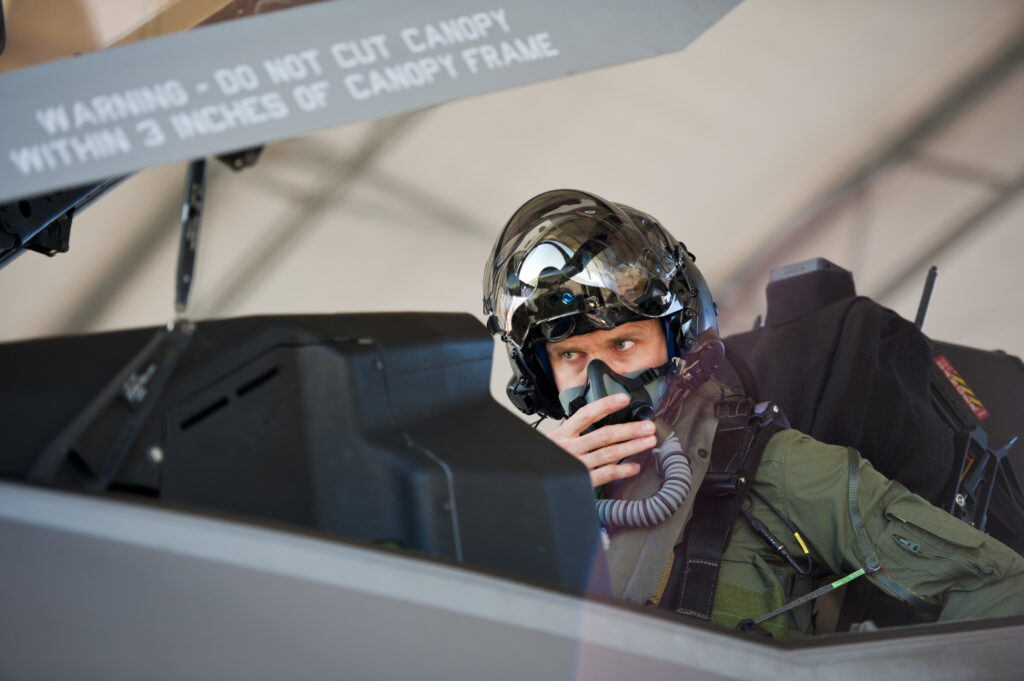
The aircraft’s helmet-mounted display system further enhances combat effectiveness by projecting critical flight and targeting information directly onto the pilot’s visor.
This enables pilots to “see through” the aircraft, track targets across the sky, and cue weapons without turning the aircraft — a capability that has redefined air combat tactics.
Multirole Flexibility
While stealth and advanced sensors define the F-35’s survivability, its multirole capability ensures operational versatility.
It can carry a mix of air-to-air and air-to-ground weapons internally to maintain stealth or externally for maximum load.
Air-to-Air Weapons
- AIM-120 AMRAAM
- AIM-9X Sidewinder
- Joint Strike Missile
- Meteor Missile
Air-to-Ground Weapons
- GBU-31/32 JDAM
- GBU-12 Paveway II
- GBU-49 Enhanced Paveway II
- GBU-53/B StormBreaker
- AGM-154 JSOW
- SPEAR 3 (planned for some international operators)
Internal Gun
- GAU-22/A 25mm cannon
The F-35 can also share real-time data with other aircraft, ground forces, and naval units, enabling it to act as both a shooter and a sensor platform. This connectivity extends the reach of allied forces and enhances the overall effectiveness of modern battle networks.
Unit and Overall Cost
A 2023 acquisition assessment put the F-35 aircraft subprogram’s total cost at $291.8 billion, spanning development, procurement, and military construction.
That figure breaks down to roughly $66.9 billion for research and development, $221.3 billion for procurement, and $3.5 billion for infrastructure, underscoring the program’s massive upfront investment.
In the same report, the F-35’s program acquisition unit cost, which averages total acquisition costs across 2,470 development and procurement aircraft, stood at $162.4 million per jet.
Key Constraints and Concerns
- Development challenges and modernization delays: Ongoing hardware and software upgrade issues have been highlighted, including the F‑35’s Block 4 modernization and its integrated core processor, which have contributed to technical setbacks.
- Engine improvements and sustainment costs: Long‑term sustainment costs have increased from $1.1 trillion in 2018 to about $1.6 trillion in 2023, according to a 2024 GAO report.
- Supply chain stability: Supply chain issues, including parts shortages and the impact of global supplier constraints, are identified as a potential focus area, as supply instability affects production and maintenance.
- Readiness and mission capability: Congress has shown interest in F‑35 readiness rates and maintenance challenges, as sustained low mission‑capable rates make it harder to field committed units.
Global Impact and Future Outlook
Since entering service, the F-35 has become a cornerstone of US and allied air power. Lockheed Martin maintains 1,300 of the aircraft worldwide and delivered a record 191 jets in 2025.
Italy and Israel expanded their fleets by 25 aircraft each, Denmark added 16, Japan added 3 more, Belgium took delivery of its first F-35, Finland rolled out its first jet, and Norway completed fleet deliveries.
The high demand comes from the F-35’s proven performance in real-world combat operations.
It played a key role in the 2025 Operation Midnight Hammer, in which the US hit nuclear sites deep inside Iran. The jet also dealt with Russian drones over Poland, which was the first time that NATO F-35s had been used to combat threats.
Its continued development focuses on software upgrades, collaborative combat, expanded weapons compatibility, and enhanced electronic warfare capabilities to maintain an edge in contested environments.