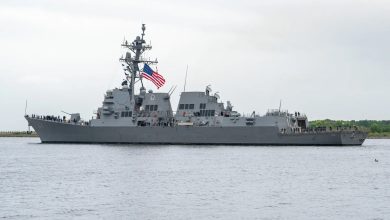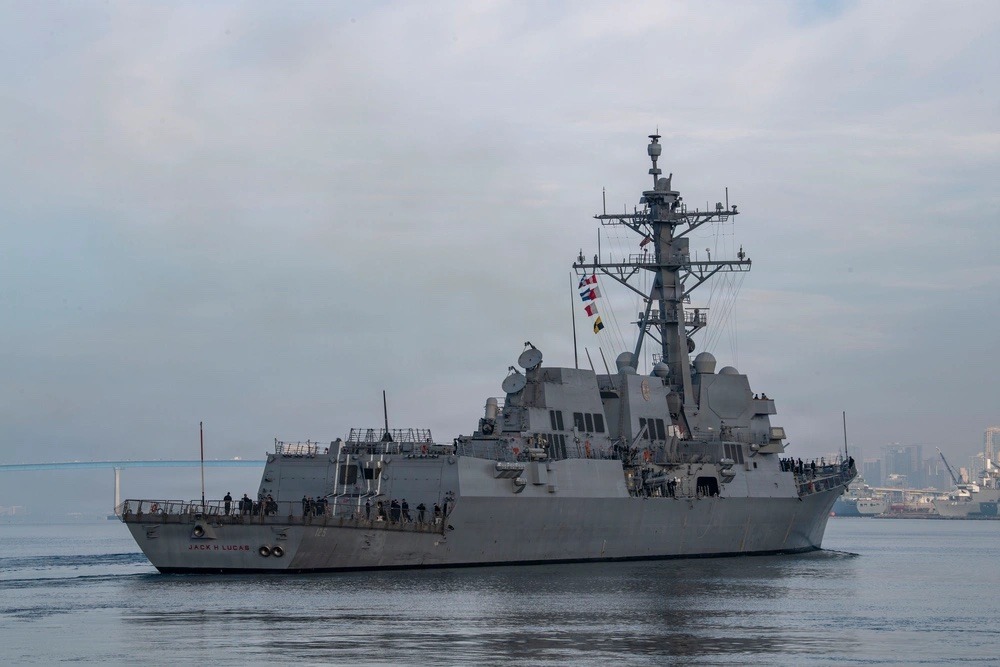
The US Navy has begun operational testing of its first Flight III Arleigh Burke-class destroyer, USS Jack H. Lucas, as it evaluates a new generation of surface combatant capabilities.
Commissioned in October 2023, the Lucas has been designated as the navy’s initial operational test and evaluation campaign ship, placing it at the center of efforts to validate technologies that will define the future Arleigh Burke-class fleet.
The designation means the ship and its crew are responsible for taking new systems to sea, testing them across demanding scenarios, and feeding lessons learned directly back into fleet-wide requirements.
At the core of the Flight III upgrade is the AN/SPY-6(V)1 Air and Missile Defense Radar, a major leap from earlier SPY-1 variants. The radar dramatically increases sensitivity and range, allowing the ship to detect and track smaller, faster, and more complex threats simultaneously.
To support SPY-6, the Flight III design required extensive changes beneath the deck. The Lucas features an upgraded electrical plant, expanded cooling capacity, and reinforced structural elements to handle the radar’s power and thermal demands.
The ship also integrates the Aegis Combat System Baseline 10, enabling improved integrated air and missile defense and enhanced ballistic missile defense performance.
How Flight III Capabilities Are Tested
As the campaign ship, the Lucas is moving quickly through a series of at-sea tests designed to stress new systems under real-world conditions.
According to the ship’s leadership, the aggressive schedule is meant to accelerate learning and ensure the technology can transition rapidly to follow-on Flight III destroyers already under construction.
Testing focuses not only on the SPY-6 radar itself, but also on how the radar integrates with combat systems, power generation, and crew workflows.
The navy is using data gathered during these deployments to refine software, validate performance thresholds, and adjust training pipelines for future crews. This iterative approach is intended to reduce risk before the radar and associated systems are fielded across the broader fleet.
It also serves as a training ground for sailors who will eventually man later Flight III ships. Crews are gaining early experience with advanced sensor management, higher electrical loads, and more complex combat system operations, helping to build institutional knowledge ahead of wider deployment.