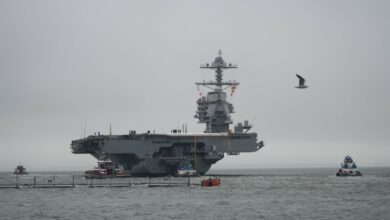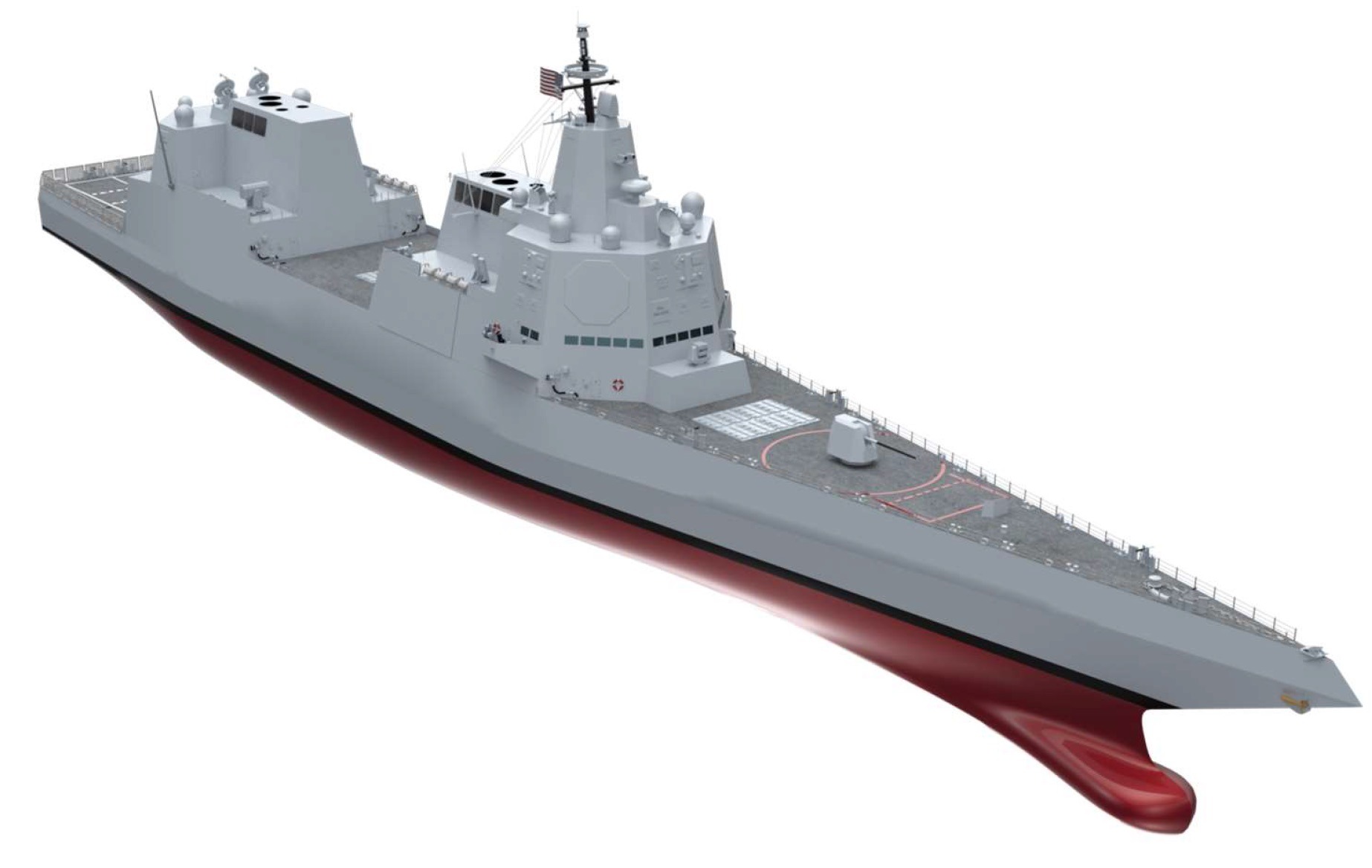
The DDG(X) is the US Navy’s planned next-generation destroyer program, designed to replace aging Arleigh Burke-class ships and incorporate lessons learned from both the Burke- and the Zumwalt-class destroyers.
Still in development, the guided-missile destroyer aims to serve as the service’s primary large surface combatant beginning in the 2030s, with a focus on greater efficiency, improved survivability, and the ability to host future weapons such as hypersonic missiles and directed-energy systems.
The DDG(X) Program at a Glance
The US Navy pursued the DDG(X) program to address several converging needs as its current fleet ages and threats evolve.
First, the Arleigh Burke-class destroyers, which have formed the backbone of the surface fleet since the 1990s, are reaching the limits of their design.
Even with multiple upgrades, they lack the space, power, and cooling capacity to accommodate future systems. The navy needs a new hull with a greater growth margin to handle technologies expected to dominate future naval warfare.
Second, the program responds to the rise of peer competitors like China and Russia, both of which are fielding advanced anti-ship missiles, air defense systems, and increasingly capable fleets.
DDG(X) is designed to provide improved survivability, missile capacity, and adaptability, ensuring the US Navy can project power in contested environments.
Finally, DDG(X) is meant to avoid past pitfalls by balancing proven systems with incremental advances. The aim is to reintroduce affordability while providing America with a long-term replacement that can remain relevant for decades.
How Will It Work?
The DDG(X) is being designed as a flexible platform that can grow with new technologies.
The US Navy deliberately chose an incremental approach that will blend Burke-class systems with a larger hull, stealth shaping, and integrated power concepts tested on Zumwalt.
The designed integrated power system (IPS) will support advanced radars and energy-intensive weapons, such as high-powered lasers. Modular missile cells will allow tailored loadouts, while the hull is sized to accommodate hypersonic missiles and next-generation sensors.
Planned features include:
- Flight III Aegis Combat System Elements: Inherit core components of the DDG-51 Flight III Aegis Baseline 10 architecture, such as the SPY-6(V)1 radar, allowing the navy to field a proven combat system without developing from scratch.
- Expanded Growth Margins (SWAP-C): Introduce greater margins in space, weight, power, and cooling, giving the ship the capacity to integrate higher-power sensors, electronic warfare systems, and future directed-energy weapons.
- IPS: Incorporate an IPS to generate and distribute substantially more onboard electrical power that supports high-demand systems, such as advanced radars, lasers, and hypersonic weapons.
- Increased range and time on station: Improve fuel efficiency and optimized hull form to remain deployed longer without resupply.
- Reduced signatures: Reduce infrared, acoustic, and underwater electromagnetic signatures to decrease the ship’s detectability and vulnerability.
Automation and improved systems design are expected to reduce crew requirements while maintaining combat effectiveness.
In short, the DDG(X) is less about today’s loadout and more about tomorrow’s adaptability to stay relevant for decades by growing into capabilities that don’t yet exist.
Key Limitations
Since DDG(X) is still a design concept, its limitations are largely potential risks rather than proven flaws:
- Cost uncertainty: The US Navy has not finalized how much each ship will cost, but given past programs, affordability and scalability remain major concerns.
- Long development timeline: First construction is expected in the early 2030s, with entry into service later that decade, leaving the US Navy dependent on Arleigh Burke destroyers in the interim.
- Technology integration risks: Incorporating advanced power systems and preparing for future weapons systems adds complexity, which could lead to delays or overruns if not carefully managed.
The DDG(X) isn’t just another warship, but an attempt to build a destroyer that can keep pace with fast-changing technology and rising global threats, a vessel designed to grow into the future rather than be left behind by it.