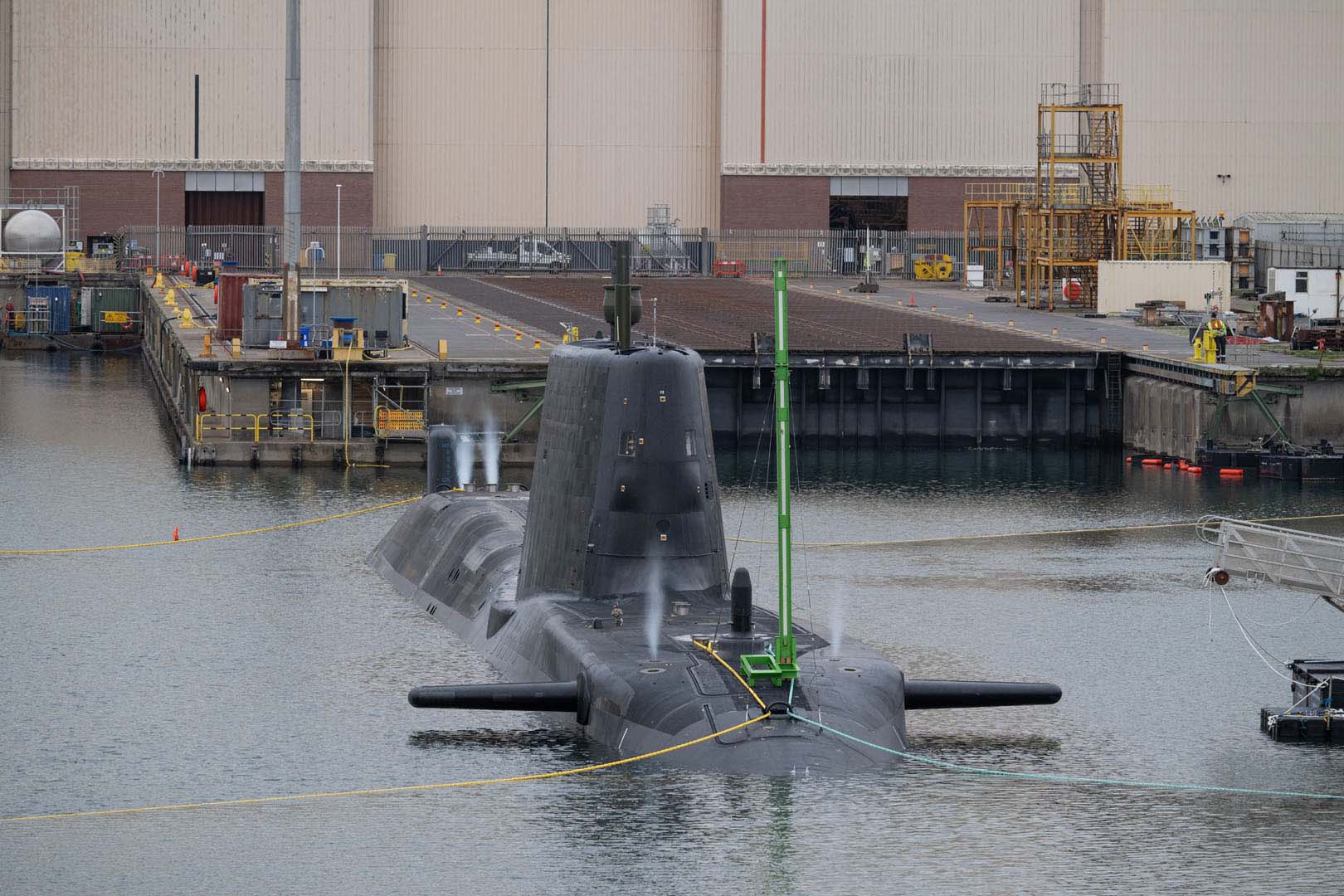
The Royal Navy submarine HMS Agamemnon has completed its maiden dive at BAE Systems’ submarine shipyard in Barrow-in-Furness, England.
HMS Agamemnon submerged to a depth of 15 meters (49 feet), testing systems including ballast tank operations and escape procedures.
Conducted in coordination with the Submarine Delivery Agency and BAE Systems, the initiative also assessed the stability of the 7,400-ton, 97-meter (318-foot) attack vessel and determined its center of gravity.
The tests combined traditional pendulum-based measurement techniques with modern technology.
During the trials, 30 crew members and engineers placed 16 tonnes (35,000 pounds) of lead weights in various locations throughout the submarine to simulate different loading conditions.
This tested the vessel’s balance and response to weight shifts, confirming its stability under operational conditions.
HMS Agamemnon is the sixth Astute-class submarine commissioned for the Royal Navy.
Astute-Class
The Royal Navy’s Astute-class consists of seven nuclear-powered submarines, five of which are in active service while HMS Achilles and HMS Agamemnon are under construction.
The submarines do not use traditional optical periscopes and instead rely on high-resolution video systems to scan the horizon.
Designed for low noise levels, the systems can travel around the globe fully submerged and are capable of producing their own oxygen and drinking water.
Astute-class submarines are equipped with Tomahawk Land Attack Cruise Missiles, which can strike land targets hundreds of miles inland.
The latest Tomahawk IV variant has a range exceeding 1,000 miles (1,609 kilometers), can be retargeted mid-flight, and transmits battlefield imagery back to the submarine.
Astute-class submarines also carry Spearfish heavyweight torpedoes, capable of engaging targets up to 14 miles (23 kilometers) away or up to 30 miles (48 kilometers) at low speed using either copper wire guidance or onboard sonar.
These torpedoes deliver a 660-pound (300-kilogram) explosive charge, which is triggered on impact or via an acoustic proximity fuse.