The UK Royal Navy has tested new maritime emergency capabilities, including an airborne casualty response unit and a containerized treatment module designed for ships without advanced onboard medical facilities.
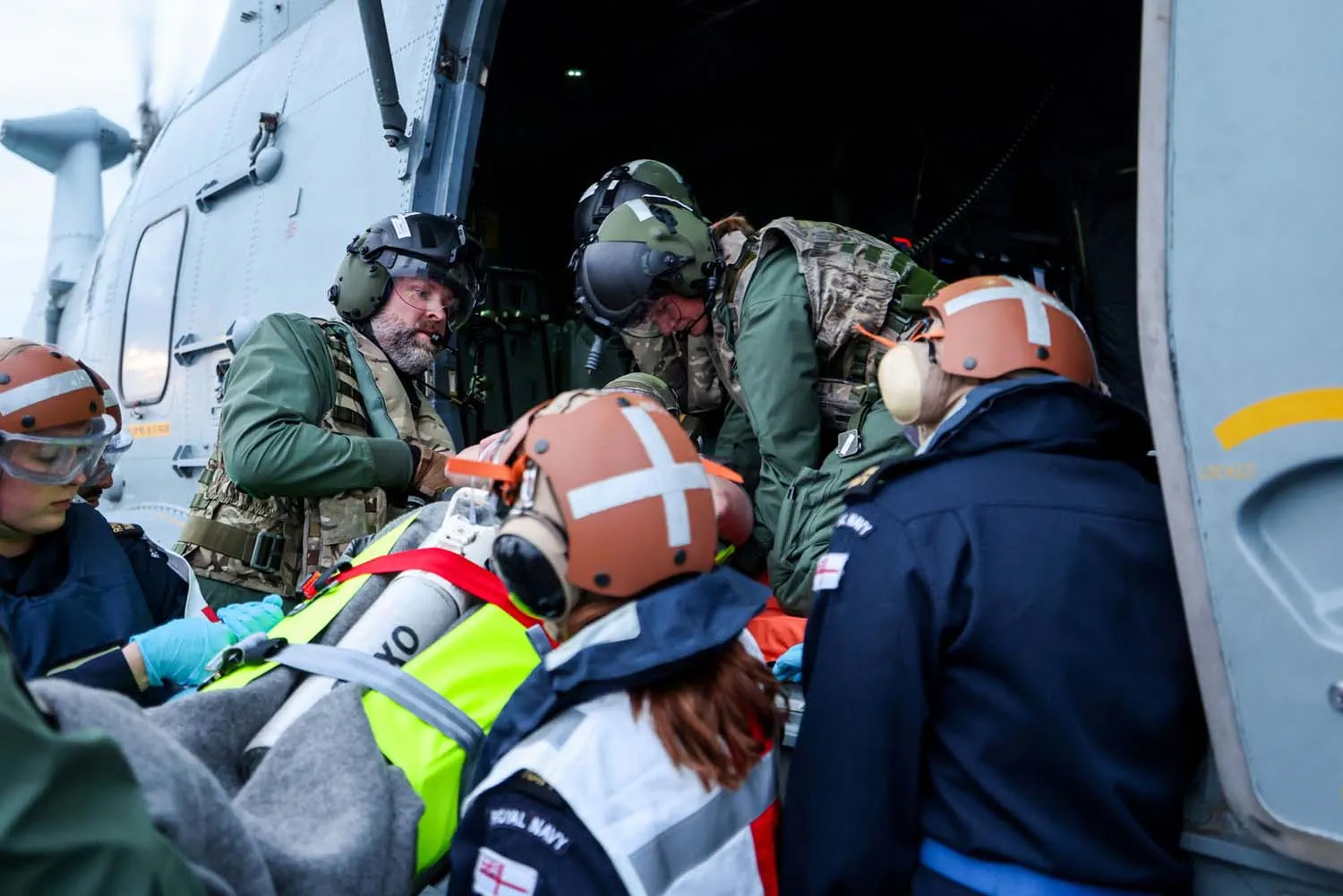
Facilitated during an exercise in the Norwegian Sea, one of the demonstrations saw the aircraft carrier HMS Prince of Wales (R09) deploy a Merlin helicopter carrying its dedicated Maritime Medical Emergency Response Team (MMERT) in response to a simulated serious injury on the HMS Duncan (D37) Daring-class destroyer.
The unit addressed the mock casualty aboard the surface combatant before transferring the patient back to the carrier.
The squad involved included emergency medicine specialists, paramedics, and critical care nurses trained to operate in demanding maritime conditions.
Meanwhile, the rotary-wing aircraft was reconfigured for casualty transport during the drill.
“The biggest goal is to treat and stabilise patients so they can be flown ashore,” the Royal Navy said.
NavyPODS Aboard the HMS Protector
Separately, British engineering specialist Force Development Services completed the first sea trials of the Royal Navy’s Persistent Operational Deployment System (NavyPODS) aboard the HMS Protector (A173) ice patrol ship off England’s east coast.
The modular system uses expandable 20-foot (6-meter) ISO containers fitted with medical facilities, power, oxygen generation, and sterilization equipment, according to Naval News.
This allows the military to quickly add Role 2 medical capability, which incorporates damage control surgery, advanced resuscitation, and laboratory solutions to vessels that lack operating theaters or advanced treatment spaces.
The company said the design includes a quieter in-house heating, ventilation, and air conditioning system and a shock-resistant mounting platform to protect equipment during major impacts at sea.
A single operator can deploy a NavyPODS facility in about 20 minutes.
“That was hugely successful with positive feedback from the clinicians,” Force Development Services Business Development Director Paul Keating-Brown told Naval News.