Boeing is preparing the US Space Force’s X-37B orbital test vehicle (OTV) for its next mission, scheduled to launch next month from Kennedy Space Center in Florida.
The deployment comes six months after the robotic spacecraft’s seventh flight as part of a secretive program between the Department of Defense and NASA.
August’s liftoff will focus on the experimental testbed’s capability to host a powerful quantum sensor and a high-bandwidth laser communications link between satellites. The US Space Force will use the results to help shape future space systems.
The quantum sensor, labeled as “the highest performing quantum inertial sensor ever tested in space,” will guide the X-37B’s navigation without GPS, paving the way for future missions to reach the moon and beyond.
“OTV-8’s laser communications demonstration will mark an important step in the US Space Force’s ability to leverage proliferated space networks as part of a diversified and redundant space architecture,” explained Gen. Chance Saltzman, chief of space operations at the US Space Force.
“In so doing, it will strengthen the resilience, reliability, adaptability and data transport speeds of our satellite communications architecture.”
We’re also demoing the world’s highest performing quantum inertial sensor ever used in space. Bottom line: testing this tech will be helpful for navigation in contested environments where GPS may be degraded or denied. (3/4)
— General Chance Saltzman (@SpaceForceCSO) July 28, 2025
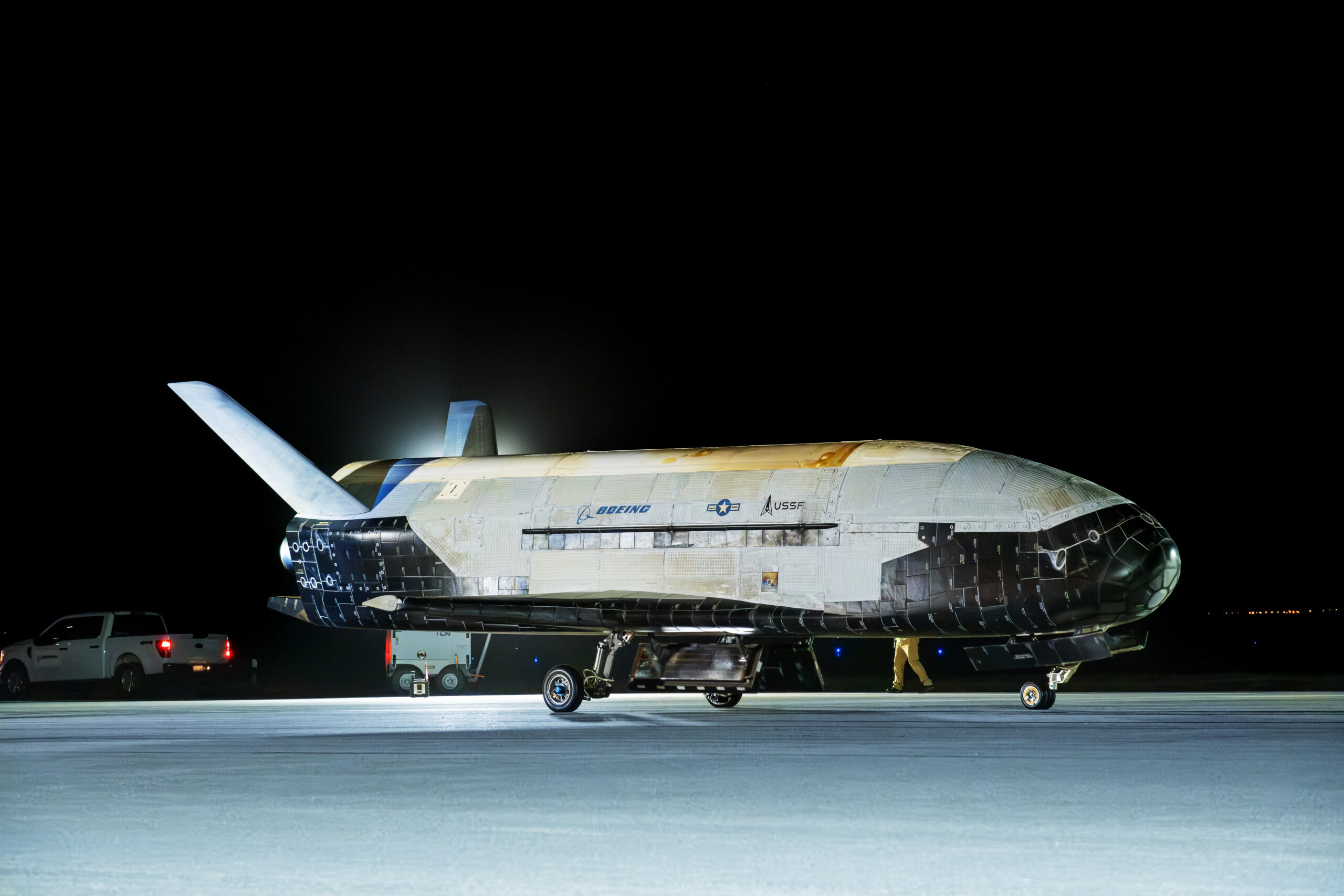
The X-37B OTV
The X-37B is a small, unmanned spaceplane launched by rockets such as the Atlas V or SpaceX’s Falcon 9. It could orbit Earth for long periods of time and land like a conventional aircraft.
Most of the X-37B’s missions are classified, but past activities suggest that the Pentagon uses the OTV to test advanced space technologies and support the development of future reusable systems and military space capabilities.
Publicized experiments have included solar power transmission, exposing materials to the space environment, deploying small satellites, demonstrating orbital maneuvering and mission flexibility, and validating extended spaceflight.
Since its inauguration in 2010, the X-37B has spent over 4,200 days in space.
The X-37B OTV measures 29 feet (9 meters) long, has a wingspan of 14 feet (4 meters), and is powered by gallium arsenide solar cells with lithium-ion batteries.
It weighs 11,000 pounds (4,990 kilograms), travels at approximately 17,500 miles (28,164 kilometers) per hour, and has a recorded operational endurance of 908 days.