Italian arms manufacturer Leonardo has unveiled its 120mm L55 tank gun, featuring higher muzzle velocity than previous variants for greater range.
Fully developed through company funds, the 55-caliber gun is capable of firing a greater number of rounds thanks to a new “self-forcing process,” according to Rivista Italiana Difesa.
An upgrade over the 120mm L44 and L45 smoothbore tank guns, the L55 features a longer barrel and other modifications to withstand higher stress.
It is 500 kilograms (1,102 pounds) heavier than the L45 and has five percent greater muzzle velocity, according to the European Defence Review.
For Future Italian Tank
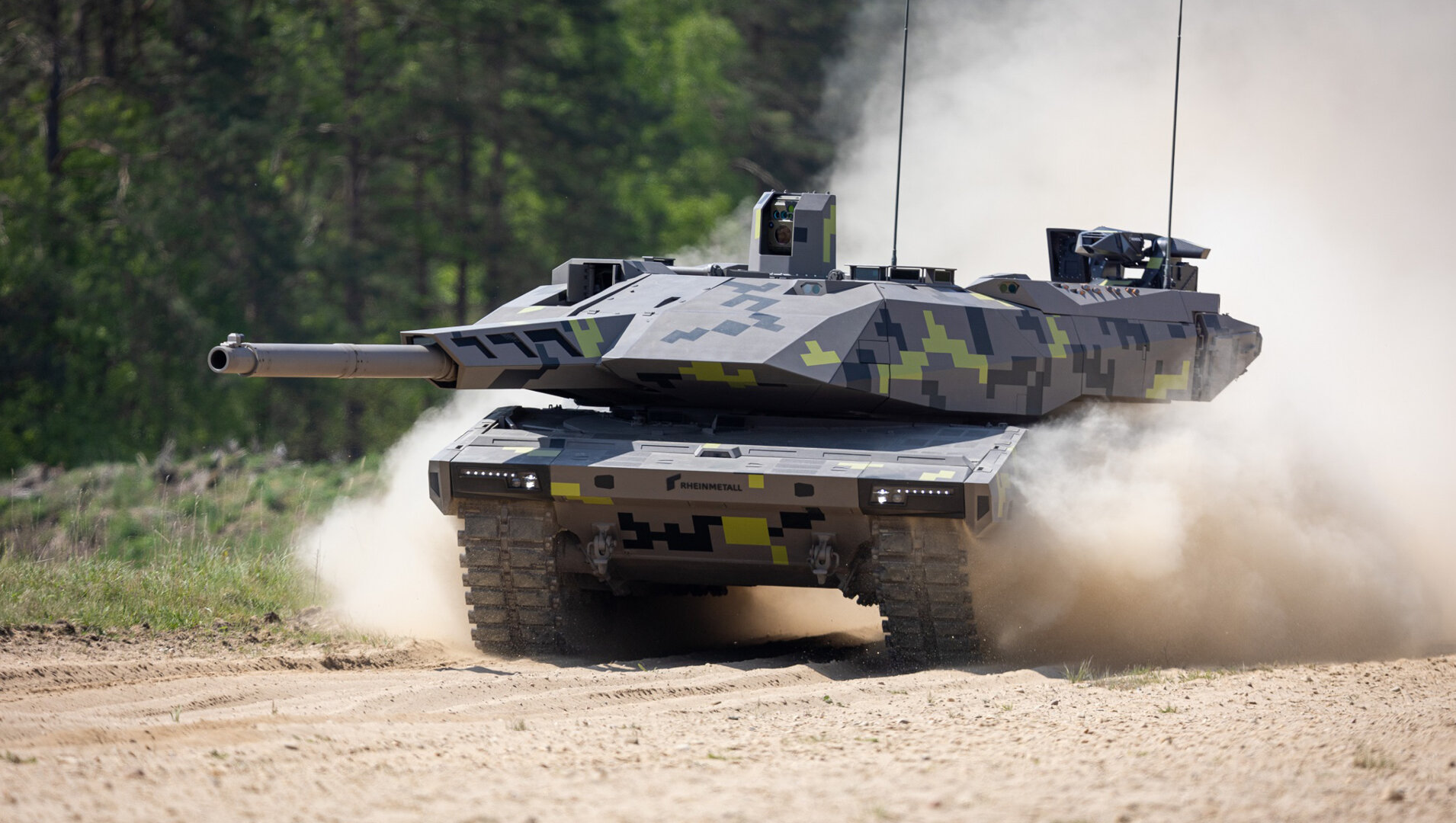
The cannon has been developed primarily for the next-generation Panther KF51 main battle tank being developed by a Leonardo-Rheinmetall joint venture.
A total of 82 KF51s meant for the Italian Army will have the Leonardo cannon, while the 50 units going to the German Army will be equipped with the Rheinmetall L55A1 gun.
The L55 can also be employed with Italy’s ARIETE C2 main battle tank and the AICS-120 combat vehicle, an Italian variant of the Lynx KF41 armored fighting vehicle.
The gun is intended only for tracked vehicles due to its recoil.
Gun Development
The L55’s development timeline was cut to 18 months thanks to software-based simulations capable of replicating the “firing phase in different conditions,” according to European Defence Review.
“The new gun was designed considering the design pressure of the latest developments in the ammunition field, especially the APFSDS (Armour-Piercing Fin-Stabilized Discarding Sabot), which will allow a significant increase in performance,” the outlet added.
Leonardo has test-fired the gun and will perform qualification trials on five units over the next 12 months.
New 120mm Round
Meanwhile, the company has also unveiled new 120mm ammunition designed to equip the 120mm cannons of main battle tanks and tracked and wheeled combat vehicles.
The 120mm Vulcano is the latest member of the Vulcano sub-caliber/precision family, with a range of 30 kilometers (18.6 miles).
It is designed to enable combat platforms to take out beyond line-of-sight targets such as armored vehicles, rocket launchers, and air defense sites.
The round can also cause “functional damage” to a main battle tank by destroying crucial components such as its optics and antennas.