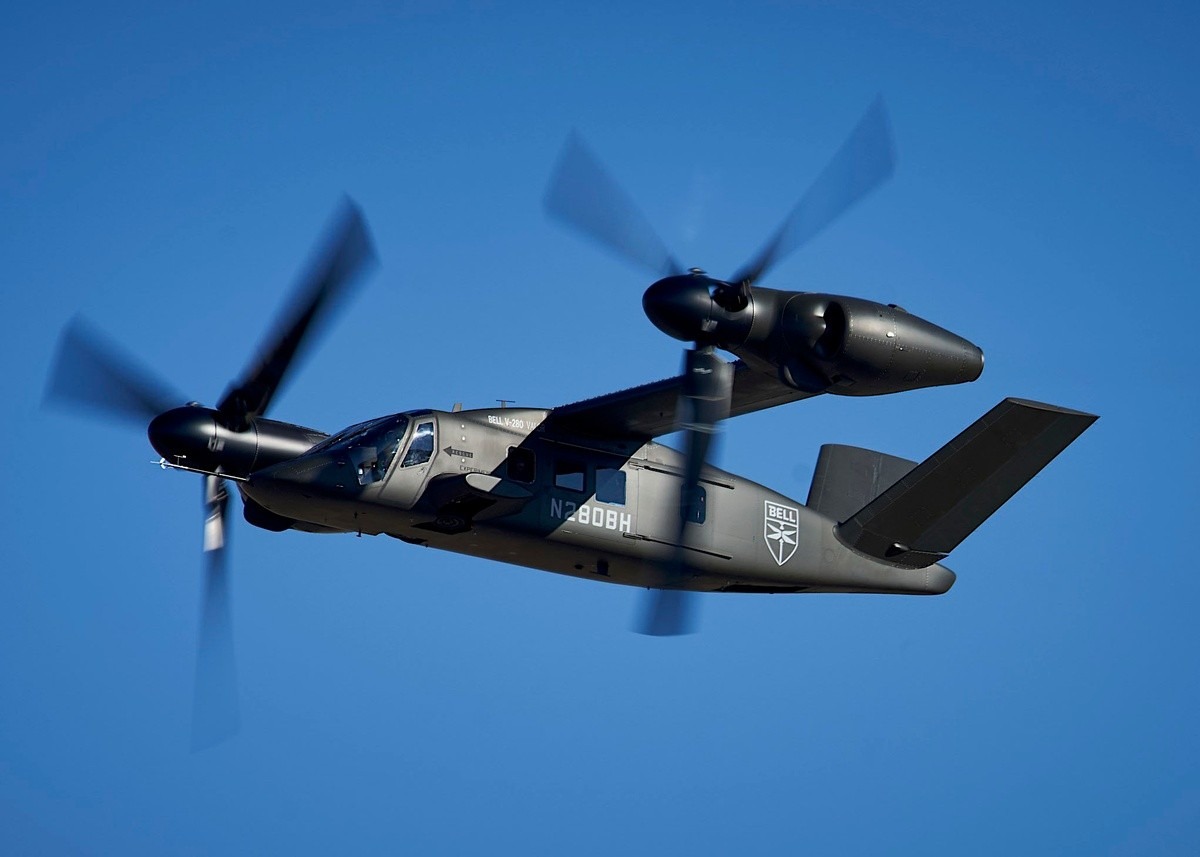
The US Army has formally named its Future Long-Range Assault Aircraft (FLRAA) the “Cheyenne II,” following its technical designation of MV-75 in May 2025.
The Cheyenne II draws its name from the federally recognized Cheyenne and Arapahoe tribes in Oklahoma and the Northern Cheyenne tribe in Montana, whose history is marked by adaptability, resilience, and a strong warrior ethos.
Naming the incoming FLRAA Cheyenne II sticks to the army tradition of naming its rotorcraft after Native American tribes and figures, such as the UH-60 Black Hawk, AH-64 Apache, and UH-72 Lakota.
The announcement was made during the Army Aviation Association of America’s annual conference.
MV-75 Cheyenne II
As they faced displacement and shifting threats, the Cheyenne adapted, reorganized, and endured, qualities the army says are reflected in the aircraft’s design and role.
The MV-75, based on Bell’s 280 Valor tiltrotor and featuring a modular open systems approach and digital backbone, mirrors these traits through its roughly doubled speed and range compared to existing army rotorcraft, as well as its multi-mission flexibility.
“The name also reflects a connection to the bold vision of the AH-56 Cheyenne, while ‘II’ signifies a new era of innovation and capability. It is a name that pays tribute to an indomitable warrior spirit and signals a decisive step forward for Army aviation,” said FLRAA Project Manager COL Jeffrey Poquette.
Meanwhile, Ryan Ehinger, Senior VP and program director of FLRAA at Bell, called the development a “significant milestone that comes right as we are accelerating assembly and production to deliver the MV-75 capability to warfighters faster.”
Initial operational capability is slated for fiscal year 2030, although US Army officials have been working to move the timeline earlier, according to a January report by Breaking Defense.