Teledyne FLIR OEM has introduced a new long-range thermal imaging system for intelligence, surveillance, and reconnaissance (ISR) applications.
Dubbed Neutrino SX8 ISR 50-1000, the technology expands the company’s Neutrino ISR product line, which is used in fixed and mobile surveillance platforms.
The system is intended for missions such as border monitoring, perimeter security, and counter-drone operations, where early detection and identification are critical.
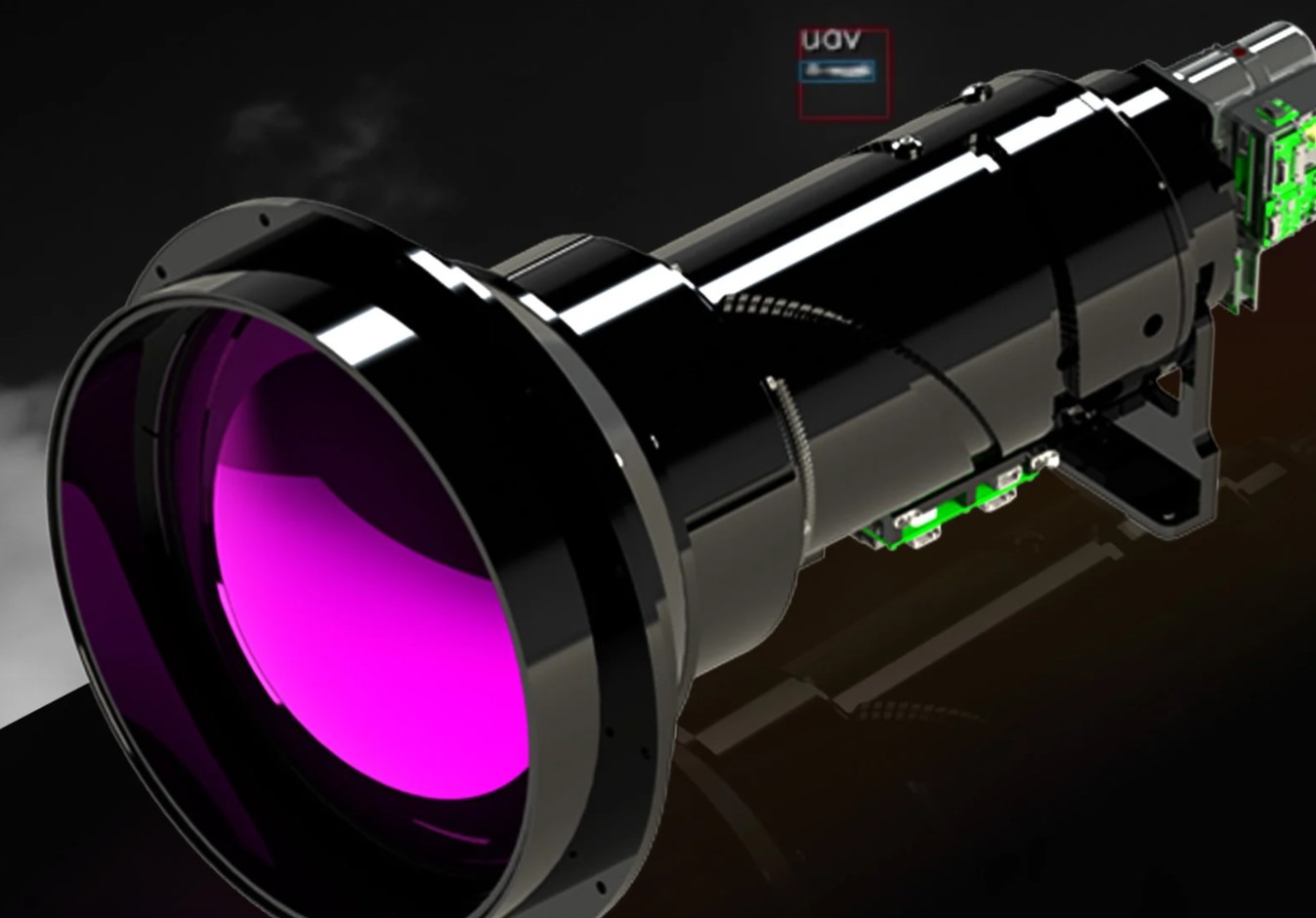
It combines a mid-wave infrared thermal camera with a continuously variable zoom lens, allowing operators to monitor targets at extended distances.
Neutrino SX8 ISR 50-1000 can detect vehicles at distances of up to 34 kilometers (21 miles), recognize them at roughly 23.5 kilometers (14.6 miles), and identify them at around 20 kilometers (12.4 miles).
According to the company, this is the longest-range configuration currently available within the Neutrino ISR family.
Sensors and Optics
At the core of Neutrino SX8 ISR 50-1000 is a cooled thermal sensor with a resolution of 1280 by 1024 pixels, operating in the mid-wave infrared spectrum.
The sensor uses pixels measuring 8 micrometers (0.000315 inches), a specification that influences image clarity and thermal sensitivity.
The camera is paired with a zoom lens covering focal lengths from 50 millimeters (2 inches) to 1,000 millimeters (39.4 inches).
Cooling for the thermal sensor is provided by a linear Stirling cooler, a mechanical component that maintains the low temperatures required for high-performance infrared imaging.
Connectivity and AI
The system uses widely adopted industry interfaces, allowing it to connect easily to existing surveillance networks and command-and-control systems.
Supported connections include Gigabit Ethernet for networked data transmission, Camera Link for high-speed image transfer, and HD-SDI for standard high-definition video output.
The Neutrino SX8 ISR 50-1000 is also designed to support artificial intelligence-based processing.
It can run software models for automated detection, tracking, and classification of objects, helping operators identify relevant targets more efficiently.
In addition, image signal processing libraries are available to improve image quality, including techniques that increase apparent resolution, reduce atmospheric distortion, and enhance contrast in challenging viewing conditions.