Hanwha Systems has won a contract amounting to 200 billion Korean won ($135.5 million) to develop the multi-function radar for South Korea’s next-generation Cheongung-III air and missile defense system.
The agreement was signed with the Agency for Defense Development and covers a prototype radar for the Mid-range Surface-to-Air Missile (M-SAM) Block-III program.
The project will run through June 2030 and marks the first development of a new Cheongung variant since upgrades to Cheongung-II in 2012.
At the center of that effort is the multi-function radar, which handles detection, tracking, identification, and fire-control support.
Hanwha Systems will use fully digital active electronically scanned array (AESA) technology for the Cheongung‑III radar.
AESA allows the radar to conduct multiple missions at once, including tracking aircraft and ballistic missiles simultaneously, offering faster reaction times and broader coverage than mechanically scanned radars.
Cheongung‑III
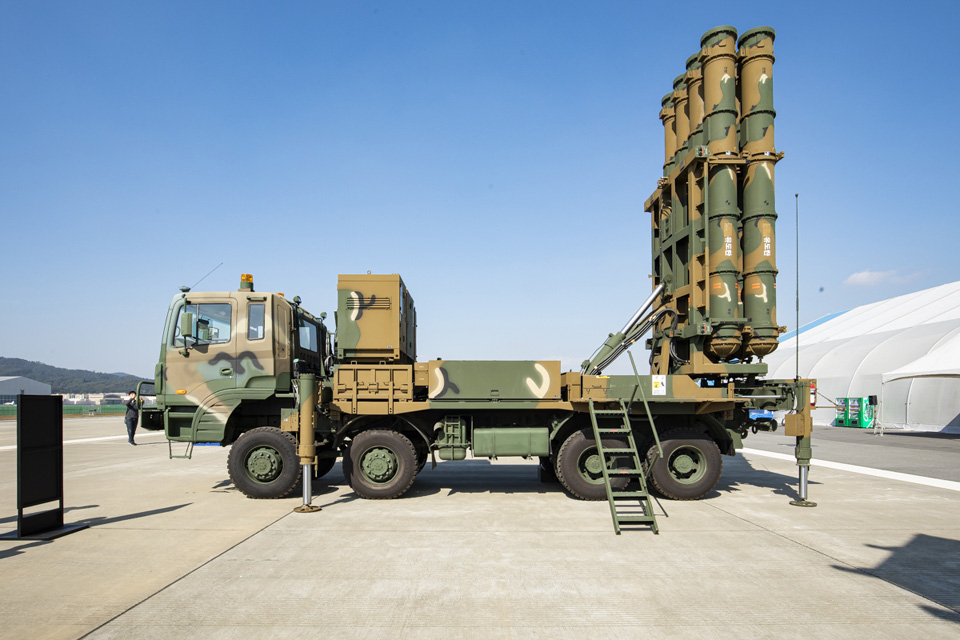
Cheongung‑III, or M-SAM Block‑III, represents South Korea’s latest medium-range surface-to-air missile system.
It combines improved detection and engagement capabilities with higher-altitude coverage and multi-target tracking, forming a key part of the country’s layered air and missile defense network.
Its multi-function radar serves as the system’s “eyes,” coordinating threat detection and missile interception in real time.
Hanwha Systems leads the radar development, integrating AESA technology to enhance simultaneous tracking of multiple targets, faster response times, and wider detection coverage.
Related radar developments by Hanwha include AESA radars for the L-SAM long-range missile system, the Long-Range Artillery Interception System, the KF-21 fighter, and naval platforms such as the Ulsan-class Batch‑III frigates and KDDX destroyers.
Cheongung‑III also builds on the export success of Cheongung-II, which has been sold to the UAE, Saudi Arabia, and Iraq since 2022 with contracts ranging from roughly $867 million to $1.1 billion.