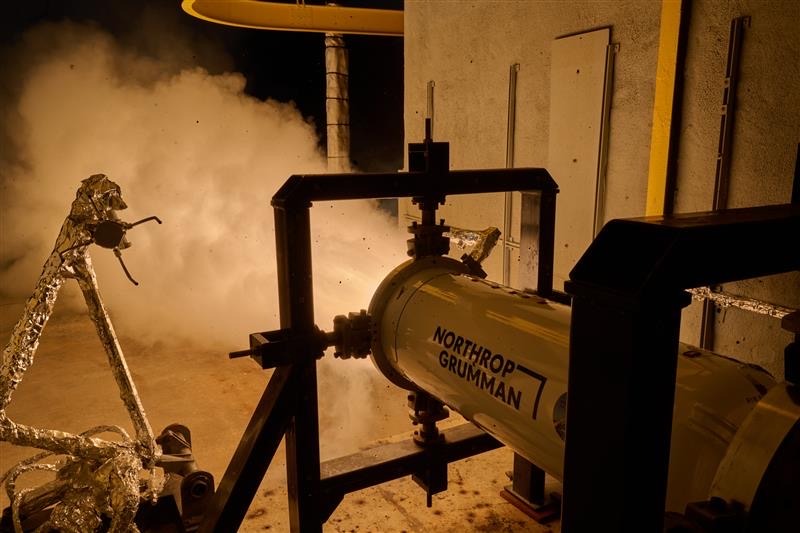
Northrop Grumman has completed the testing of an Mk 72 solid rocket motor in Maryland, part of an effort to expand production capacity and ease missile supply bottlenecks as demand accelerates.
The static fire test in its propulsion facility in Elkton was funded by the US Navy and focused on validating both performance and manufacturability.
Rather than pitching the Mk 72 as a clean-sheet design, Northrop framed the program as an effort to modernize a proven motor line by tightening production timelines and reducing risk.
Gordon LoPresti, senior director of propulsion systems and controls at Northrop Grumman, said that the Mk 72 is “tailorable to the US Navy’s needs, is low-risk and can be produced at scale.”
The test aligned digital modeling and “digital twin” tools with real-world performance data, an approach meant to shorten qualification cycles and avoid costly redesigns later.
Attention was also placed on supply chain resilience, with efforts including trade studies aimed at easing manufacturability challenges and establishing multiple sources for critical components.
Northrop Grumman’s Solid Rocket Motor Footprint
The Mk 72 test fits into a much larger solid rocket motor portfolio that Northrop Grumman has been expanding across the US.
Over the past seven years, the company has invested more than $1 billion in advanced manufacturing facilities to increase missile and rocket motor output.
In September 2024, Northrop and Raytheon partnered on a static fire of an advanced long‑range solid rocket motor at the West Virginia Allegany Ballistics Laboratory, demonstrating new design technologies relevant to hypersonic and other future weapon systems.
In August, the company and the US Air Force completed the first qualification testing of the Sentinel intercontinental ballistic missile’s stage-two solid rocket motor.