US Army Seeks Laser Weapons to ‘Hard Kill’ Group 1 to 3 Drones

The US Army is seeking laser weapons that can achieve a “hard kill,” or kinetically render a target unable to maintain flight, against Group 1 and 2 drones and one-way attack Group 3 drones.
In the published request for information (RFI), the service said it plans to develop and produce up to 20 Enduring-High Energy Laser (E-HEL) weapon systems. Each system must adopt a Modular Open System Approach and build on range-proven laser and beam control technologies.
The term “range-proven” refers to technologies demonstrated on a government test range and verified by government representatives.
The RFI also opens the door for companies without recent government-witnessed test data to prove their systems’ capabilities through new demonstrations under government oversight.
Operational Requirements
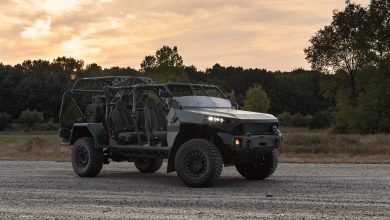
The E-HEL system must be capable of supporting both semi-fixed and mobile, or maneuver, operations. Moreover, it should function either in a palletized configuration for rapid deployment or mounted on a Joint Light Tactical Vehicle for field mobility.
It will be required to track the target uncrewed aerial vehicles in both clear or “blue sky” and cluttered conditions, while accepting external targeting cues from the Forward Area Air Defense network.
The system must also be designed for easy handling using standard equipment, such as forklifts, and be transportable by ground and air, including via C-17 aircraft.
The government testing will evaluate fluence, tracker performance, engagement range, and laser quality track. Meanwhile, systems that don’t yet achieve a hard kill on Group 3 drones will still be assessed for scalability and lethality potential.
Broader Army Laser C‑UAS Effort
This RFI supports the US Army’s broader efforts at fielding directed-energy weapons as part of its modernization and counter-unmanned aerial system strategy.
Previous efforts include the service awarding HII a contract to develop an anti-drone HEL weapon against Group 1 to 3 drones, similar to the recently published RFI.
In September, the army received its first two “LOCUST” counter-drone 20-kilowatt laser weapon system prototypes mounted on infantry squad vehicles, complementing a similar effort of mounting a 50-kilowatt laser weapon onto a Stryker combat vehicle.