L3Harris Technologies has secured a $24-million contract to supply its software-defined data device for the US Army’s Next Generation Command and Control (NGC2) transport layer.
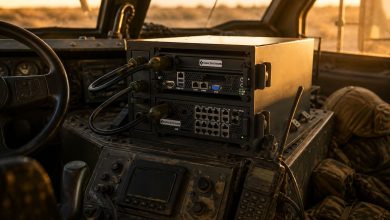
The deal covers the delivery of the new AN/PRC-158C NGC2 Gateway Manpack — a specialized version of the Falcon IV AN/PRC-158 — to the US Army’s 4th Infantry Division ahead of their scheduled participation in Project Convergence 2026.
“The Army’s NGC2 program is too important to accept anything less than success in execution, including system protection against device compromise, external threats to the network and data spillage,” said Sam Mehta, L3Harris President of Communication Systems.
Falcon AN/PRC-158
The Falcon IV AN/PRC-158 is a compact, lightweight, modular two-channel radio operating across the 30 to 2,500 MHz frequency range.
Designed to meet the Pentagon’s demand for high-data, secure communications, it integrates MUOS satellite capability for beyond-line-of-sight connectivity.
Built on a Software Communications Architecture, the radio can switch between multiple waveforms to match mission requirements and act as a mini router to bridge communications across networks or frequencies — a key feature supporting the NGC2 network.
Next-Gen Command Platform
The US Army’s NGC2 initiative aims to create a seamless, secure, and interoperable network linking soldiers, vehicles, aircraft, and command centers across all battlefield domains.
Instead of being a single device or program, the NGC2 is an ecosystem or technology stack with four layers: transport, infrastructure, data, and applications.
It deviates from the previous practice where different units had their own separate data or silos.
However, a recently published US Army memo flagged several security and oversight concerns in the platform prototype, including the risk of sensitive information being accessed without traceability and some third-party applications having high-severity code vulnerabilities.