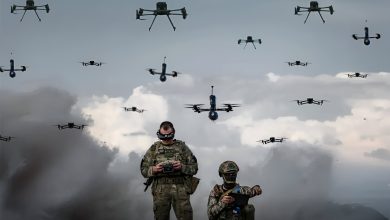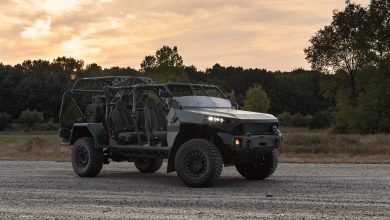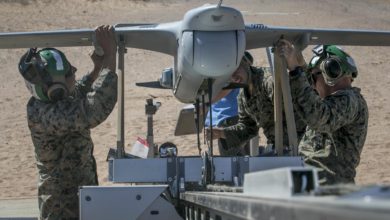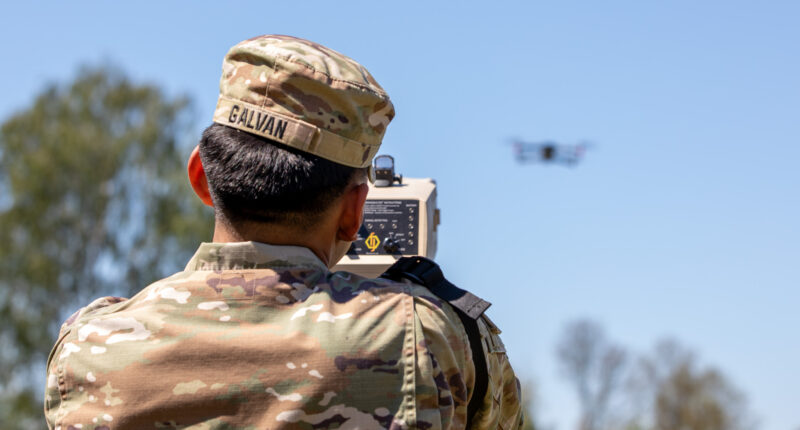
The US Army has issued an open call for solutions capable of operating in the Air-Ground Littoral, the zone from the ground up to several thousand feet, where small drones and unmanned ground vehicles are increasingly deployed.
The solicitation targets unmanned ground vehicles for mine clearance and mobility, as well as drone swarm systems, sensor-to-shooter targeting, fire coordination, and attack operations.
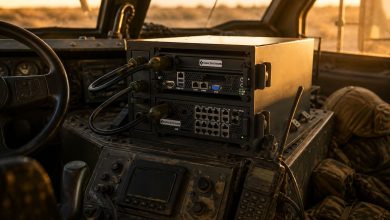
Proposed technologies must demonstrate interoperability with the army’s NGC2 command-and-control stack to enable faster and more efficient decision-making.
NGC2 is a modular, open-architecture system that connects sensors, vehicles, command posts, and personnel.
Submissions are now open and will close on September 5, 2025.
Selected technologies will be delivered to the 4th Infantry Division (4ID) at Fort Carson, Colorado, in early 2026.
The US Army stressed that it welcomes contributions from across the industry, particularly from small businesses and non-traditional defense contractors.
The open call leverages flexible acquisition authorities to support rapid prototyping, iterative development, and potential future procurement.
Soldiers will use the technologies in training scenarios, potentially including a combat training center rotation, with evaluations focused on usability, mission effectiveness, and interoperability with NGC2 systems.
Solutions showing strong potential may advance development, prototyping, or collaborative testing.
Focus Areas
The initiative targets eight key capability areas to improve operational effectiveness across combat, intelligence, sustainment, cyber, and information domains.
For movement and maneuver, solutions should include unmanned systems for route clearance, breaching, and concealing friendly forces.
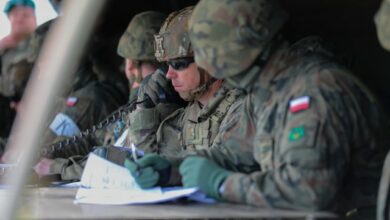
Mission command technologies are expected to enable data-driven decision-making, extended communications, and automated common operating pictures.
Intelligence tools encompass sensor networks, loitering platforms, and predictive analysis of information streams, supported by reconnaissance and target acquisition systems that provide low-signature early warning and forward observation capabilities.
In fires, the US Army seeks drone swarms, sensor-to-soldier targeting, and autonomous direct-fire platforms.
Sustainment includes autonomous casualty evacuation, resupply, predictive maintenance, and warehouse automation.
Protection focuses on counter-unmanned aircraft systems, as well as chemical, biological, radiological, and nuclear detection.
Finally, information tools address network vulnerability detection, penetration testing, and automated monitoring of disinformation.