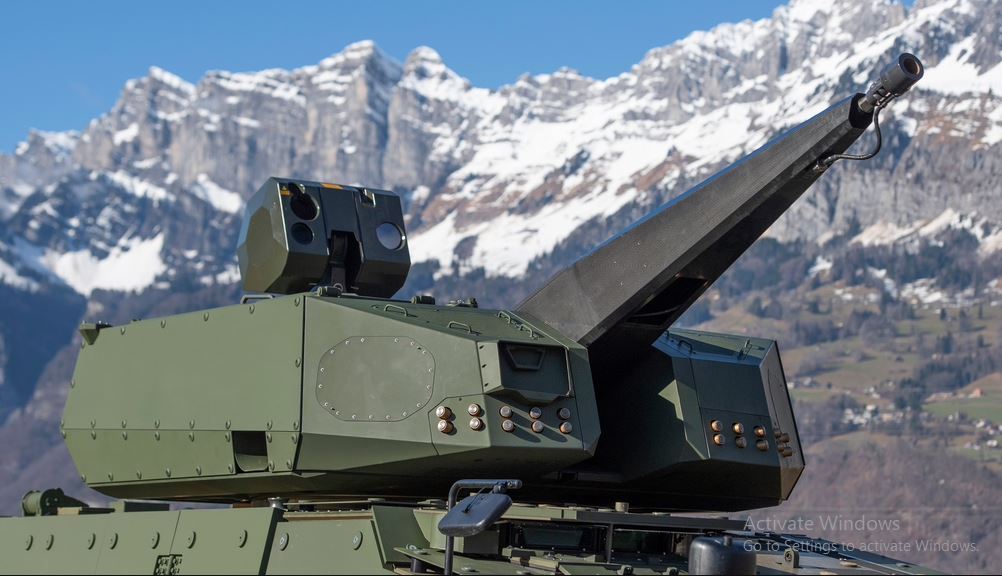
Rheinmetall anticipates securing a multi-billion-euro order for Skyranger self-propelled air defense systems with the German Armed Forces by late 2025.
CEO of Rheinmetall Armin Papperger said that the potential deal is valued between 6 billion and 8 billion euros ($6.9 to $9.2 billion) for a “significant number” of systems.
While exact figures were not disclosed, previous planning documents from Berlin have indicated a potential requirement for 500 to 600 sets of the Skyranger 30 in various configurations, Defence Industry Europe reported.
Papperger gave additional details on the future procurement, saying it is expected to begin under a framework agreement, followed by phased execution contracts.
Current talks lay out the delivery phases through 2029 and a subsequent tranche from 2029 to 2035.
The upcoming acquisition aligns with Germany’s commitment to meet NATO defense spending benchmarks, with the country targeting approximately 3.5 percent of GDP for defense by 2029. The alliance capability targets are also slated for revision in that year.
Testing on Boxer Vehicles
Rheinmetall’s recently announced roadmap follows its February 2025 delivery of the first Boxer Skyranger 30 cannon-based air defense vehicle to the Bundeswehr.
This verification model will be used for training and testing over the coming months.
Germany ordered the testbed last year, along with 18 serial-production Skyranger vehicles scheduled for delivery between 2027 and 2028.
The Skyranger 30
Developed by Rheinmetall Air Defence, the Skyranger 30 mounts a 30-millimeter KCE-ABM revolving cannon capable of firing programmable airburst munitions for engaging drones, helicopters, low-flying aircraft, and precision-guided munitions.
The system integrates a short-range missile launcher compatible with the MBDA Mistral 3, RTX Stinger, and Halcon SkyKnight interceptors, giving operators flexibility in countering a wide range of aerial threats.
Future configurations are planned to incorporate directed-energy weapons, beginning with laser systems rated at 20 kilowatts and scalable up to 100 kilowatts, enhancing their ability to defeat small, fast, and low-signature targets at minimal per-shot cost.
The turret supports dual radar target-acquisition sets with fixed active electronically scanned array or AESA antennas for 360-degree coverage, coupled with multiple roof-mounted optoelectronic sensor packages for all-day target tracking and identification.
Its modular design allows integration on stationary, wheeled, or tracked platforms for point defense or mobile protection, with an open systems approach supporting cost-effective upgrades and mission tailoring.