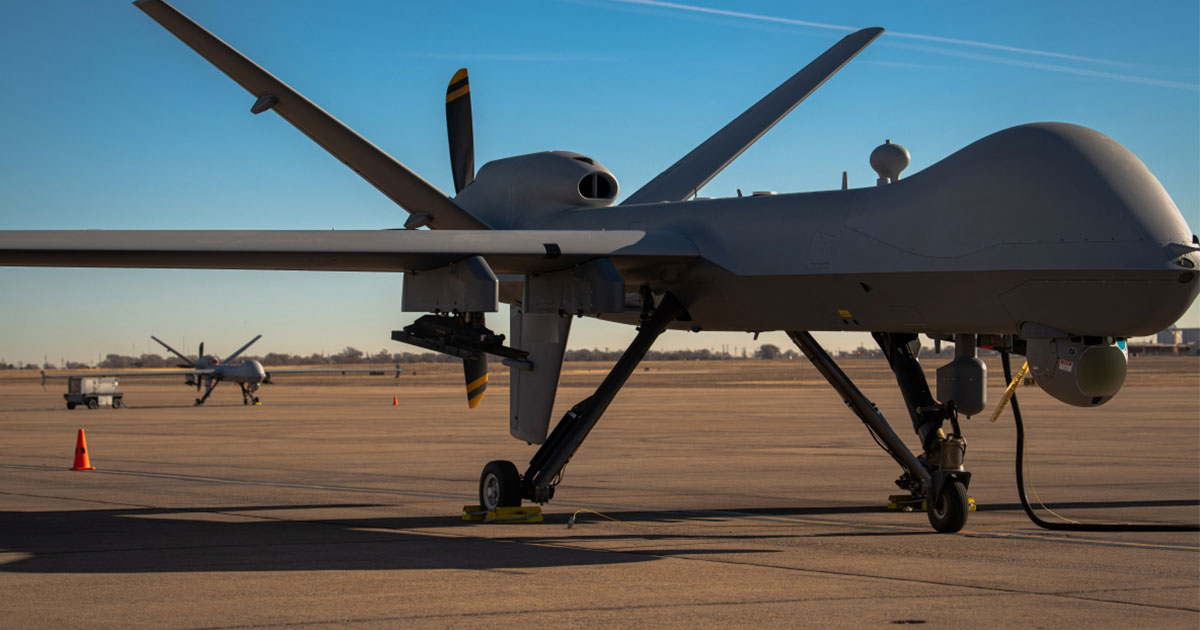
Tobyhanna Army Depot and General Atomics Aeronautical Systems (GA-ASI) have introduced a new maintenance, repair, and overhaul capability for the MQ-9 Reaper Ground Control Station.
The initiative will enable complete testing, diagnostics, and refurbishment of essential components.
Key systems covered include Linux processors, file servers, and control consoles.
Recent efforts build on a public-private partnership that began in 2013, when Tobyhanna was designated as the Depot Source of Repair for Ground Control Systems.
Since then, Tobyhanna and GA-ASI have developed and upgraded technical documentation, training materials, test equipment, and repair procedures.
MQ-9 Reaper
The MQ-9 Reaper is a medium-altitude, long-endurance unmanned aircraft capable of carrying sensors for intelligence, surveillance, and reconnaissance, as well as precision-guided munitions.
It is used for both data collection and strike missions.
In recent months, the drone has been deployed in several operations in Yemen, involving responding to missile attacks launched by the Iran-backed Houthis.
Boosting Drone Capabilities
As drone warfare becomes increasingly central to the US military strategy, Washington is stepping up efforts to modernize and streamline unmanned aircraft operations.
Alongside ongoing work to improve maintenance for systems already in service, recent initiatives focus on rapid innovation and cost efficiency.
In July, the US Defense Innovation Unit named 10 finalist firms in its Low-Cost Sensing Challenge for Counter-small Unmanned Aircraft Systems.
The project aims to develop affordable sensor technologies for detecting and tracking small drones.
The selected prototypes employ a range of detection methods, including passive radio frequency, acoustic sensors, optical sensors, and multi-sensor systems.
In parallel, Washington unveiled 18 new drone prototypes developed using primarily commercial off-the-shelf components, built in collaboration with industry.
Designed for fast deployment, the systems moved from concept to prototype in just 18 months.