On December 12, 2024, under the Florida sky at Cape Canaveral Space Force Station, the US Army held its breath.
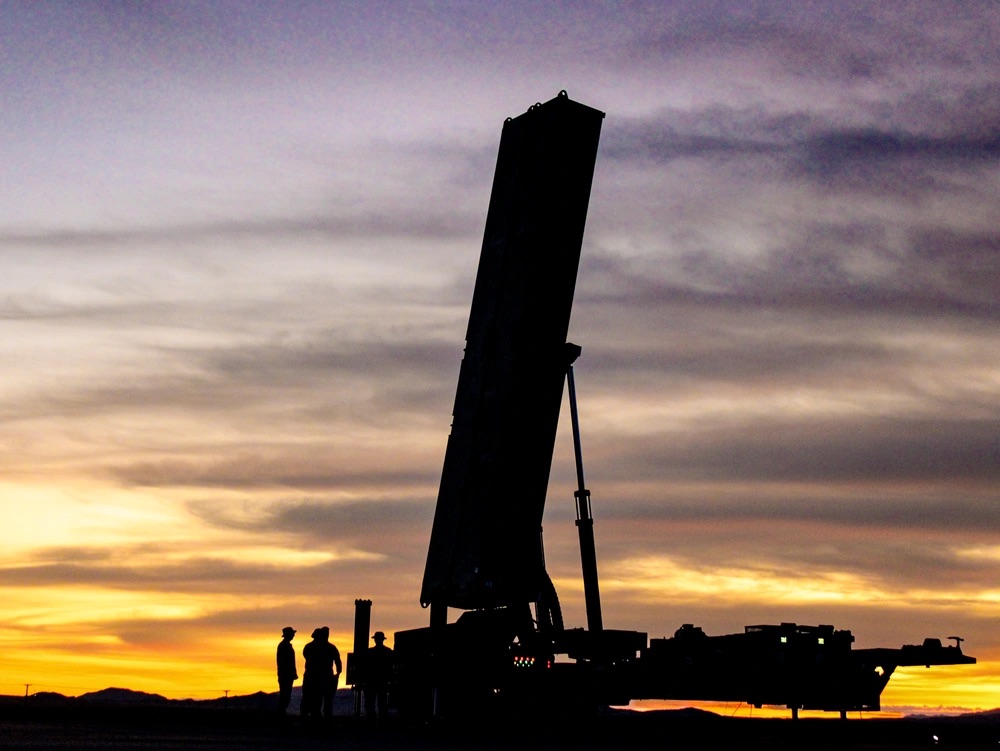
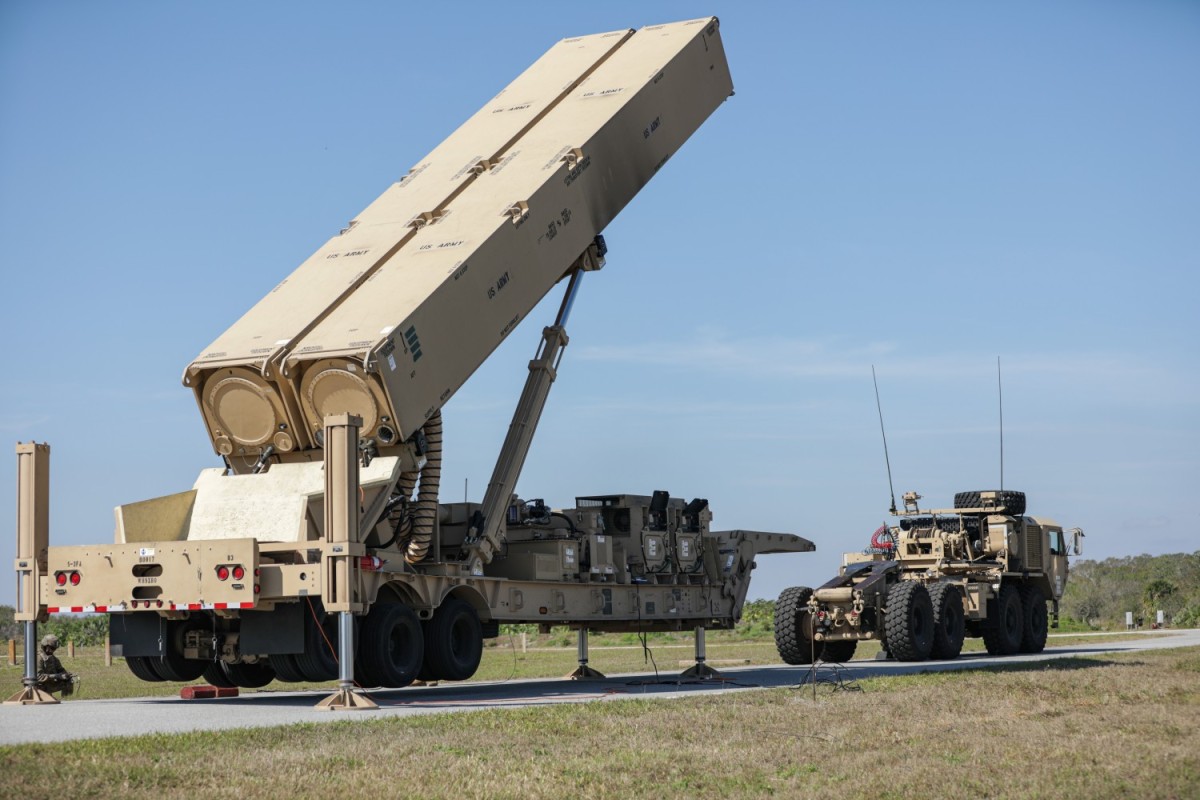
A massive Transporter Erector Launcher, hitched to an M983 tactical truck, elevated a canister to a near-vertical position. Inside was the Army’s Long-Range Hypersonic Weapon (LRHW), a system that had, until recently, been a source of immense frustration and public setbacks.
This was the moment of the Canaveral Gambit — a high-stakes test to prove that America’s premier ground-launched hypersonic program had finally overcome the crippling issues that had kept it flightless.
With a roar, the missile ignited and streaked east over the Atlantic. For observers, it was a spectacular sight; for the Pentagon, it was a moment of programmatic redemption. This was not just another test. It was the first “end-to-end” live-fire event for the LRHW system, integrating the mobile launcher and the Battery Operations Center in a fully operational configuration.
Eyewitness photos captured the missile’s ascent and the distinct separation of its first-stage booster, a critical sequence in its flight profile.
The success was a stark contrast to the program’s recent history.
Throughout 2023, the LRHW had been grounded. A planned launch in March and another in September were both scrubbed during pre-flight checks, failures the US Army attributed not to the sophisticated missile itself, but to a “mechanical engineering problem” with the Lockheed Martin-produced launcher.
These repeated delays, following earlier booster failures in 2021 and 2022, forced the army to concede it would miss its ambitious goal of fielding the weapon by the end of fiscal year 2023, fueling a narrative that the US was falling dangerously behind its rivals.
But the December 2024 success rewrote that story. It validated not only the missile but the entire ground-based ecosystem designed to make it a credible battlefield threat.
The timing was deliberate. Just months later, on April 24, 2025, the Army formally christened the LRHW with its popular name: “Dark Eagle.”
The symbolism was potent. “Dark” was chosen to embody the weapon’s ability to “disintegrate adversary capabilities,” while “eagle” paid tribute to the master hunter, a nod to the system’s promised combination of speed, accuracy, maneuverability, and survivability.
As Patrick Mason, a senior army acquisition official, stated, “Hypersonic weapons will complicate adversaries’ decision calculus, strengthening deterrence. Their speed, accuracy, and versatility are befitting its new popular name, Dark Eagle.”
The successful test and subsequent branding were more than just programmatic milestones; they were a clear strategic communication.
After years of highly visible struggles that fed perceptions of a “hypersonic gap” with Russia and China — both of whom had already fielded their own systems — this event was a powerful signal to allies and adversaries alike.
While a June 2024 test in Hawaii had proven the missile’s All-Up Round could fly, it was launched from a static test stand.
The December launch from the mobile Transporter Erector Launcher was the final, crucial piece of the puzzle. It demonstrated that the US had not only designed a hypersonic weapon but had mastered the immense engineering challenge of making it a deployable, operational system.
The hunter had finally awakened.
Anatomy of a Hypersonic Predator
The Boost-Glide Principle: A Trajectory of Unpredictability
The Dark Eagle represents a class of weapon known as a hypersonic boost-glide vehicle, a technology that fundamentally alters the dynamics of long-range strikes.
Its operation is a two-part symphony of raw power and aerodynamic finesse, designed to be inherently unpredictable and, therefore, exceptionally difficult to counter.
Unlike a traditional ballistic missile, which follows a high, parabolic arc through the vacuum of space like a thrown stone, a boost-glide vehicle flies a much flatter, atmospheric trajectory.
The process begins with the Boost Phase. A massive, two-stage solid-fuel rocket booster, jointly developed by the Army and Navy, launches the weapon, accelerating it to speeds well over Mach 5 (five times the speed of sound, or over 3,800 miles/6,115 kilometers per hour) and propelling it to the upper reaches of the atmosphere.
At a predetermined altitude and velocity, the crucial Separation and Glide phase occurs. The spent rocket booster is jettisoned, and the payload — an unpowered, wedge-shaped vehicle known as the Common Hypersonic Glide Body (C-HGB) — is released to begin its long glide toward the target.
This is where the weapon’s revolutionary nature becomes apparent. During its glide, the C-HGB executes significant Atmospheric Maneuvers. Using its aerodynamic shape and control surfaces, it can make unpredictable turns and altitude changes, all while sustaining incredible speeds that have been reported to peak as high as Mach 17.
This combination of extreme velocity and an erratic flight path presents an almost insurmountable challenge for existing air and missile defense systems. Radar systems struggle to maintain a track, and interceptors cannot calculate a reliable intercept point for a target that is constantly changing its destination and arriving in minutes, not hours.
Core Components & Technical Specifications
The Dark Eagle system is a complex integration of three major elements: the glide body that delivers the lethal effect, the powerful rocket that gets it there, and the mobile ground equipment that allows soldiers to launch it from anywhere in the world.
The Common Hypersonic Glide Body (C-HGB): The Tip of the Spear
The C-HGB is the heart of the weapon, the product of decades of American research into hypersonic flight.
Its design lineage can be traced back to the Sandia Winged Energetic Reentry Vehicle Experiment of the 1980s and, more directly, the Army’s Advanced Hypersonic Weapon program, which conducted tests in the 2010s.
This long, iterative development history underscores the immense technical challenges involved.
The C-HGB program is a joint-service effort, with the US Navy and Sandia National Laboratories leading the design and Dynetics, a subsidiary of Leidos, contracted to manufacture the prototypes.
Crucially, the Dark Eagle is a non-nuclear weapon. Its lethality comes from the C-HGB functioning as a kinetic energy projectile warhead.
It carries no traditional explosive payload. Instead, it relies on its immense velocity to generate such overwhelming kinetic energy upon impact that it can, in the US Army’s own words, “disintegrate” even hardened targets.
This design choice necessitates the incredible speeds the system achieves.
The C-HGB itself is a sophisticated piece of engineering, comprising not just the warhead but also its advanced guidance system, internal cabling, and a critical thermal protection shield to survive the searing 3,000 degrees Fahrenheit (1,649 degrees Celsius) temperatures generated by atmospheric friction at hypersonic speeds.
The Powerhouse Booster: The Navy-Army All Up Round (AUR)
To propel the C-HGB to its operational speed and altitude, it is integrated with a formidable 34.5-inch (88-centimeter) diameter, two-stage solid-fuel rocket booster.
This complete missile assembly is known as the All-Up Round, and when placed in its launch canister for the Army, it is designated the AUR+C.
The booster is a joint Army-Navy development, a collaboration designed to save costs and accelerate timelines.
The industrial team behind it is a consortium of American defense giants: Lockheed Martin and Northrop Grumman are responsible for the missile component, with Aerojet Rocketdyne providing the powerful booster propulsion system.
The Mobile Warfighter: The Ground System
What makes Dark Eagle a uniquely US Army capability is its ground system, designed for mobility and survivability.
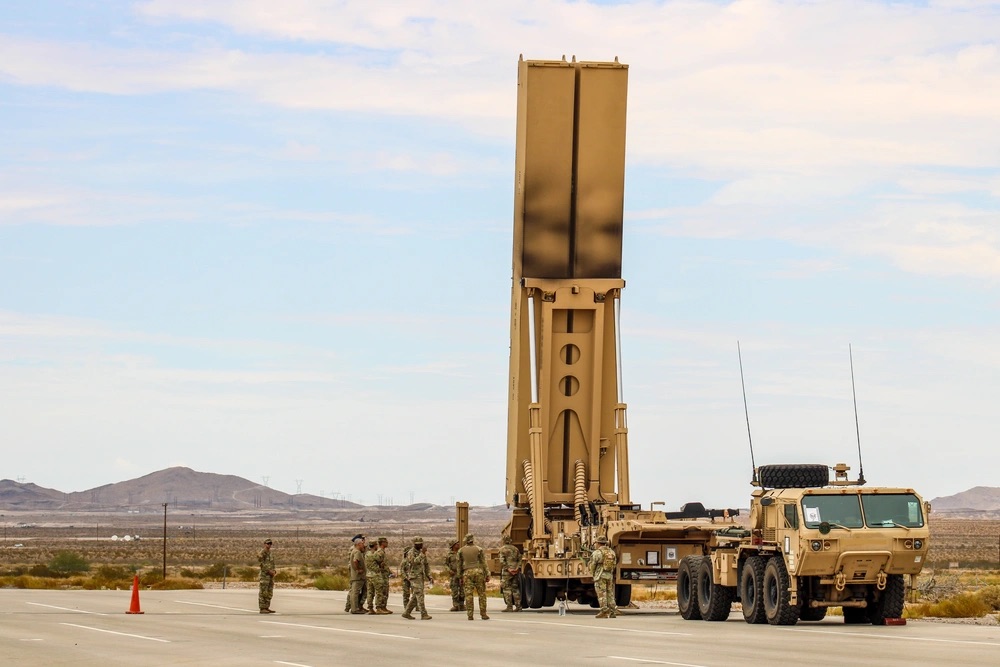
The weapon is launched from a Transporter Erector Launcher (TEL), a massive, road-mobile platform consisting of a modified M870A4 trailer towed by an Oshkosh M983 Heavy Expanded Mobility Tactical Truck.
This mobility is a core feature, allowing a battery to quickly deploy to a launch position, fire its missiles, and relocate — a “shoot and scoot” tactic that makes it incredibly difficult for an adversary to target and destroy.
A standard operational Dark Eagle battery is a self-contained fighting unit. It is composed of four TELs, each carrying two missiles for a total of eight AUR+Cs, one Battery Operations Center (BOC) vehicle for command, control, and fire-control, and a BOC support vehicle.
Dark Eagle System Specifications
| Specification | Details |
| Official Designation | Long-Range Hypersonic Weapon (LRHW) |
| Popular Name | Dark Eagle |
| Type | Ground-launched, intermediate-range, boost-glide hypersonic missile |
| Warhead | Conventional, Kinetic Energy Penetrator (via Common Hypersonic Glide Body) |
| Reported Range | 1,725 miles (2,776 km) |
| Demonstrated Range | ~2,000 miles (3,200 km) in June 2024 test |
| Maximum Speed | > Mach 5 (over 3,800 mph); reported peak speed of Mach 17 |
| Guidance | Classified; likely INS with GPS augmentation and terminal guidance |
| Launcher Platform | M983 HEMTT towing a modified M870A4 Transporter Erector Launcher (TEL) |
| Missile Weight | ~16,300 lbs (7,400 kg) |
| Missile Diameter | 34.5 inches (0.88 m) |
| Prime Contractors | System Integrator: Lockheed Martin; Glide Body: Dynetics/Sandia Labs; Booster: Lockheed Martin/Northrop Grumman/Aerojet Rocketdyne |
The Eagle’s Journey: A Program Forged in Trial
The story of the Dark Eagle is not one of effortless ascent. It is a story of trial, error, and hard-won success, mirroring the life cycle of its namesake — from a vulnerable hatchling, through a clumsy fledgling stage, to a mature and lethal hunter.
The Nest: Origins in Prompt Global Strike (Early 2000s – 2018)
The conceptual egg for Dark Eagle was laid in the early 2000s with the Department of Defense’s Conventional Prompt Global Strike initiative.
The goal was revolutionary: to develop the capability to strike high-value targets anywhere on Earth within one hour using a conventional warhead. This led to the Army’s Advanced Hypersonic Weapon (AHW) program, which served as the direct technological ancestor to Dark Eagle.
The AHW had a successful flight in 2011, proving the basic physics of a boost-glide vehicle, but a subsequent test in 2014 failed.
The Common Hypersonic Glide Body (C-HGB) at the heart of Dark Eagle is a direct evolution of the design tested in the AHW program. This period was the program’s hatchling stage — fragile and experimental, but containing the essential DNA of the future weapon.
First Flight: A Fledgling’s Stumble (2019 – 2023)
Spurred by rapid hypersonic advancements in Russia and China, the FY2019 National Defense Authorization Act formally accelerated the modern LRHW program.
The Army set an aggressive timeline: field a prototype battery with live rounds by the end of FY2023. This was the program’s fledgling stage, and its attempts to fly were marked by repeated, public, and painful stumbles.
The core C-HGB itself had shown promise in early flight experiments in 2017 and 2020. The problems arose when the US Army tried to integrate it into a complete weapon system.
The stumbles began in October 2021, when a booster rocket failed during a test, preventing the C-HGB from ever deploying in what officials termed a “no test.”
In June 2022, another attempt to test the complete All-Up-Round (AUR) in Hawaii ended in failure after ignition.
The most frustrating setbacks came in 2023. With the ground equipment already in the hands of soldiers, the Army moved the system to Cape Canaveral for live-fire tests. But a launch attempt in March 2023 was scrubbed due to pre-flight check failures.
A re-test in September 2023 met the same fate. Critically, officials stressed these failures were due to issues with the launcher and ground support equipment, not the missile’s glide body. Nevertheless, the damage was done.
In September 2023, the Army officially acknowledged it would miss its fielding deadline, a major blow to the program’s credibility.
Learning to Hunt: The Juvenile Stage (2024 – Present)
The period from 2024 onward represents the juvenile eagle stage, where the program, having learned from its failures, began to achieve its key developmental milestones.
The Army revamped its testing approach, moving away from a rush-to-field mentality to a more methodical, subcomponent-focused process to iron out the integration issues.
The turning point came on June 28, 2024. In a test at the Pacific Missile Range Facility in Hawaii, the program achieved its first successful end-to-end flight of the AUR.
Launched from a test stand, the missile flew its intended course for over 2,000 miles (3,219 kilometers), releasing the C-HGB to strike a target area in the Marshall Islands. This success validated the fundamental design of the missile and glide body.
In parallel, the soldiers destined to operate the weapon were not idle. Even as engineers worked to fix the hardware, the 1st Multi-Domain Task Force (MDTF) at Joint Base Lewis-McChord was continuously training with the ground equipment they had received back in 2021.
They deployed the system across the country for Exercise Thunderbolt Strike in February 2023 and integrated it into major joint exercises like Resolute Hunter in June 2024 and Bamboo Eagle in August 2024. This crucial work developed the tactics, techniques, and procedures needed to make Dark Eagle a credible combat system.
This culminated in the December 12, 2024, test at Cape Canaveral. This was the sub-adult eagle’s first successful hunt — the first successful launch from the operational TEL and BOC, proving the entire system could function as designed.
The program had finally taken flight.
Key Dark Eagle Program Milestones
| Date | Event | Outcome / Significance |
| 2011 | Advanced Hypersonic Weapon (AHW) Test | Successful flight; precursor to C-HGB. |
| Oct 2017 | C-HGB Flight Experiment 1 (FE-1) | Successful test of the glide body. |
| Mar 2020 | C-HGB Flight Experiment 2 (FE-2) | Successful test, validating the glide body design. |
| Oct 2021 | Ground Equipment Delivered | 1st MDTF receives TELs and BOCs, minus live missiles. |
| Oct 2021 | Booster Test | FAILURE. Booster rocket fails; characterized as a “no test.” |
| June 2022 | All-Up-Round Test | FAILURE. Anomaly after ignition; test of full missile fails. |
| Mar 2023 | Joint Flight Campaign-2 (JFC-2) | SCRUBBED. Test aborted due to pre-flight check failures with the launcher. |
| Sep 2023 | JFC-2 Retest | SCRUBBED. Test again aborted due to launcher issues. Army misses FY23 fielding goal. |
| June 2024 | End-to-End Flight Test (Hawaii) | SUCCESS. First successful test of the full AUR missile from a test stand. |
| Dec 2024 | End-to-End Flight Test (Florida) | SUCCESS. First successful live-fire from the operational TEL and BOC. |
| Apr 2025 | Official Naming | Army formally designates the LRHW system as “Dark Eagle.” |
| FY 2025 | Planned Initial Fielding | New target date for delivering live rounds to the first operational battery. |
| Q4 FY 2026 | Planned Fielding of 2nd Battery | Second battery scheduled for fielding, with minor missile modifications. |
The program’s difficult journey reveals a crucial truth about developing such a revolutionary technology.
The most significant failures were concentrated in the booster and launcher integration, not the C-HGB itself, which is arguably the most technologically novel component. This indicates that the fundamental physics and design of the glide vehicle were sound from early on.
The challenge lay in the immensely complex systems engineering required to make the entire weapon — from ground power-up to booster separation — work reliably.
The Army’s pivot to a more methodical, subcomponent-focused testing regimen after the 2023 scrubs was a direct response to this reality and the key to its eventual success.
The lesson, learned publicly and at great expense, is that fielding a hypersonic weapon is not just about designing a glider; it is about mastering an entire ecosystem of rocketry, ground support, and launch mechanics.
The Strategic Calculus: Why America Needs the Dark Eagle
The immense investment and programmatic pain endured to develop the Dark Eagle were not undertaken in a vacuum.
The weapon is a direct and necessary response to a rapidly shifting global strategic landscape, driven by the advancements of America’s great power competitors.
The New Great Power Competition: Responding to the Threat
The primary impetus for the Dark Eagle program is the fielding of operational hypersonic weapons by China and Russia. China has deployed the road-mobile, conventionally-armed DF-17 and is developing the longer-range DF-27.
Russia has declared its nuclear-armed Avangard HGV operational, launched from ICBMs, and has used its air-launched Kinzhal and ship-launched Zircon hypersonic missiles in combat.
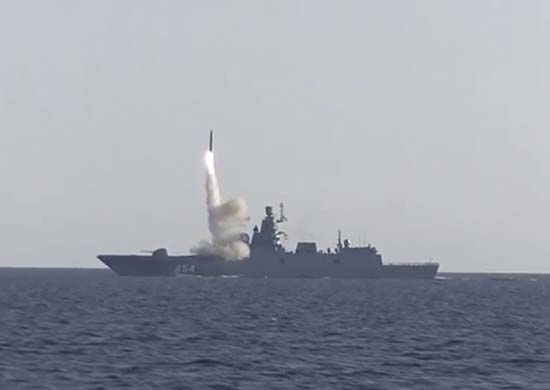
These systems provide adversaries with the ability to strike targets with unprecedented speed and survivability, threatening to render existing US and allied defenses obsolete.
Dark Eagle is therefore a critical effort to restore a credible deterrent, ensuring the US is not left without a comparable capability to hold adversary targets at risk.
Dismantling the Fortress: The Anti-Access/Area Denial (A2/AD) Mission
The core mission for the US Army’s Dark Eagle is to serve as a “door kicker” against advanced adversary defenses, particularly China’s formidable Anti-Access/Area Denial (A2/AD) network in the Pacific.
This A2/AD strategy is designed to create a “keep-out” zone, using a dense web of long-range sensors, missiles, and air defenses to prevent US forces, especially high-value assets like aircraft carriers, from operating safely near the Chinese mainland.
Dark Eagle is engineered to defeat this strategy. Its combination of speed and unpredictable maneuverability allows it to penetrate these defensive bubbles and deliver precision strikes against the most critical, high-payoff, and time-sensitive targets that form the backbone of an A2/AD network.
This target set includes hardened command-and-control bunkers, long-range radar installations, adversary missile launchers, and key logistical hubs.
By neutralizing these vital nodes at the outset of a conflict, Dark Eagle is intended to create corridors of access for other, slower-moving US and allied forces to follow, effectively dismantling the fortress from within.
Comparative Analysis: Dark Eagle vs. The Competition
While often lumped together under the “hypersonic” label, a closer analysis reveals that Dark Eagle and its primary Russian and Chinese counterparts are designed for fundamentally different strategic purposes.
vs. Russia’s Avangard
The comparison with Russia’s Avangard highlights a profound difference in military doctrine.
- Platform and Warhead: Dark Eagle is a conventionally-armed, road-mobile system designed for tactical and operational flexibility. Avangard is a nuclear-armed HGV (with a reported yield of over 2 megatons) launched from fixed, silo-based ICBMs like the SS-19 and the future RS-28 Sarmat.
- Doctrine and Purpose: This distinction reflects their intended roles. Dark Eagle provides a conventional prompt strike capability at the theater level. Avangard is a strategic nuclear weapon, designed to guarantee penetration of US homeland missile defenses and preserve the credibility of Russia’s nuclear second-strike capability.
- Performance: Consistent with its strategic role, Avangard has an intercontinental range and a higher reported top speed (Mach 20+). Dark Eagle has a shorter, intermediate range of 1,725 miles (2,776 kilometers) and a reported peak speed of Mach 17.
vs. China’s DF-17
The DF-17 is a more direct peer competitor to Dark Eagle, as both are road-mobile, conventionally-armed, theater-range systems. However, key differences remain.
- Primary Mission: The DF-17 is widely reported to have a primary anti-ship mission, designed specifically to target and destroy US aircraft carriers and other large naval vessels, forming a key part of its A2/AD enforcement strategy. Dark Eagle’s target set is broader and more focused on fixed, hardened ground infrastructure to break the A2/AD network itself.
- Performance: Based on open-source reporting, Dark Eagle appears to hold a performance advantage. Its stated range of 1,725 miles exceeds the DF-17’s estimated range of 1,118-1,553 miles. Furthermore, Dark Eagle’s reported peak speed of Mach 17 is significantly higher than the Mach 5-10 range attributed to the DF-17. If these figures hold, Dark Eagle represents a more capable and potent system.
This analysis reveals that Dark Eagle is not a simple “me-too” weapon. It is an asymmetric response tailored to a specific American strategic problem.
While Russia’s Avangard is a tool of strategic nuclear deterrence and China’s DF-17 is a tool of maritime A2/AD enforcement, the US Dark Eagle is an offensive weapon designed to actively defeat and dismantle the very A2/AD strategies that its competitors are building.
However, the conventional nature of Dark Eagle introduces a unique and perilous strategic risk: warhead ambiguity.
Because hypersonic weapons drastically compress warning and decision timelines, an adversary detecting the launch of a Dark Eagle may not have the time or ability to determine whether the incoming warhead is conventional or nuclear.
This is particularly dangerous for nations like Russia and China that co-locate their conventional and nuclear command-and-control systems. The fear of a disarming first strike could force an adversary into a “use-it-or-lose-it” dilemma, potentially provoking a nuclear response to a conventional US attack.
Thus, a weapon designed to provide a non-nuclear option could, paradoxically, increase the risk of nuclear escalation.
The Price of Speed: Costs, Criticisms, and the Path Forward
The revolutionary capability offered by Dark Eagle comes at a staggering cost, and despite its recent testing successes, the program is shadowed by significant questions about its ultimate effectiveness and affordability.
The Bottom Line: An Exquisite and Expensive Capability
Dark Eagle is one of the most expensive conventional munitions in the US arsenal. The Army’s FY2025 budget request for the program totaled $1.282 billion, broken down into $744 million for missile procurement and $538 million for Research, Development, Test, and Evaluation.
This high cost is exacerbated by significant growth. According to a June 2025 Government Accountability Office (GAO) assessment, the estimated cost of fielding just the first prototype battery rose by $150 million in a single year, from $2.54 billion in January 2024 to $2.69 billion in January 2025.
The Army attributed this increase to the rising cost of the missiles themselves and the need for investigations and re-tests following earlier failures.
On a per-unit basis, a 2023 Congressional Budget Office study estimated that a missile similar to the LRHW would cost approximately $41 million.
For context, this is significantly more than a Trident II D5 submarine-launched ballistic missile, which costs around $31 million.
Army officials have acknowledged that the first batch of eight missiles procured in FY2025 will exceed the Congressional Budget Office’s estimate, though they express hope that costs will decrease as production quantities increase in the future.
An Unproven Killer? The Lethality and Reliability Question
Perhaps more concerning than the cost are the lingering doubts about the weapon’s actual performance in combat. The Pentagon’s own chief tester has raised serious red flags.
The 2024 report from the Director, Operational Test & Evaluation (DOT&E) delivered a stark verdict: “There is not enough data available to assess the operational effectiveness, lethality, suitability, and survivability of the LRHW system.”
This is a critical caveat to the program’s recent flight test successes. While the Army has proven the missile can fly, it has not yet proven it can reliably kill its intended targets.
The DOT&E report warns that this “uncertainty in weaponeering tools could result in excessive employment requirements or failure to meet warfighter objectives.” In simple terms, commanders might have to fire multiple, multi-million-dollar missiles at a single target to ensure its destruction, or risk mission failure.
Beyond lethality, broader technical challenges inherent to hypersonic flight remain, including the long-term reliability of electronics shielded from extreme heat and the difficulty of communicating through the plasma sheath that envelops the vehicle at high speeds.
The Dark Eagle program thus embodies a central tension in modern defense acquisition: the clash between the urgent, strategy-driven need for rapid fielding and the methodical, data-driven process required to prove a weapon is truly effective.
The program was placed on a Middle Tier of Acquisition pathway specifically to accelerate its delivery. However, the initial failures demonstrated the perils of rushing a complex, revolutionary technology.
The current situation reflects a compromise: the US is fielding a flight-proven capability quickly but is accepting a significant level of operational risk, with the weapon’s true effectiveness to be determined through ongoing testing and future upgrades.
Deployment and Future Outlook: The Hunter Takes Its Perch
Despite the unresolved questions, the Army is moving forward with an aggressive fielding plan.
- Initial Fielding: The first operational battery, assigned to the 5th Battalion, 3rd Field Artillery Regiment of the 1st MDTF at Joint Base Lewis-McChord, is scheduled to receive its live missiles by the end of FY2025.
- Force Expansion: A second battery is on track for fielding in the fourth quarter of FY2026, with a third battery planned to follow, meeting the Army’s goal of three operational batteries by FY2027.
- Forward Basing: The weapon’s 1,725-mile range necessitates forward deployment to be strategically relevant. The Army has openly expressed interest in operating its Indo-Pacific-focused 1st MDTF from allied territory like Japan, a move that would place critical targets on the Chinese mainland within Dark Eagle’s reach and carry immense geopolitical weight.
- Joint Force Capability: The Army’s program is running in parallel with the Navy’s Conventional Prompt Strike effort, which will deploy the same AUR+C missile from its Zumwalt-class destroyers by 2025 and its Block V Virginia-class submarines by 2028, creating a multi-domain hypersonic strike capability.
The extreme cost of Dark Eagle is already creating internal budgetary pressures and driving a search for more affordable alternatives.
In June 2025 testimony, Army Chief of Staff General Randy George pointedly stated the service was preparing to test “long-range missiles that are a tenth of the price.” This signals a clear recognition that while Dark Eagle is a vital, high-end capability, its cost makes it a niche asset.
It will likely be reserved for the most critical, heavily defended targets at the outset of a major conflict. Its existence is spurring the development of a more balanced high/low mix of long-range fires, with cheaper systems filling out the arsenal for less demanding targets.
The US Army’s Dark Eagle is a weapon born of necessity, forged in failure, and now poised on the cusp of deployment. It stands as a testament to American technological ambition and a critical response to a rapidly deteriorating strategic environment. The program has overcome immense engineering hurdles to transform from a grounded concept into a flight-proven system.
However, it enters service as an exquisite and exceptionally expensive capability, with profound questions about its real-world lethality and survivability yet to be answered. It is a “break-glass-in-case-of-war” asset, not a workhorse.
The journey of the Dark Eagle from a troubled fledgling to a master hunter is nearly complete, but its true, disruptive impact on the global balance of power — and the stability of an increasingly fragile world — is only just beginning to unfold.