
With major conflicts in Eastern Europe and the Middle East, and flashpoints emerging in South Asia and the Pacific, national security and resilience must remain a top priority for the United States.
According to the Institute for Economics & Peace, there are 59 active state-based conflicts across the globe, the highest number since the end of World War II.
While much has changed in the last 80 years, powerful lessons from that era can help the United States navigate today’s unpredictable geopolitical landscape — before it’s too late.
The Industrial Backbone of Security
In the 2010s, the US lost its position as the global manufacturing leader to China. Since then, American manufacturing capacity has declined significantly while China’s has surged.
This reversal has broken a decades-long cycle of prosperity and peace forged in the ashes of two world wars.
During World War II, it was America’s industrial might that gave its military a critical edge and laid the foundation for generations of economic growth and global stability.
Today, this dynamic has flipped: the Department of Defense must help seed a revitalization of American manufacturing through innovation and targeted investment.
Policymakers are now debating how to fix the defense industrial base, and how to pay for it.
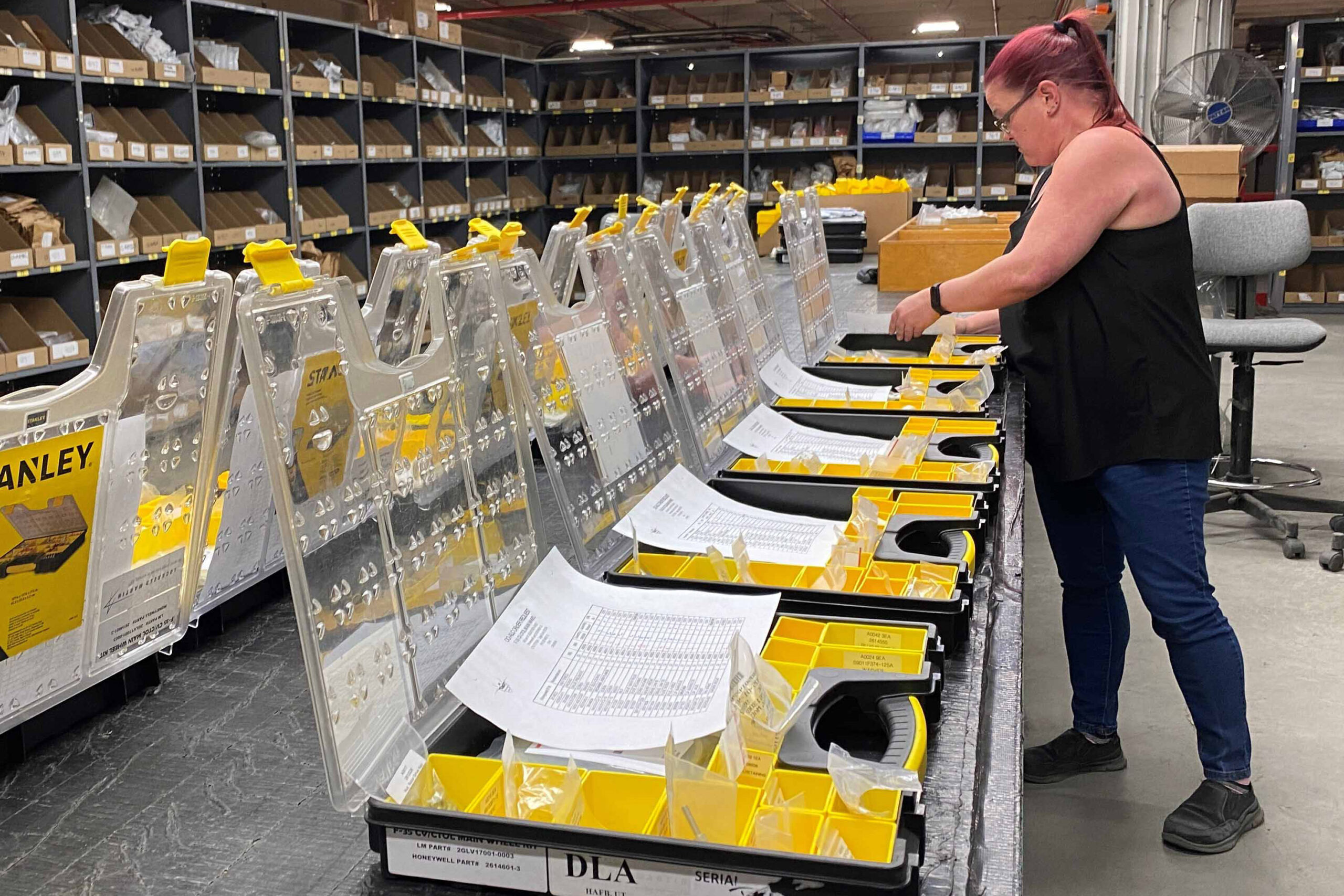
Rebuilding the Defense Industrial Base
Critics raise three key objections to American reindustrialization: We don’t have the time, the workforce, or the money.
They argue that fixing our defense manufacturing challenges alone will take years, require hundreds of thousands of workers, and cost hundreds of billions of dollars.
But that view looks at the problem from the wrong end. By revitalizing the sector most vital to our national security, the defense industrial base, we can spark positive ripple effects across the broader economy.
Before World War II, the US held 40 percent of global industrial capacity. Today, that number is just 17 percent, and China is the one with the dominant position.
To catch up, we must deploy advanced technologies and bold policies to reinvent manufacturing, starting with defense.
Build the Infrastructure for Modern Manufacturing
We need to build physical spaces for manufacturing, both large and small.
While most concerns around reindustrialization focus on massive facilities for things like semiconductors or batteries, defense manufacturing also depends on smaller, specialized operations.
These “hidden champions,” often occupying less than 50,000 square feet, can supply components and logistical support to major players like Lockheed Martin and RTX, as well as to a new generation of innovative firms.
They also serve as fast-moving labs for cutting-edge manufacturing techniques.
We must adopt advanced technologies not only to speed up production but also to accelerate innovation, including AI, robotics, digital engineering, 3D printing, and autonomous processes.

Reimagine What and How We Manufacture
Most major defense facilities are built for narrow production purposes. The future lies in flexible, diversified manufacturing, where the same machinery can produce both defense and commercial products.
In World War II, Ford’s car production lines were retooled to build bombers.
Today, companies like Divergent 3D can go from printing supercar components in the morning to munitions in the afternoon on the same equipment.
Supporting ecosystems for these smaller, adaptable firms is where the battle for manufacturing versatility will be won.
Grow a New Industrial Workforce
We need to incentivize a new generation of workers for defense and defense-adjacent industries.
A 2022 Third Way study found that barely 0.3 percent of working-age Americans were enrolled in registered apprenticeship programs. That number is five times higher in Canada, seven times higher in Germany, and twelve times higher in Switzerland.
Expanding these programs can create a talent pipeline that is engaged, skilled, and future-ready.
Universities also have a critical role to play. University-based research and development was crucial to the military-industrial complex during the Cold War and the creation of broader economic engines including Silicon Valley.
That model must be renewed, with more research flowing not just to the big prime defense contractors, but also to smaller defense tech companies.
Unlock Private Capital for National Security
Venture capital has long overlooked defense, but that is beginning to change.
If we frame defense production as a steppingstone to broader commercial success rather than the other way around, we could open the flood gate for the $1.3 trillion venture capital market into the defense and defense-related realms.
This is also a key advantage over China, where total venture capital investment in 2025 is projected to barely reach $70 billion.
High-profile investments in firms like SpaceX and Anduril are encouraging but much more needs to be done by venture capitalists.
Embrace Dual-Use Manufacturing
Finally, the Pentagon must shift away from bespoke, one-off solutions and embrace dual-use manufacturing.
In World War II, Bill Knudsen mobilized America’s auto industry to serve military needs without sacrificing efficiency or scale.
We must do the same today. This approach not only attracts private capital; it also allows the Department of Defense to tap into a wider, more capable industrial base.
By focusing on scalable, adaptable production ecosystems, we can trigger a new tech-industrial revival — one that makes America not just more secure, but more prosperous for generations to come.
 Arthur Herman is a Senior Fellow at the Civitas Institute and the author of Freedom’s Forge: How American Business Produced Victory in World War II.
 John Burer is the founder and CEO of ACMI Group and the American Center for Manufacturing & Innovation.
The views and opinions expressed here are those of the author and do not necessarily reflect the editorial position of The Defense Post.
The Defense Post aims to publish a wide range of high-quality opinion and analysis from a diverse array of people – do you want to send us yours? Click here to submit an op-ed.