S.Korea Boramae Jet Program Nears First Phase Completion With Sixth Prototype Test Flights

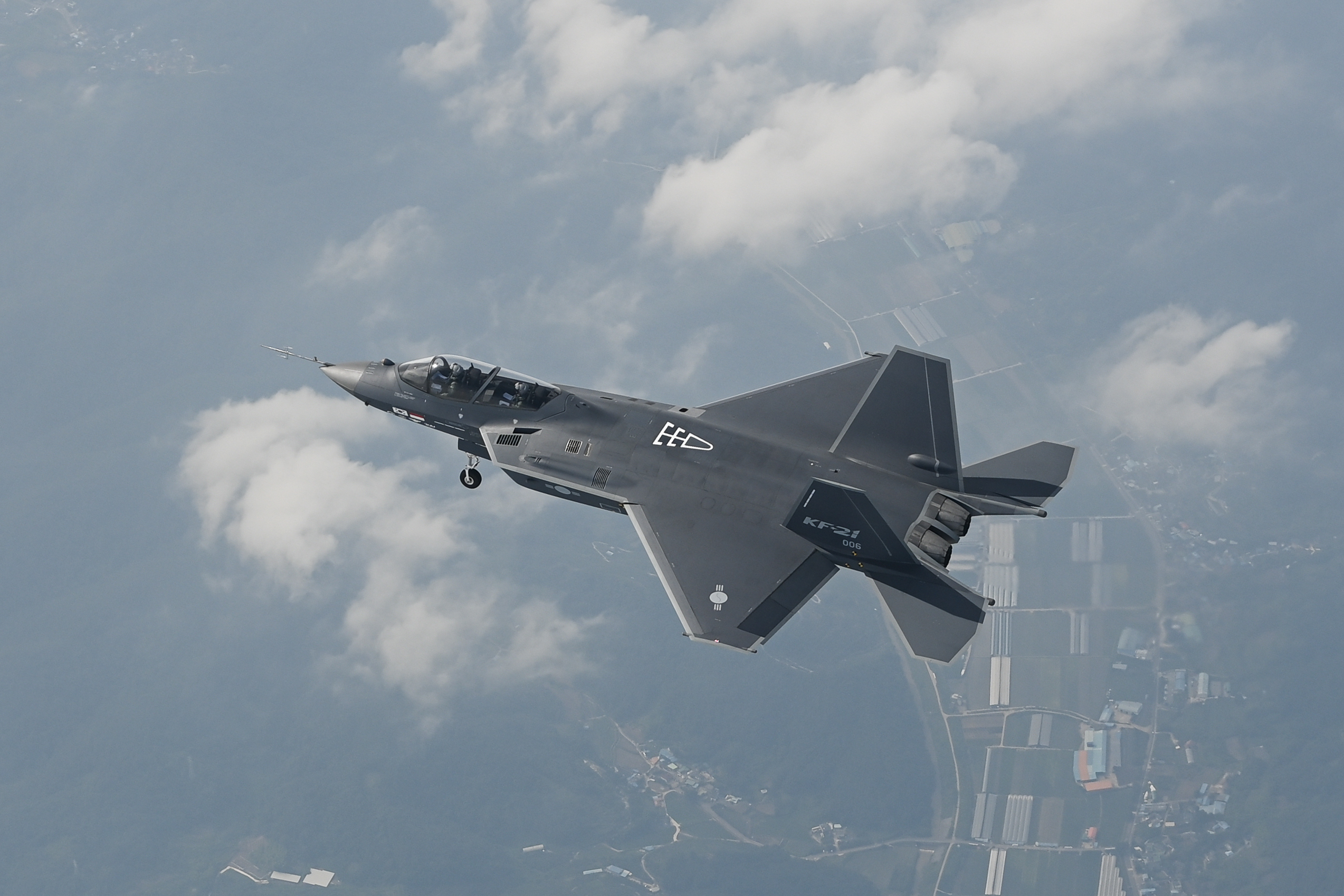
South Korea has completed critical test flights of the sixth prototype under the KF-21 Boramae fighter jet program.
The evaluations are among the last of the aircraft’s initial development phase, preparing the testbed for enhancements in early 2026.
The recent assessments were centered on combat readiness and flight control systems, Defence Blog reported, citing program officials from KF-21 lead partner Korea Aerospace Industries (KAI).
Additional sessions trialed the platform’s altitude when activating an onboard gun and its capability to stabilize under rapid-fire conditions.
While the sixth prototype was used in strike trials, developers noted its primary role is to test advanced electronic warfare systems. Other prototypes in the fleet have been assigned specific tasks, including radar integration and high-angle-of-attack recovery testing.
Weapon Tests, Operational Evaluation Next Year
KAI said that the program has logged more than 1,300 sorties, or about 70 percent of the flight tests planned for the Block 1 phase.
Other milestones include successful air-to-air missile firings of the Meteor and AIM-2000, including during supersonic flight and with external fuel tanks.
The state-owned company revealed that the Block 2 work next year will focus on precision air-to-ground strike capabilities, internal weapons bays, and improved stealth.
“From initial glide tests to complex combat scenarios, the KF-21 has demonstrated steady progress,” a KAI program engineer said.
“This puts us on schedule for the Republic of Korea Air Force’s operational evaluation early next year.”
Hundred-Plus Fleet by 2030
Seoul plans to manufacture up to 120 KF-21 Boramaes by the early 2030s, with the first batch of approximately 20 jets slated for delivery between 2026 and 2027.
Once commissioned, the indigenous plane will replace the military’s American-made F-4 and F-5 combat fleets.
Each KF-21 has a length of 17 meters (57 feet), a wingspan of 11 meters (36 feet), and a fuel capacity of 6,000 kilograms (13,228 pounds).
It is fitted with two Hanwha/General Electric F414 engines with a combined output of 110,000 horsepower for an operational range of 1,500 nautical miles (2,778 kilometers/1,726 miles), a service ceiling of 16,700 meters (54,790 feet), and a top speed of Mach 1.8 (2,223 kilometers/1,381 miles per hour).