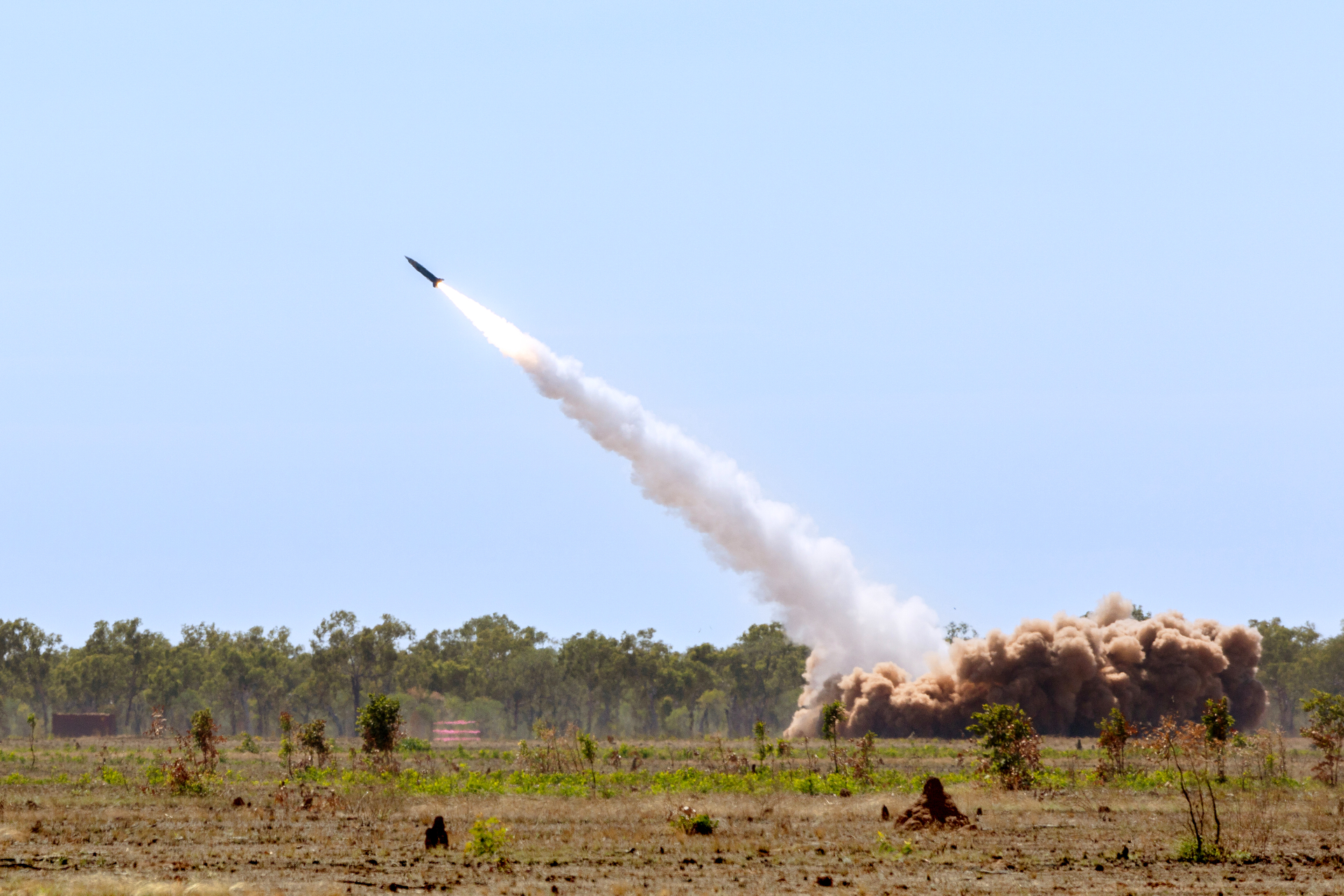
On November 17, 2024, a significant shift in geopolitical strategy unfolded as President Joe Biden authorized Ukraine to employ US-supplied Army Tactical Missile Systems (ATACMS) for strikes deep within Russian territory.
This decision marked a profound departure from previous US policy, granting Kyiv “unprecedented precision against high-value targets well behind the front lines.”
The authorization followed months of cautious hesitation and occurred amid escalating conflict dynamics, notably North Korea’s increased military support to Russia.
The policy adjustment established a precedent for the use of advanced Western weaponry on internationally recognized Russian territory, which could significantly alter future deterrence calculations.
The Army Tactical Missile System (ATACMS), often pronounced “attack-ems,” is a long-range, precision-guided ballistic missile system developed by the US and manufactured by Lockheed Martin.
Its recent deployment has solidified its reputation as a “game changer” in contemporary warfare, highlighting the pivotal role of long-range precision munitions in shaping modern conflicts.
This comprehensive guide will explore ATACMS’s origins in the Cold War, its intricate technical specifications, its transformative influence on the Ukrainian battlefield, its global proliferation and associated controversies, and finally, the advent of its planned successor, the Precision Strike Missile (PrSM).
Genesis of a Game Changer: ATACMS’s Cold War Roots
The ATACMS, officially designated MGM-140, was conceived and developed by Ling-Temco-Vought, a company later acquired by Lockheed Martin.
Its genesis is firmly rooted in the Cold War era, specifically the 1980s when the US Army sought a potent countermeasure to the Soviet Union’s formidable arsenal of long-range artillery and missile systems.
As the US Army’s inaugural long-range tactical missile, ATACMS was designed for deep interdiction, targeting high-value assets such as airfields, artillery and missile forces, logistical supply areas, and command groups.
It superseded the Lance missile, which, with a maximum conventional warhead range of merely 46 miles (74 kilometers), was primarily intended for delivering nuclear payloads.
The MGM-140A ATACMS achieved operational status in January 1991, coinciding precisely with the onset of Operation Desert Storm. Its performance during this conflict was instrumental in securing a swift victory for the US and its allies.
Reports from the time, including those by then-Army Acquisition Executive Stephen K. Conver, highlighted its deployment against a diverse array of critical targets: “surface-to-air missile sites, logistics sites, Scud [missile] positions, howitzer and rocket batteries, and tactical bridges.”
Indications suggested that ATACMS “destroyed, or rendered inoperable, all of its targets,” cementing its status as a “precious asset.”
The US military subsequently utilized hundreds of ATACMS missiles during Operation Iraqi Freedom, further demonstrating its efficacy.
Early iterations of ATACMS could engage stationary surface targets up to 100 miles (160 kilometers) away.
The subsequent generation, the Block 1A (M39A1), significantly enhanced its capabilities by incorporating GPS guidance for superior precision and extending its range to between 165 and 185 miles (20 and 300 kilometers).
Defense analysts later identified the technological advancements embodied by ATACMS as integral to the “second offset” strategy. This strategic concept posited that the combination of precision guidance and stealth technology would provide the US military with a decisive advantage, far surpassing the capabilities of its competitors.
ATACMS’ historical development and initial combat success in Desert Storm established a foundational doctrine for long-range precision strike.
The shift from the Lance missile’s limited conventional range and primary nuclear role to ATACMS’ precise conventional strike capability represented a fundamental paradigm shift in how the US Army could project power.
Its validated performance in Desert Storm underscored the immense value of investing in precision-guided munitions for conventional warfare, moving beyond the traditional reliance on overwhelming brute force.
This laid the essential groundwork for subsequent US military doctrine, which increasingly emphasized precision and standoff capabilities. The “second offset” concept, exemplified by ATACMS, illustrates how technological superiority in specific domains, such as precision guidance, can create asymmetric advantages and fundamentally reshape battlefield dynamics.
The enduring legacy of ATACMS extends beyond a single weapon system; it represents the proven efficacy of a new method of warfare, one that continues to influence global military modernization efforts, including the contemporary focus on long-range precision fires and multi-domain operations.
Precision and Power: Understanding ATACMS’ Technical Prowess
The MGM-140 Army Tactical Missile System is a supersonic tactical ballistic missile, capable of speeds exceeding Mach 3, approximately 2,300 miles (3,700 kilometers) per hour.
Its physical characteristics include a length of 13 feet (4 meters) and a diameter of 24 inches (610 millimeters), with a launch weight varying between 1,600 and 2,300 kilograms depending on the specific variant.
The missile is propelled by a single-stage, solid propellant rocket motor, a design choice that enhances its reliability and minimizes handling risks.
ATACMS follows a high-altitude ballistic trajectory, a characteristic that renders it challenging for anti-ballistic missile defenses to intercept.
After reaching the apex of its arc, the missile transitions into a controlled flight mode, guided by aerodynamic rudders that receive continuous signals from an onboard control system, ensuring precise targeting.
ATACMS missiles are launched from two highly mobile ground platforms: the tracked M270 Multiple Launch Rocket System (MLRS) and the wheeled M142 High Mobility Artillery Rocket System (HIMARS). A HIMARS launcher is capable of carrying one ATACMS missile, while the larger M270 can carry two.
Intriguingly, the launch container for ATACMS is designed to mimic the appearance of a standard MLRS rocket pod, featuring six circular patterns on its lid, a deliberate measure to obscure the type of missile loaded from enemy observation.
The guidance system employed by ATACMS is a sophisticated hybrid approach, integrating GPS (Global Positioning System) and INS (Inertial Navigation System) for unparalleled precision targeting.
The INS provides self-contained navigation through the use of accelerometers and gyroscopes, making the system inherently resistant to electronic jamming and interference. Concurrently, GPS provides highly accurate location data, continuously refining the missile’s trajectory to ensure pinpoint accuracy.
This synergistic combination results in exceptional accuracy, with a Circular Error Probable of approximately 29.5 to 32.9 feet (9 to 10 meters) or less for Block IA variants equipped with a unitary warhead.
The evolution of ATACMS warheads from predominantly cluster munitions to unitary warheads, coupled with continuous upgrades to its guidance systems, reflects a broader trend in modern warfare toward minimizing collateral damage and maximizing precision against specific, high-value targets.
Early variants, such as the M39 (Block I), were equipped with 950 M74 anti-personnel and anti-materiel bomblets, designed for area saturation over a circular area of approximately 676 feet (206 meters) in diameter.
The M39A1 (Block IA) carried a reduced load of 300 M74 bomblets, enabling extended range. While effective against area targets like airfields, ground troops, and supply depots, these cluster munitions are controversial due to their reported 2 percent failure rate for M74 bomblets, which leaves unexploded ordnance posing long-term risks to civilians.
Later variants, including the M48 (Block I/Block 1 Unitary) and M57 (TACMS 2000/T2K/Block IVA), marked a significant shift by carrying a 472 to 500 pounds (214 to 227 kilogram) WAU-23/B penetrating high-explosive blast fragmentation unitary warhead. These unitary warheads are specifically optimized for precision strikes against point targets and hardened facilities.
The M57E1 MOD represents the most recent configuration, achieved through modifying older variants by replacing their cluster munitions with unitary warheads, re-graining the propellant for enhanced performance, and upgrading the navigation and guidance systems to achieve a range of up to 186 miles (300 kilometers).
This transition signifies a doctrinal and ethical maturation in US precision strike capabilities.
While area-effect weapons retain some utility, the prevailing emphasis has shifted towards surgical strikes, reflecting a desire to manage the political fallout of civilian casualties and align with principles of international humanitarian law, even if formal adherence to treaties like the Convention on Cluster Munitions is not universal.
The continuous upgrades ensure that an aging platform remains relevant by incorporating modern accuracy standards.
This trend highlights the increasing importance of precision in modern conflicts, not only for military effectiveness but also for strategic messaging and managing international perception, albeit at a higher cost per target engaged, as precision munitions are more expensive, typically ranging from $1 million to $1.5 million per missile depending on the variant.
The ethical debate surrounding cluster munitions continues to influence policy decisions, even as their military utility in specific scenarios is acknowledged.
ATACMS Variants: Specifications at a Glance
| Variant Name | Primary Warhead Type | Number of Submunitions (if applicable) | Range (km/miles) | Guidance System | Key Features/Notes |
| M39 (Block I) | Cluster Munition (M74 APAM bomblets) | 950 | 25-165 km (15-100 mi) | Inertial Navigation System (INS) | Cold War origins, effective against area targets, 2% dud rate for M74 |
| M39A1 (Block IA) | Cluster Munition (M74 APAM bomblets) | 300 | 20-300 km (12-186 mi) | GPS-aided INS | Extended range due to lighter payload |
| M39A2 (Block II) | Brilliant Anti-Tank (BAT) Submunitions | 13 | Not specified, similar to Block IA | INS/GPS | Designed for anti-armor, enlarged warhead section |
| M48 (Block I/Block 1 Unitary) | Unitary (WAU-23/B penetrating HE blast fragmentation) | N/A | 70-300 km (43-186 mi) | GPS-aided INS | Quick Reaction Unitary (QRU) warhead, derived from Harpoon |
| M57 (TACMS 2000/T2K/Block IVA) | Unitary (WAU-23/B penetrating HE blast fragmentation) | N/A | 70-300 km (43-186 mi) | GPS-aided INS | Cost-reduced version of M48, 9m CEP |
| M57E1 MOD | Unitary (227 kg) | N/A | Up to 300 km (186 mi) | Upgraded INS/GPS | Modernized older variants, replaces cluster munitions, re-grained propellant |
The Ukrainian Front: ATACMS in Modern Conflict
The Biden administration’s authorization on November 17, 2024, for Ukraine to employ ATACMS for deep strikes into Russian territory marked a significant departure from previous US caution regarding the provision of long-range weaponry.
This policy shift was influenced by several critical factors.
Firstly, a notable escalation occurred in November 2024 with North Korea’s increased support to Russia, involving the supply of self-propelled howitzers, the deployment of approximately 11,000 troops to join Russian ground forces, the provision of technicians to study Western weapons, and the delivery of short-range ballistic weapons.
This intervention highlighted deepening ties between Vladimir Putin and Kim Jong Un.
Secondly, the authorization took place during President Biden’s “lame duck session” prior to the January 2025 inauguration of President-elect Donald Trump.
As a consistent supporter of Ukrainian defense, Biden likely sought to maximize aid and strengthen Kyiv’s position before a potential change in US policy under a new administration.
Lastly, the fall of 2024 witnessed an intensified Russian offensive, with troops advancing into the Kharkiv region, signifying a shift in Russia’s strategy towards a prolonged war of attrition.
ATACMS provided Ukraine with significantly enhanced strike capabilities, enabling it to hit targets deep behind enemy lines, up to 190 miles (300 kilometers) away, a range well beyond most conventional artillery systems.
This capability conferred a substantial strategic advantage by degrading Russian logistical support, disrupting command and control networks, and diminishing Russia’s capacity to sustain offensive operations.
Consequently, it compelled Russia to relocate critical assets further from the front lines, thereby complicating their operations and stretching vital supply lines.
Ukraine has effectively utilized ATACMS to strike key targets. These include an ammunition supply location in Russia’s Bryansk region and an ammunition depot in the Kursk region, both strikes successfully disrupting Russian supply lines.
In October 2023, ATACMS strikes on two Russian airfields in occupied territory reportedly destroyed multiple helicopters, an air control tower, and ammunition depots, severely disrupting Russian air operations.
It is important to note that ATACMS are currently used exclusively on military targets to minimize the risk of excessive civilian casualties.
Russia’s reactions to ATACMS deployment have been multifaceted. Moscow has reported destroying some missiles in the air and has retaliated with its own strikes into Ukrainian territory.
Russian officials have also issued warnings to the US against supplying additional weapons, with President Putin reportedly renewing signals about the potential use of nuclear weapons if strikes continue inside Russian territory, even lowering the legal threshold for such launches.
However, this rhetoric is largely perceived as political, as ATACMS does not pose an existential threat to Russia, thus undermining the prospects of nuclear retaliation.
In a more tangible adaptation, Russia has moved approximately 90 percent of its military aircraft, particularly fighter bombers equipped with glide bombs, away from the ATACMS strike envelope.
The introduction of ATACMS has compelled Russia to reconsider its troop deployments and command structures, forcing crucial land-based military assets to be pulled further away from battlefronts.
While Russia might increase its deployment of multi-layer air-defense systems, such as the S-400 and Pantsir-SM, to intercept ATACMS, their effectiveness remains questionable against a proliferation of threats including drones, decoys, electronic warfare, and saturation strikes.
The “shoot and scoot” capability of HIMARS launchers further complicates Russia’s efforts to neutralize them before they can fire.
The deployment of ATACMS in Ukraine has fundamentally altered Russian military doctrine and operational calculus, forcing a reactive and costly adaptation.
Historically, Russian military doctrine relied on “brute force” and “concentrated firepower.” ATACMS’s precision-strike capability directly challenges this, necessitating a “reconsideration of troop deployments and command structures.”
The subsequent redeployment of Russian assets, while an adaptation, presents “significant challenges to Russian logistics” and introduces “operational inefficiencies.”
While ATACMS has not necessarily “turned the tide of the war” due to limited numbers and Russian adaptations, it has imposed substantial costs and compelled a fundamental shift in Russian operational behavior.
This defensive and reactive shift indicates ATACMS’ success in degrading Russian operational efficiency and creating a “strategic headache” for the military.
Moscow’s declaration of a “new phase of war,” though largely political, acknowledges the strategic challenge posed by these capabilities. This dynamic illustrates the continuous “action-reaction” cycle inherent in military innovation and adaptation.
A new capability, like ATACMS, forces an adversary to expend resources and alter established doctrine, even if it does not lead to outright defeat. This highlights the importance of maintaining a technological edge and the psychological impact of long-range precision fires, which can disrupt an enemy’s confidence and planning.
However, the impact of ATACMS may be short-lived due to Ukraine’s limited stockpile, likely fewer than 50 missiles, and the potential for US policy changes. The single-missile pod configuration also restricts the volume of fire from each launcher.
Furthermore, the 186-mile (300-kilometer) range, while impressive, is insufficient to reach some of Russia’s deepest strategic targets.
Concerns also persist regarding the use of cluster munitions and the long-term risk of unexploded ordnance.
Key ATACMS Combat Deployments and Impact
| Conflict/Operation | Date of Deployment/First Use | Key Targets Engaged | Observed Impact/Effectiveness |
| Operation Desert Storm | January 1991 | Surface-to-air missile sites, logistics sites, Scud positions, howitzer and rocket batteries, tactical bridges | Crucial for quick victory; “destroyed, or rendered inoperable, all of its targets”; established long-range precision strike doctrine |
| Operation Iraqi Freedom | 2003 | High-value targets (specifics not detailed) | Hundreds deployed, demonstrating continued utility in precision strikes |
| Russia-Ukraine War | October 2023 (first reported use) / November 2024 (deep strike authorization) | Russian airfields (occupied territory), ammunition supply locations (Bryansk, Kursk regions), command posts, supply depots | Enhanced Ukrainian strike capabilities; disrupted Russian logistics and air operations; forced Russian relocation of assets; altered Russian military doctrine |
Global Reach and Strategic Considerations
Beyond the US Army and Marine Corps, ATACMS is operated by several allied nations, including Australia, Bahrain, Finland, Greece, Israel, Japan, South Korea, Romania, Turkey, Ukraine, and the United Arab Emirates.
Notably, Taiwan received its initial shipment of ATACMS in November 2024, a significant enhancement to its long-range strike capabilities amidst escalating regional tensions.
The US export policy for ATACMS incorporates strict safeguards. Missiles are frequently exported with their warhead assembly welded to prevent any modification of range or payload, ensuring compliance with the Missile Technology Control Regime (MTCR). The MTCR is an international framework designed to prevent the proliferation of missiles capable of delivering a 1,102-pound (500-kilogram) payload over a range of 186 miles (300 kilometers) or more.
A primary area of controversy surrounding ATACMS pertains to variants that carry cluster munitions.
Critics contend that these weapons violate international humanitarian law due to their inherent difficulty in precise targeting and their propensity to leave behind unexploded bomblets, which pose long-term risks to civilian populations.
The US decision to supply cluster ATACMS to Ukraine drew criticism for seemingly disregarding decades of human suffering caused by such weapons and for overlooking the international consensus, as embodied by the Convention on Cluster Munitions, which posits that there is no responsible use for them.
The selective export of ATACMS, coupled with stringent safeguards, highlights the US’ delicate balancing act between strengthening its allies and preventing proliferation.
While the US adheres to non-proliferation efforts through mechanisms like the MTCR, the deployment of cluster munitions in Ukraine, despite international condemnation, demonstrates a prioritization of immediate military effectiveness in acute conflict scenarios over adherence to certain international treaties.
This situation exemplifies the “dual-use dilemma” inherent in advanced military technology and the complex ethical dimensions of modern warfare.
It also suggests that even with stringent controls, the deployment of certain weapon types can have significant long-term humanitarian consequences, potentially undermining broader international norms and US soft power, even as it achieves short-term tactical gains.
ATACMS plays a crucial role in Anti-Access/Area Denial (A2/AD) strategies and Multi-Domain Operations. It provides essential deep-strike capabilities against high-priority targets, including enemy command and control centers, logistics hubs, and air defense systems.
The system is an effective tool for engaging targets beyond the range of traditional artillery, supporting a spectrum of operations from counter-insurgency and counter-terrorism to conventional warfare.
Its inherent mobility and flexibility make it particularly well-suited for rapid-response and expeditionary operations.
When equipped with ATACMS, HIMARS can function as a versatile multi-role platform capable of engaging both land and sea targets, offering conventional deterrence capabilities and aiding in the defeat of sophisticated A2/AD threats.
This capability aligns seamlessly with the US military’s Joint All-Domain Operations concept, which aims to integrate land, sea, and air forces to achieve dominance in contested environments.
The Next Frontier: The Precision Strike Missile (PrSM)
Despite numerous upgrades over its lifespan, ATACMS is now over 30 years old, considered bulky, and lacks the modularity demanded by contemporary operational requirements.
Its limitations, particularly in terms of range and volume of fire, have become “insufficient to meet evolving operational requirements” in the current strategic landscape.
The single-missile pod configuration of ATACMS inherently restricts the firepower that can be delivered from each launcher.
The imperative for a new solution became increasingly apparent in the “era of great power competition” with formidable adversaries such as China and Russia.
To address these shortcomings, Lockheed Martin developed the Precision Strike Missile (PrSM), a next-generation, surface-to-surface missile system specifically designed to replace ATACMS.
PrSM offers significantly enhanced capabilities. Its range substantially surpasses that of ATACMS, with Increment 1 demonstrating a threshold lethal range of 248.5 miles (400 kilometers) and achieving over 310 miles (499 kilometers) in testing.
Future increments are projected to achieve ranges exceeding 621 miles (1,000 kilometers). This extended reach brings key Russian bases in Crimea and western Russia within striking distance.
PrSM also boasts a doubled loadout capacity; its slimmer design allows two missiles to fit into a single HIMARS or MLRS pod, effectively doubling the firepower per launch compared to ATACMS’s one-missile configuration.
The missile incorporates advanced INS/GPS guidance, with Increment 2 featuring a multi-channel guidance system specifically designed for engaging moving targets, including naval vessels and high-value relocatable land targets. Increment 3 will further focus on enhanced lethality.
The extended range of PrSM provides greater standoff, thereby improving the survivability of both the crew and the launcher.
Designed with an open architecture, PrSM facilitates future upgrades and the integration of new capabilities, including the potential application of ramjet technology to achieve a 621-mile (1,000-kilometer range.
The US Army initiated the PrSM program in 2016. Initial prototype flight tests commenced in 2019. The first deliveries of Increment 1 Early Operational Capability (Inc 1 EOC) missiles began in November/December 2023, following successful production qualification testing.
Initial operational capability is anticipated in 2025.
Development for Increment 2 began in 2020, with procurement planned for fiscal year 2026 and deliveries expected in 2027.
Lockheed Martin secured a fourth production contract in March 2024, aimed at significantly increasing production capacity to meet Army demand.
When compared to rival systems such as Russia’s Iskander-M (with a range of approximately 310 miles/499 kilometers) and China’s DF-26 (estimated at around 2,500 miles/4,023 kilometers), PrSM’s initial range may appear shorter.
However, PrSM’s distinct advantage lies in its unwavering focus on precision, seamless integration with existing US platforms, and its ability to double the firepower per launch unit.
The estimated cost of a PrSM missile is approximately $3.5 million per unit.
Challenges for the program include scaling production amidst global component shortages, managing the training and logistical adjustments required for US and allied forces, and anticipating adversary development of hypersonic weapons and advanced air defenses that could challenge PrSM’s effectiveness.
The transition from ATACMS to PrSM represents a strategic imperative driven by the evolving nature of peer-to-peer competition.
This shift prioritizes not just extended range, but also increased volume of fire and multi-domain targeting capabilities. ATACMS had limitations in range and volume of fire that were deemed insufficient for contemporary operational requirements.
PrSM’s ability to fit two missiles per pod directly addresses the volume of fire limitation, enabling “more devastating salvos” that can potentially “overwhelm Russian countermeasures.”
The inclusion of anti-ship capabilities explicitly expands its utility beyond traditional land targets, aligning with the US military’s Joint All-Domain Operations concept.
This is not merely an incremental upgrade but a fundamental re-evaluation of what constitutes effective long-range precision fires in a contested environment.
The emphasis shifts from simply hitting targets to overwhelming defenses and operating across multiple domains (land, sea).
The open architecture and incremental development approach of PrSM suggest a recognition that continuous adaptation is necessary against rapidly evolving threats, including advanced air defenses and hypersonic weapons.
This development signifies a long-term US commitment to maintaining a decisive advantage in long-range precision fires, a capability crucial for deterrence and power projection against sophisticated adversaries.
ATACMS vs. PrSM: A Comparative Analysis
| Feature | ATACMS | PrSM |
| Status | In service, being phased out | Entering service, initial operational capability (IOC) anticipated 2025 |
| Manufacturer | Lockheed Martin (originally LTV) | Lockheed Martin |
| Max Range | ~300 km (190 miles) | Increment 1: 400-499+ km (250-310+ miles); Future: >1,000 km (620+ miles) |
| Missiles per Pod | 1 | 2 |
| Primary Warhead | Cluster (M74) or Unitary (WAU-23/B) | Unitary HE (Inc 1); Multi-channel guidance for moving targets (Inc 2); Enhanced lethality (Inc 3) |
| Guidance System | GPS-aided INS | INS/GPS (Inc 1); Multi-channel guidance (Inc 2) |
| Key Advantages | Proven combat record, precision strike, mobile launch platforms | Extended range, doubled firepower per launcher, anti-ship capability (Inc 2), open architecture for future growth, improved survivability |
| Key Limitations | Aging design, limited range for deep strategic targets, single missile per pod limits volume of fire, cluster munition controversy | Higher unit cost, production scaling challenges, ongoing development for full capabilities |
| Cost per Missile | ~$1.0 – $1.5 million | ~$3.5 million |
| Operational Context | Deep strike against high-value fixed targets, conventional warfare, counter-insurgency | Deep strike against fixed and moving targets (land/sea), critical for A2/AD, Multi-Domain Operations |
Legacy and Future of Long-Range Fires
ATACMS has undeniably served as a “cornerstone” of US long-range precision strike capabilities since its introduction in the 1990s.
Its recent deployment in Ukraine, particularly in 2023, truly demonstrated its “transformative potential in a contemporary conflict,” earning it the moniker of a “game changer.”
The missile proved the effectiveness of deep interdiction capabilities against high-value targets, compelling adversaries to adapt their doctrine and logistics in response.
The global security landscape is in constant flux, with long-range precision munitions becoming increasingly pivotal in modern warfare. This evolving environment necessitates continuous innovation in military capabilities.
The US Army’s Long-Range Precision Fires initiative, with the Precision Strike Missile at its core, represents a foundational element of its Multi-Domain Operations concept.
This strategy is specifically designed to counter sophisticated Anti-Access/Area Denial (A2/AD) strategies employed by peer competitors such as China and Russia.
A significant enabler for this development was the US withdrawal from the Intermediate-Range Nuclear Forces Treaty in 2019, which had previously restricted the development of ground-based missiles with ranges exceeding 312 miles (500 kilometers).
The continuous evolution from ATACMS to PrSM and beyond, including the exploration of hypersonic weapons, signifies a fundamental and accelerating arms race in long-range precision fires.
This race is driven by the imperative to overcome increasingly sophisticated A2/AD strategies and to maintain deterrence in an era of great power competition.
ATACMS faced limitations in range and volume of fire that were deemed insufficient for the demands of peer-to-peer conflict.
PrSM, with its extended range and doubled loadout, directly addresses these shortcomings.
The development of even longer-range systems, such as PrSM Increment 4 aiming for 621+ miles (1,000+ kilometers), and the pursuit of hypersonics, indicates that current capabilities are viewed as stepping stones, not an end state.
This indicates a strategic arms race focused on conventional long-range precision. The US is not merely upgrading but fundamentally reshaping its long-range strike portfolio to ensure it can penetrate and operate effectively within highly defended areas.
The emphasis on “deterrence” suggests that these weapons are as much about dissuading conflict as they are about winning it.
In conclusion, the transition from ATACMS to PrSM is a critical component of the US Army’s broader modernization efforts, aimed at equipping soldiers with cutting-edge weapon systems to address evolving threats and operational requirements.
Maintaining a credible deterrent and ensuring forces can operate effectively in increasingly complex and contested security environments necessitates a blend of rapid fielding of modified existing systems with ambitious development of next-generation weapons, including hypersonics.
The future of long-range fires will likely involve even greater precision, speed (through hypersonic capabilities), and multi-domain integration, ensuring the United States and its allies remain equipped to deter, defend, and dominate in an increasingly contested global security landscape.
The rapid pace of development in long-range precision fires will likely contribute to increased global instability as more nations seek similar capabilities, potentially lowering the threshold for conventional conflict by making deep strikes more feasible.
This also implies a continuous and significant investment in research and development and production, shaping defense budgets and industrial bases for decades to come.
The comprehensive understanding of these systems, therefore, remains a dynamic snapshot in a rapidly evolving landscape of military technology.