The US Army is preparing to field its second “Dark Eagle” battery by the fourth quarter of fiscal year 2026, according to the Government Accountability Office.
This includes the maiden flight testing of a “missile with minor modifications” in the fourth quarter of 2025.
As part of the rapid field Middle Tier Acquisition effort, this follows the first battery’s fielding by the end of this year, as revealed by a US Congressional report in February.
Formally designated as the Dark Eagle in April 2025, the hypersonic missile system is Washington’s deterrence capability against China, North Korea, and Russia’s hypersonic capabilities.
Dark Eagle
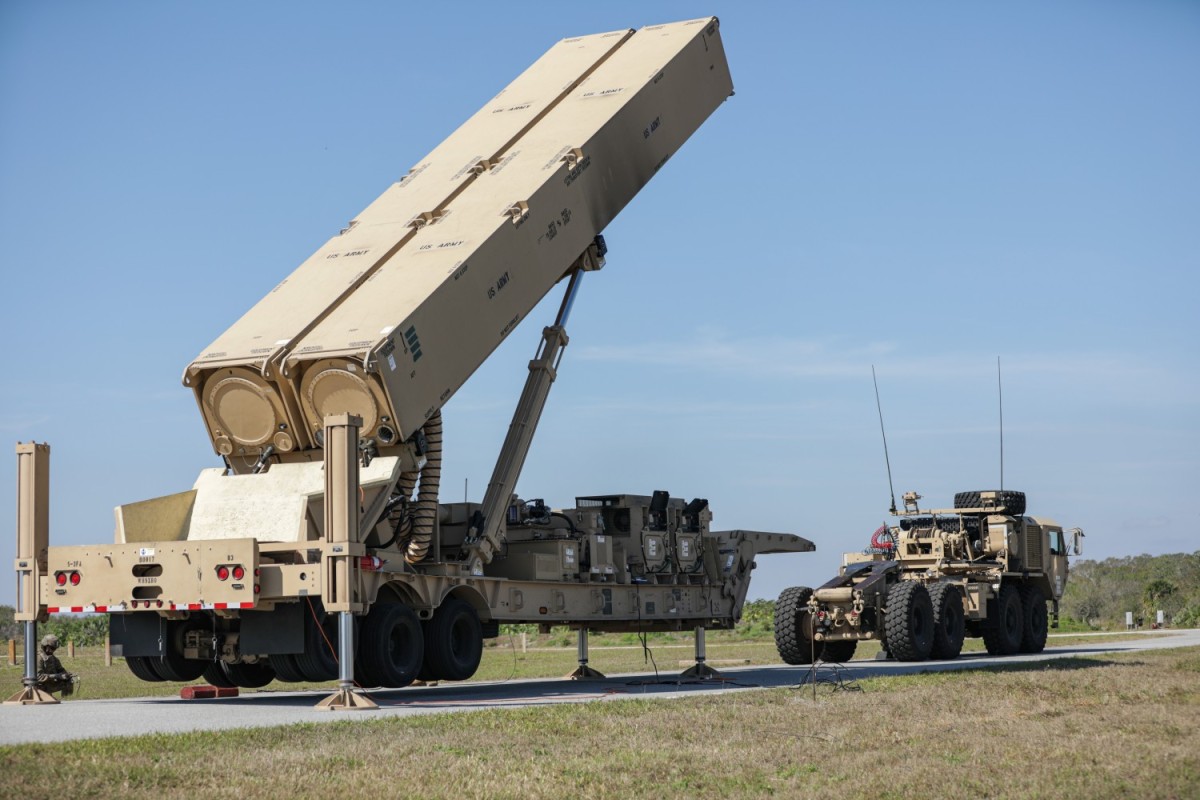
The Dark Eagle comprises a mobile ground-based battery equipped with four Transporter Erector Launchers (TEL), supported by command and control elements, with each TEL capable of launching two missiles for a total of eight.
Each hypersonic missile is powered by a solid-fueled two-stage rocket booster and carries a Common Hypersonic Glide Body (C-HGB), an unpowered but highly maneuverable vehicle.
Leidos subsidiary Dynetics and Lockheed Martin were contracted by the US Army to help build the long-range hypersonic weapon.
During the launch phase, the booster accelerates the missile to hypersonic speeds and high altitudes before releasing the C-HGB.
Then, the C-HGB begins its glide phase, traveling at a speed of Mach 5 with unpredictable flight patterns at a reported range of approximately 1,725 miles (2,776 kilometers).
This allows it to reach targets rapidly and complicate adversary response times, making it especially useful to defeat Anti-Access/Area Denial (A2/AD) strategies that may be employed against US forces.
The 5th Battalion, 3rd Field Artillery Regiment at Joint Base Lewis-McChord in Washington, part of the 1st Multi-Domain Task Force, is the first Dark Eagle battery operator.
The force is focused on integrating capabilities across all domains, with a strategic emphasis on the Indo-Pacific region.