When Cold War tensions surged, the US needed a bomber that could strike anywhere in the world, carry unprecedented payloads, and endure for decades.
Out of that need, the B‑52 Stratofortress was born — a jet-powered giant that would define strategic bombing for generations. Its combination of range, payload, and adaptability allowed it to dominate skies from Vietnam to the Middle East.
Dive in to discover how it works, its evolution, and why it remains central to the US and allied strategy today.
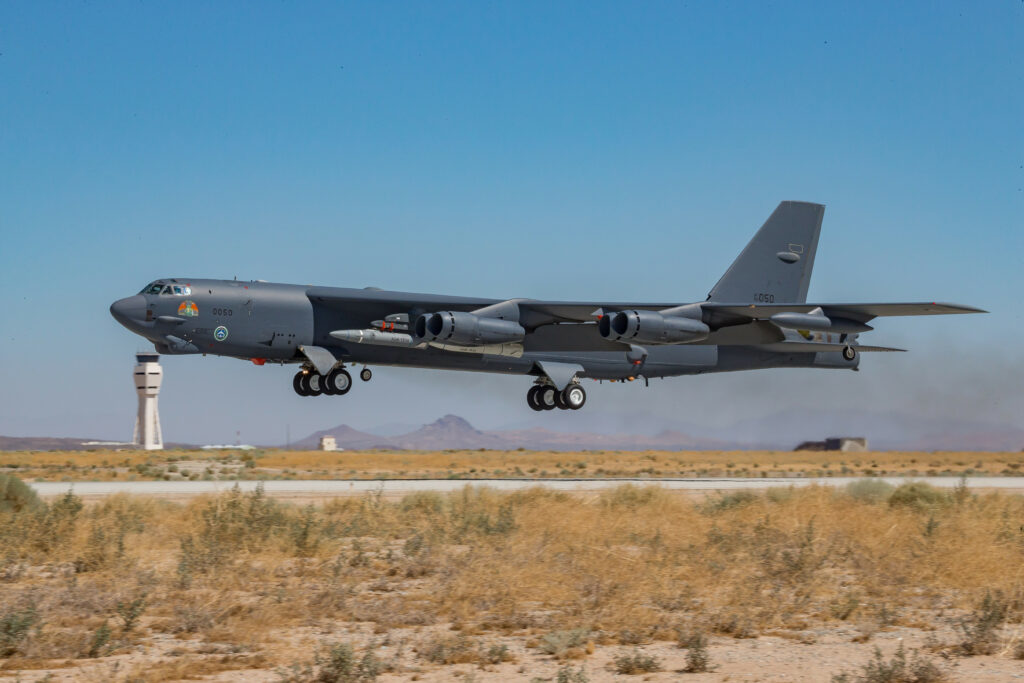
What is the B‑52 Stratofortress?
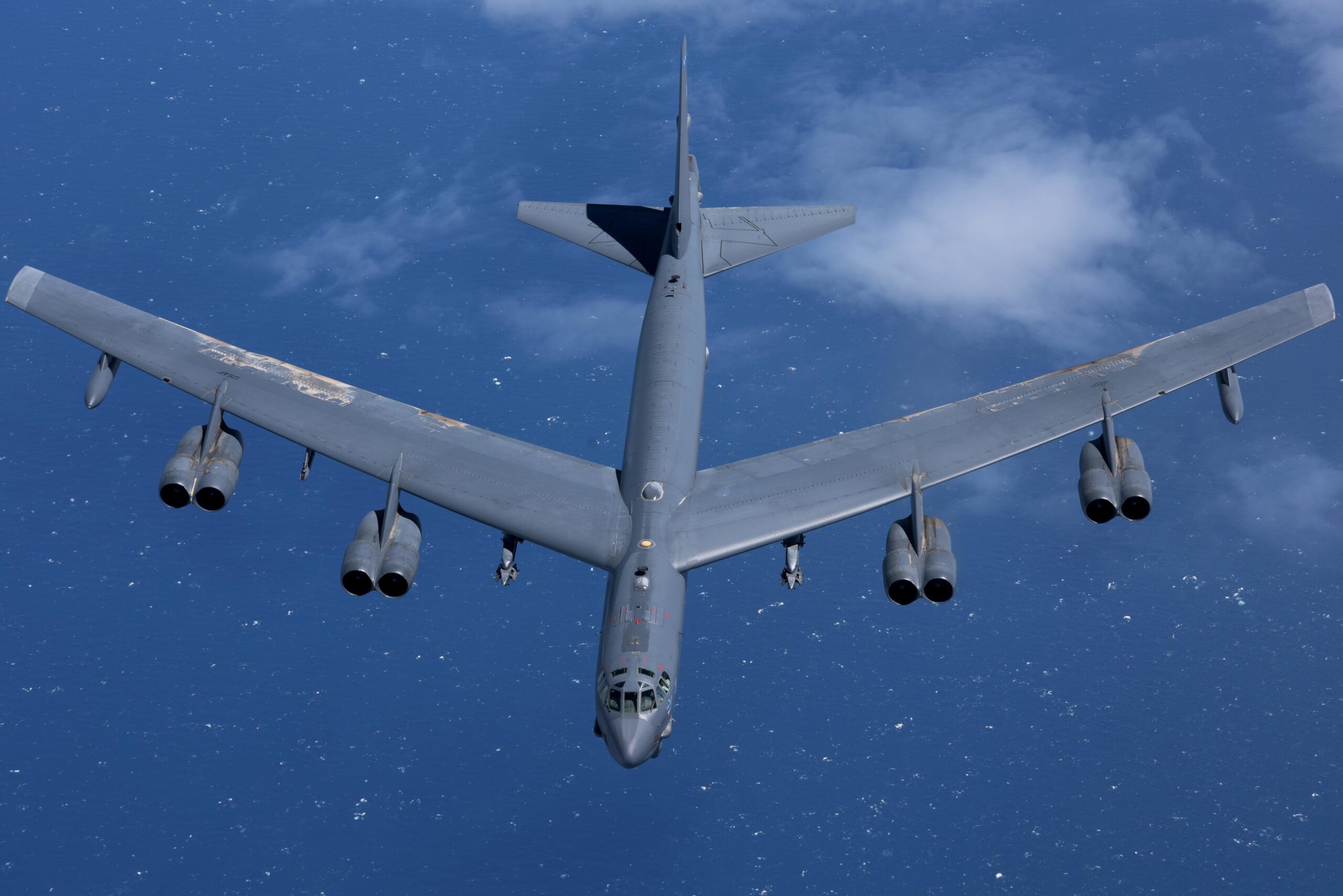
The B‑52 Stratofortress is a long-range, heavy bomber built for global strike operations.
Developed by Boeing in the 1950s, it was designed to deliver nuclear weapons deep into enemy territory — a mission that demanded unmatched range, payload, and endurance.
Over time, it adapted to conventional warfare, precision-guided munitions, and modern electronic warfare.
Capable of flying intercontinental missions with aerial refueling, the B‑52 serves as both a strategic deterrent and a flexible strike platform, bridging the gap between high-yield global reach and adaptable, modern battlefield operations.
Its airframe, engines, and mission systems have been continuously upgraded, keeping this six-decade-old aircraft relevant in a world of emerging threats.
| Category: | Details: |
| Primary Function | Heavy bomber |
| Contractor | Boeing |
| Powerplant | Eight Pratt & Whitney engines TF33-P-3/103 turbofan |
| Thrust | 17,000 pounds each engine |
| Wingspan | 185 feet (56.4 meters) |
| Length | 159.4 feet (48.5 meters) |
| Height | 40.8 feet (12.4 meters) |
| Weight/Maximum Takeoff Weight | 185,000 pounds (83,250 kilograms)/488,000 pounds (219,600 kilograms) |
| Fuel Capacity | 312,197 pounds (141,610 kilograms) |
| Payload | 70,000 pounds (31,500 kilograms) |
| Speed | Mach 0.84 (650 miles/1,046 kilometers per hour) |
| Range | 8,800 miles (14,162 kilometers) |
| Ceiling | 50,000 feet (15,151 meters) |
| Armament | Approximately 70,000 pounds (31,500 kilograms) mixed ordnance: bombs, mines and missiles |
| Unit Cost | $84 million (fiscal 2012 constant dollars) |
| Initial Operating Capability | April 1952 |
| Inventory | Active force, 58 (test, 4); ANG, 0; Reserve, 18 |
Origins of the B‑52 Stratofortress
In the late 1940s and early 1950s, the US Air Force faced a looming strategic challenge: how to deliver nuclear weapons deep into Soviet territory?
Existing bombers lacked the range, payload, and survivability required for global strike missions.
The solution was the B‑52 Stratofortress, a long-range, jet-powered bomber designed to fly higher, farther, and carry heavier payloads than any previous aircraft.
Boeing built the B‑52 and combined advanced aerodynamics, eight turbojet engines, and a robust airframe capable of supporting massive bomb loads to provide a credible nuclear deterrent while offering flexibility for conventional strike roles if needed.
The first B‑52 prototype flew in 1952, and the aircraft entered service in 1955, quickly becoming the backbone of the United States’ strategic bomber fleet.
Evolution and Variants
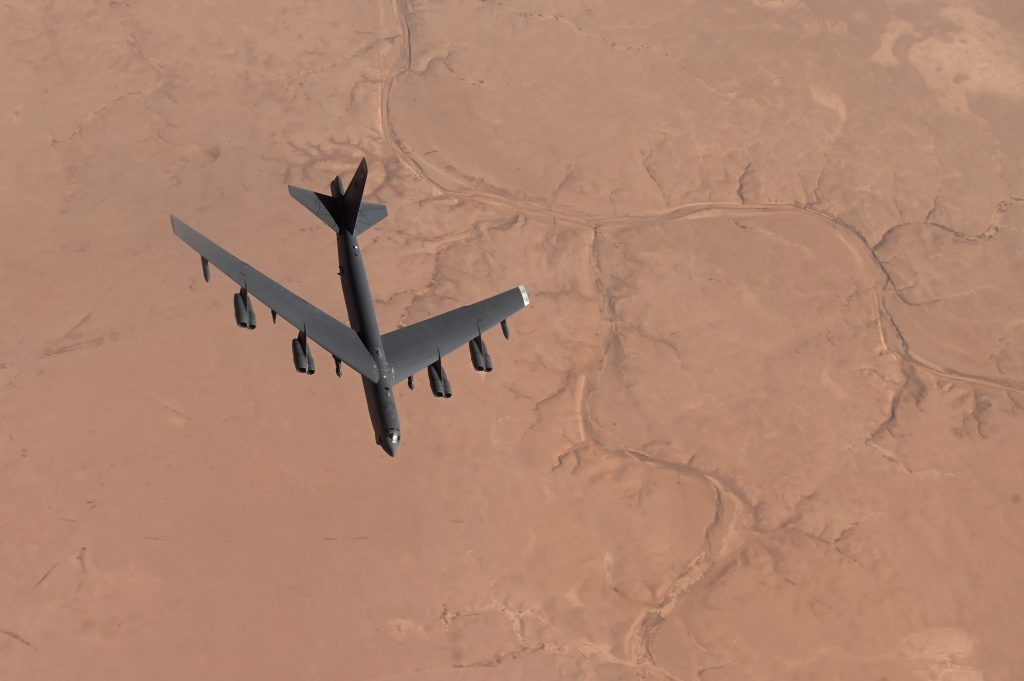
The B‑52 has undergone continuous upgrades over its decades-long service:
- B‑52A/B: Initial models, primarily experimental, with limited production.
- B‑52C/D: Expanded payload and improved avionics for Cold War nuclear missions.
- B‑52E/F: Enhanced defensive systems and fuel efficiency.
- B‑52G/H: Streamlined fuselage, modernized engines, and improved radar; the B‑52H remains the only version in service today, capable of carrying nuclear or conventional ordnance and integrating modern targeting systems.
These iterations addressed early limitations in navigation, defensive systems, and electronic warfare, ensuring the B‑52 remained relevant despite rapidly evolving threats.
| Variant | Primary Role Focus | Key Improvements | Operational Status |
| B-52A / B | Early strategic nuclear bomber | Initial production models; established baseline long-range heavy bomber configuration | Retired |
| B-52C / D | Cold War nuclear deterrence; later conventional bombing | Increased payload capacity; improved avionics; B-52D modified for conventional bombing | Retired |
| B-52E / F | Strategic nuclear strike | Enhanced defensive systems; improved navigation; fuel efficiency refinements | Retired |
| B-52G | Nuclear deterrence; later conventional missions | Shortened vertical tail; wet wing fuel tanks; structural weight reduction; improved radar and avionics | Retired |
| B-52H | Nuclear and conventional long-range strike | More efficient turbofan engines; upgraded radar; modern electronic warfare suite; compatibility with precision-guided munitions | Active |
How It Works
Key Features
- Intercontinental range: Can fly more than 8,800 miles (14,162 kilometers) without refueling, extended via aerial tankers.
- Massive payload: Carries up to 70,000 pounds (31,751 kilograms) of bombs and missiles, including nuclear weapons, cruise missiles, and precision-guided munitions.
- High-altitude performance: Operates effectively at high altitudes to avoid early-generation air defenses.
- Durable airframe: Designed for decades of operational use with extensive maintenance and upgrades.
Strengths
- Proven deterrent: Central to US nuclear strategy for over six decades.
- Flexible strike options: Capable of conventional, strategic, and precision missions globally.
- Extensive modernization: Continuous upgrades in avionics, sensors, and weapons ensure operational relevance.
Limitations
- Non-stealthy: Large radar cross-section makes it vulnerable to modern integrated air defenses.
- High operating cost: Requires significant maintenance, crew, and aerial refueling support. US Air Force details that it costs $16,000 per hour to operate.
- Aging airframe: Despite upgrades, structural fatigue and age impose operational limits.
Global Use and Operational Deployment
The B‑52 has seen action in nearly every major US conflict since the 1960s:
- Vietnam War: Carpet-bombing campaigns and conventional strike missions.
- Gulf War (1990–1991): Long-range precision strikes using conventional munitions.
- Operation Enduring Freedom and Iraqi Freedom: Precision-guided bomb delivery in counterinsurgency and conventional operations.
- Ongoing Deterrence Patrols: Global missions supporting NATO and allied operations.
Allied forces rely on B‑52s for training exercises and coalition operations, showcasing their strategic reach and credibility in joint missions.
Future Outlook
Despite being over 65 years old, the B‑52 remains a cornerstone of US strategic aviation.
Modernization programs focus on new engines, updated radars, improved cockpit, avionics, precision weapons integration, and improved communications to keep it relevant through the 2050s.
While it cannot match stealth platforms like the B‑21, its range, payload, and proven flexibility ensure the Stratofortress will continue to project American power and deterrence well into the future.