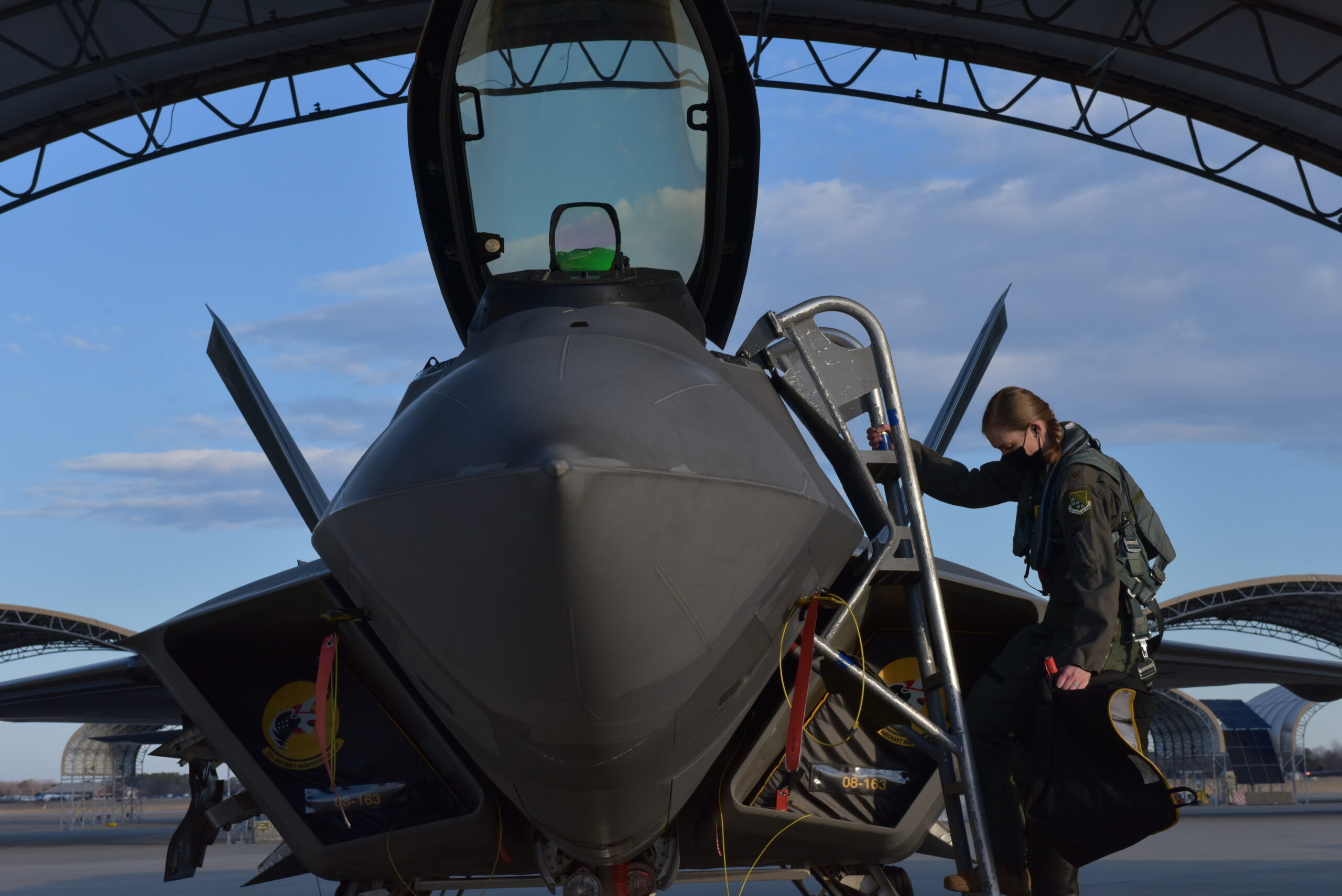
Defense Unicorns and the US Air Force Sustainment Center’s software unit have tested a new method to install and update F-22 fighter jet software.
During the demonstration, software was loaded into a specific onboard computing environment, described as an “open mission system enclave,” in just minutes.
The tool used for this, called Unicorn Delivery Service (UDS), acts as a secure platform that allows approved software to be installed onto the aircraft without modifying the entire system.
According to the company, this is a significant change from the traditional process, which typically requires long integration cycles, specialized facilities, and direct involvement from the aircraft manufacturer.
“Future wars will be won by whoever can adapt fastest,” said Rob Slaughter, co-founder and CEO of Defense Unicorns.
“This demonstration proves the US Air Force is building that advantage now.”
Accelerating Software Updates
The approach aims to change how software is managed on the F-22 by adopting practices more in line with modern IT systems.
Instead of relying on large, infrequent upgrade cycles, the model enables smaller software updates to be installed more rapidly and with greater flexibility.
If introduced into regular operations, this would allow the US Air Force to deploy new capabilities, such as mission software updates, sensor integrations, or threat-response functions.
Updates could also be applied closer to mission execution, potentially by ground crews or operators, thereby reducing dependence on centralized, time-intensive upgrade processes.
A central element of this model is a modular, standards-based software architecture.
The structure allows applications developed for the F-22’s onboard computing environment to be reused on other aircraft equipped with compatible systems.
Software can be packaged as portable payloads and transferred across platforms, including fourth-, fifth-, and potentially sixth-generation aircraft, with limited additional integration work.