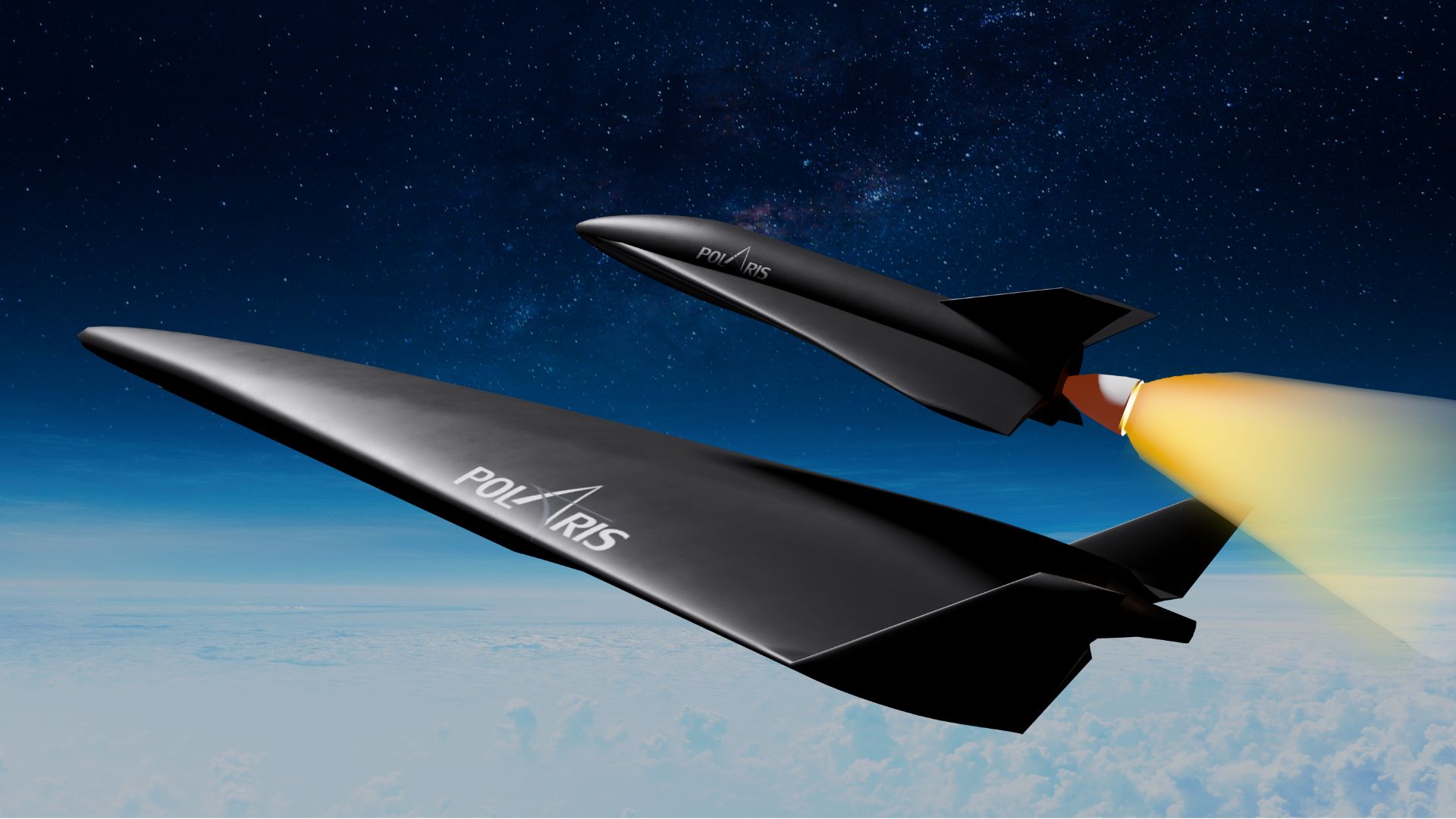
Germany has contracted Polaris Spaceplanes to develop and flight-test a two-stage reusable hypersonic test vehicle.
The platform is being built under the Hypersonic Test and Experimentation Vehicle (HYTEV) program. Its concept was developed between 2024 and 2025, with the platform scheduled to be flight-ready by the end of 2027.
HYTEV is intended to serve as a hypersonic testbed and experimental platform supporting defense-related, scientific, and institutional research. In a secondary role, the vehicle could function as a spaceplane for reconnaissance missions beyond the atmosphere.
“We are incredibly proud about the continuous trust of the Bundeswehr in our competences. As far as we know, a contract for a comparable system was never awarded before to an entity in Europe, maybe even worldwide,” Polaris Spaceplanes wrote.
“We are looking forward to an exciting and highly ambitious project.”
Two-Stage Spacecraft
The concept features horizontal takeoff and landing using a pair of turbofan engines for conventional flight and cruise. The upper stage relies exclusively on rocket propulsion, accelerating the vehicle to hypersonic speeds before stage separation.
This upper stage can be configured for either experimental payload carriage or small satellite launch operations.
Comparable in size and takeoff mass to a fighter jet, the platform is reported to offer a payload capacity of up to 1,000 kilograms (2,205 pounds) to low-Earth orbit.
Hypersonic Engine
Polaris Spaceplanes has been advancing key propulsion technologies in parallel.
In 2023, the company was contracted to develop a linear aerospike rocket engine for a spaceplane demonstrator and completed an in-flight ignition test in 2024.
The engine, designated AS-1, has since been evaluated through the company’s MIRA II and MIRA III small-scale demonstrators, which have been undergoing testing for more than a year and have achieved several milestones to date.