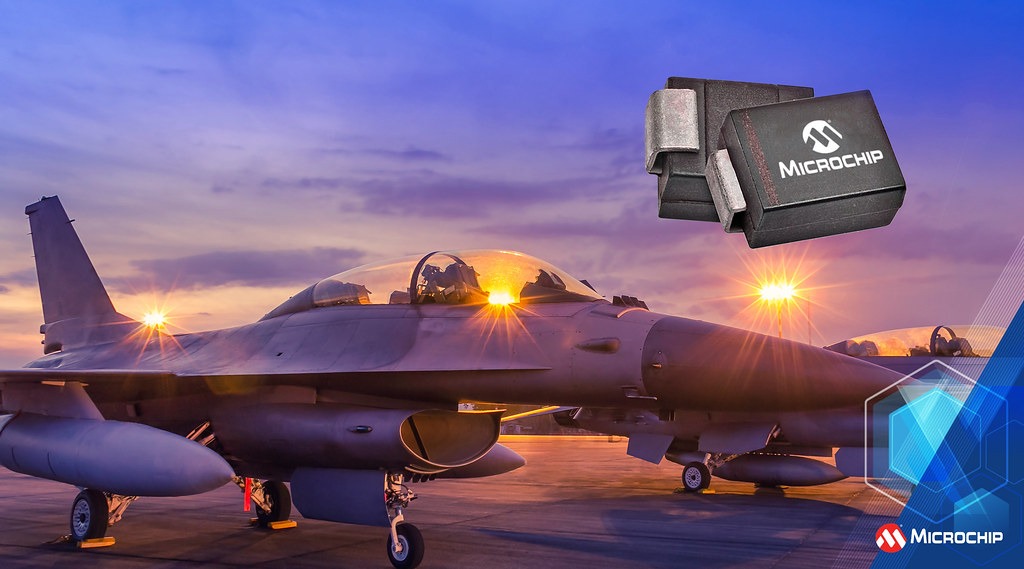
Microchip Launches Military-Qualified Plastic-Packaged Surge Protection Devices

Microchip Technology has launched a new line of military-certified surge-protection components designed to shield sensitive military and aerospace electronics from power spikes, lightning strikes, and electromagnetic interference.
The JANPTX family of transient voltage suppressor (TVS) devices absorbs sudden voltage surges before they can damage critical systems such as avionics, sensors, and communications equipment.
Unlike traditional military-grade TVS devices, typically housed in heavier hermetic metal or ceramic packages, Microchip’s new devices use plastic packaging while still meeting MIL-PRF-19500 military qualification standards.
This allows the components to reduce weight and cost while maintaining the reliability required for use in demanding defense and aerospace environments.
“By delivering the first MIL-PRF-19500 qualified plastic TVS devices, we enable engineers to achieve high reliability and performance in a lightweight, cost-effective package,” said Ronan Dillon, associate director of Microchip’s high-reliability and RF business unit.
Lightweight Surge Protection for Military Electronics
The surface-mount, unidirectional devices are designed for use across a wide range of military platforms and operate at working voltages from 5 to 175 volts.
According to Microchip, each device can suppress transient events of up to 1.5 kilowatts and respond in under 100 picoseconds, allowing it to divert damaging electrical energy almost instantaneously.
Despite their plastic construction, the devices are qualified to the MIL-PRF-19500/716 specification and designed to meet IEC standards covering electrostatic discharge, fast transients, and surge immunity.
Microchip also offers equivalent hermetic versions of the same TVS devices for applications that still require traditional packaging.
Weighing roughly 0.25 grams (0.009 ounces), the components are aimed at size-, weight-, and power-constrained platforms, including avionics, electrical subsystems, and other mission-critical electronics where reliability is essential but payload margins are limited.
The devices are available now in production quantities and are supported by SPICE models, which allow engineers to simulate a circuit’s behavior virtually rather than relying on time-consuming physical prototyping.