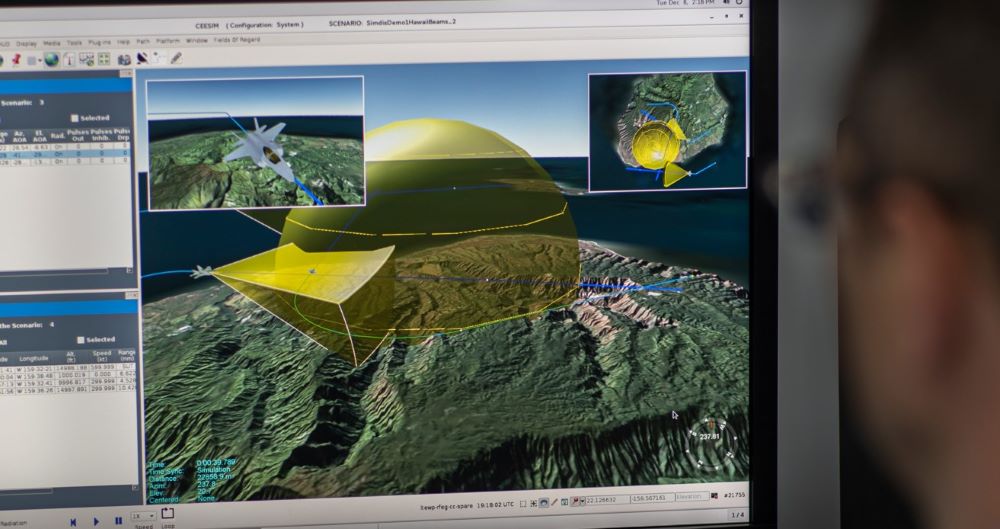
Northrop Grumman’s Combat Electronic Environment Simulator (CEESIM) has been tapped to support a new Enhanced Weapons Lab.
CEESIM will provide the lab with high-fidelity radio-frequency simulations designed to stress-test weapons, mission systems, and survivability suites under conditions that mirror real combat.
Rather than relying on open-air ranges that cannot reproduce dense threat environments, the system generates controlled, repeatable radio frequency (RF) scenarios that help engineers validate how aircraft sensors and electronic warfare processors respond to modern and emerging threats.
James Conroy, Northrop Grumman’s vice president for targeting and survivability, framed the selection as a crucial step for future survivability work. “Spectrum superiority begins in the lab with CEESIM,” he said, adding that accurate threat modeling accelerates improvements across fifth-generation platforms.
Northrop Grumman emphasized that CEESIM’s modular design — with standard and compact variants — allows customers to tailor configurations to different requirements and lab footprints.
The company has provided RF-simulation support to Lockheed Martin since the earliest phase of fifth-generation fighter development, supplying systems used by both US and international fleets.
Global Electronic Warfare Simulation Technology
Recent US efforts in electronic warfare simulation and testing have focused on creating realistic, high-fidelity environments for developing next-generation systems.
In August 2025, the Defense Advanced Research Projects Agency unveiled the Digital RF Battlespace Emulator, described as the “world’s largest real-time electronic warfare (EW) test range.”
The system can simulate complex electromagnetic environments using software-defined models and high-performance computing, allowing developers to test advanced RF and EW capabilities without relying on live ranges.
In late 2024, L3Harris demonstrated its Distributed Spectrum Collaboration and Operations EW architecture. The system collected radio frequency data and streamed it in real time for analysis, illustrating how distributed, networked EW sensors can operate together to detect and respond to threats across multiple domains.