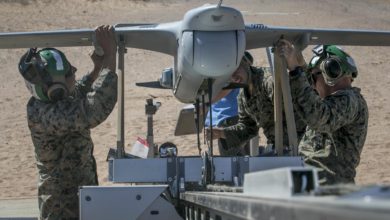
The UK Ministry of Defence’s innovation arm has launched a one-million-pound ($1.3 million) competition to spur development of autonomous sensor systems to detect and counter deception in intelligence and surveillance operations.
UK Defence Innovation — on behalf of the Defence Science and Technology Laboratory (Dstl) — has opened Phase 2 of its Themed Competition on “Autonomous Sensor Management and Sensor Counter Deception.”
Bidders are invited to propose sensor management systems capable of operating autonomously in contested environments where adversary efforts may try to hide, spoof, or confuse intelligence, surveillance, and reconnaissance (ISR) networks.
Under the terms, London will fund up to two collaborative projects — even if they didn’t take part in Phase 1 — with the goal of reaching Technology Readiness Level 6, or a system ready for demonstration in relevant environments, by project completion.
Proposals must show how their systems could integrate with existing ISR architectures via the SAPIENT standard, support open interfaces, and use real sensing networks for demonstrations.
Autonomous Sensor Management
Autonomous sensor management involves systems that can dynamically control and prioritize a network of sensors, fuse data in real time, filter out noise and deception, and present clean, actionable intelligence to decision‑makers.
As battlespaces grow more complex and contested, this type of capability is becoming a priority worldwide.
The US Air Force Research Laboratory awarded a contract to Sarcos Defense in 2022 to develop a collaborative sensing platform that uses AI to detect, track, and classify critical targets, even in adverse and contested conditions.
Meanwhile, Israel has moved swiftly toward sensor fusion on a national scale. Its airborne ISR platform Oron — flying on a Gulfstream G550 — now carries an AI‑enhanced sensor suite that consolidates radar, electro-optical, and signals intelligence feeds to provide real-time wide-area surveillance and a common operating picture for multiple services.
Closer to sensor‑management at the edge, private industry is also stepping up.
Australian firm Arkeus has developed a hyperspectral optical radar optimized for ISR from drones or manned aircraft, designed to process imagery and detect anomalies or threats in near real time, a capability useful in maritime, border security, and reconnaissance operations.