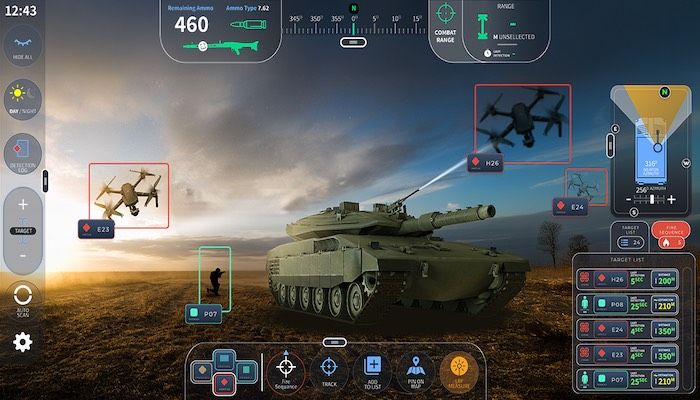
Israeli defense AI company Axon Vision has secured its first major contract for the license-based version of its EdgeUAV system
Valued at about 2 million shekels ($614,000), the deal was signed with a leading manufacturer of loitering munitions and represents a new commercial step for Axon Vision, which specializes in AI-powered situational awareness technologies.
The order follows a successful integration phase and will be fulfilled through phased software license deliveries, according to a report by The Jerusalem Post. Its completion is scheduled for January 2026.
Axon Vision said the software allows unmanned systems to autonomously detect, track, and engage targets with higher precision and reduced operator workload, reflecting an increasing demand for onboard AI in aerial warfare systems.
Inside EdgeUAV’s Growing Adoption
The EdgeUAV suite integrates real-time computer vision, neural network processing, and adaptive targeting algorithms to support autonomous flight and engagement missions.
It enables unmanned platforms to carry out entire mission sequences without continuous operator control. This reduces response time and improves precision in contested airspace.
AI integration in drone warfare has become increasingly central to Israeli defense innovation. Earlier in 2025, Rafael Advanced Defense Systems unveiled an AI-assisted version of its Spike NLOS missile, which uses image-recognition algorithms to identify and track moving targets beyond visual range.
Elbit Systems has also enhanced its SkyStriker loitering munition with autonomous navigation and target-selection features powered by onboard machine learning.
Meanwhile, Israel Aerospace Industries introduced new AI-based mission management software for its Harop and Mini-Harpy drones, allowing swarms to coordinate attacks without relying on ground-based control.
Similar developments are shaping global defense programs. The US Air Force’s Valkyrie XQ-58A drone employs onboard AI for manned-unmanned teaming, while the UK’s LANCA project is testing autonomous flight control algorithms for future loyal wingman operations.