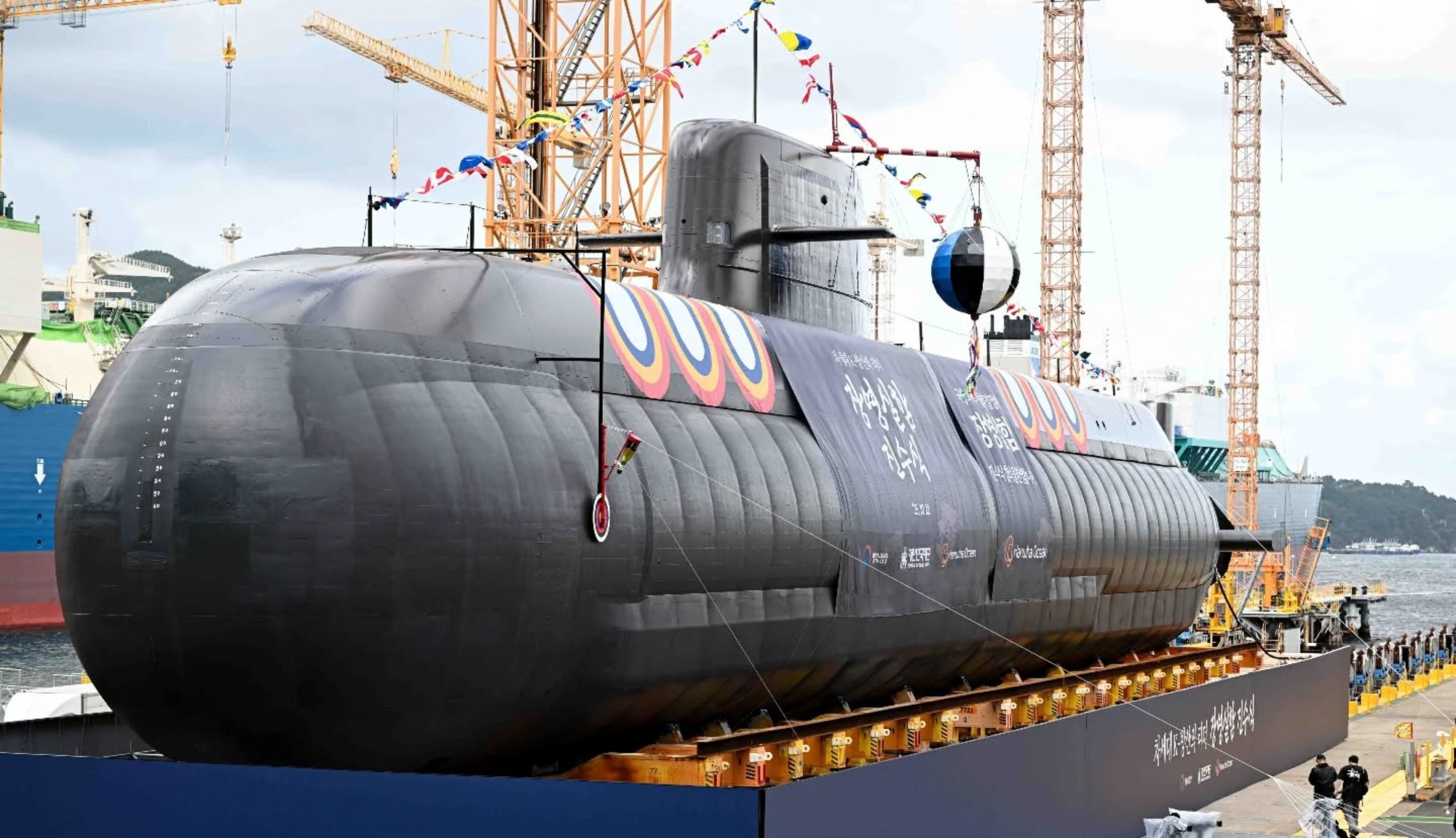
Hanwha Ocean has launched the Republic of Korea Navy’s first Dosan Ahn Chang-ho-class (KSS-III) Batch-II attack submarine, marking a milestone in the country’s push to build and operate its own advanced undersea fleet.
The ROKS Jang Yeong-sil (SS-087) was inaugurated at Hanwha’s shipyard in Geoje-si, Gyeongsang, with top military and defense officials in attendance.
Seoul said the 3,600-ton diesel-electric vessel will play a key role in strengthening the East Asian country’s defense at sea and improving its ability to handle security threats around the Korean Peninsula.
The South Korean navy plans to test and evaluate the submarine before officially adding it to the fleet in late 2027.
More Power, Stealth, and Range
The Jang Yeong-sil is larger and more advanced than earlier KSS-III Batch-I submarines, featuring lithium-ion batteries that allow longer underwater missions, higher speeds, and reduced risk of detection.
Its upgraded combat and sonar systems provide greater accuracy in tracking and engaging targets on land or at sea. An auxiliary propulsion system also enables continued maneuvering even if the main propeller fails, enhancing safety and survivability.
Moreover, the submarine incorporates noise and vibration reduction technology, improving stealth and making it more difficult for enemy forces to detect.
The Dosan Ahn Chang-ho Batch-II
The KSS-III Batch-II system, constructed entirely with locally-sourced technology and components, measures 89 meters (292 feet) long with a 10-meter (33-foot) beam.
It can reach speeds of up to 20 knots (37 kilometers/23 miles per hour) and travel around 10,000 nautical miles (18,520 kilometers/11,508 miles) without surfacing, enabling missions lasting more than 20 days underwater.
The submarine carries a crew of about 50 personnel and is armed with submarine-launched ballistic missiles and land-attack cruise missiles, giving South Korea a stronger undersea strike and deterrence capability.
Seoul currently plans to commission up to nine KSS-III vessels through the 2030s. Three units of the fleet, all under the KSS-III Batch-I, were integrated into service between 2021 and 2024.