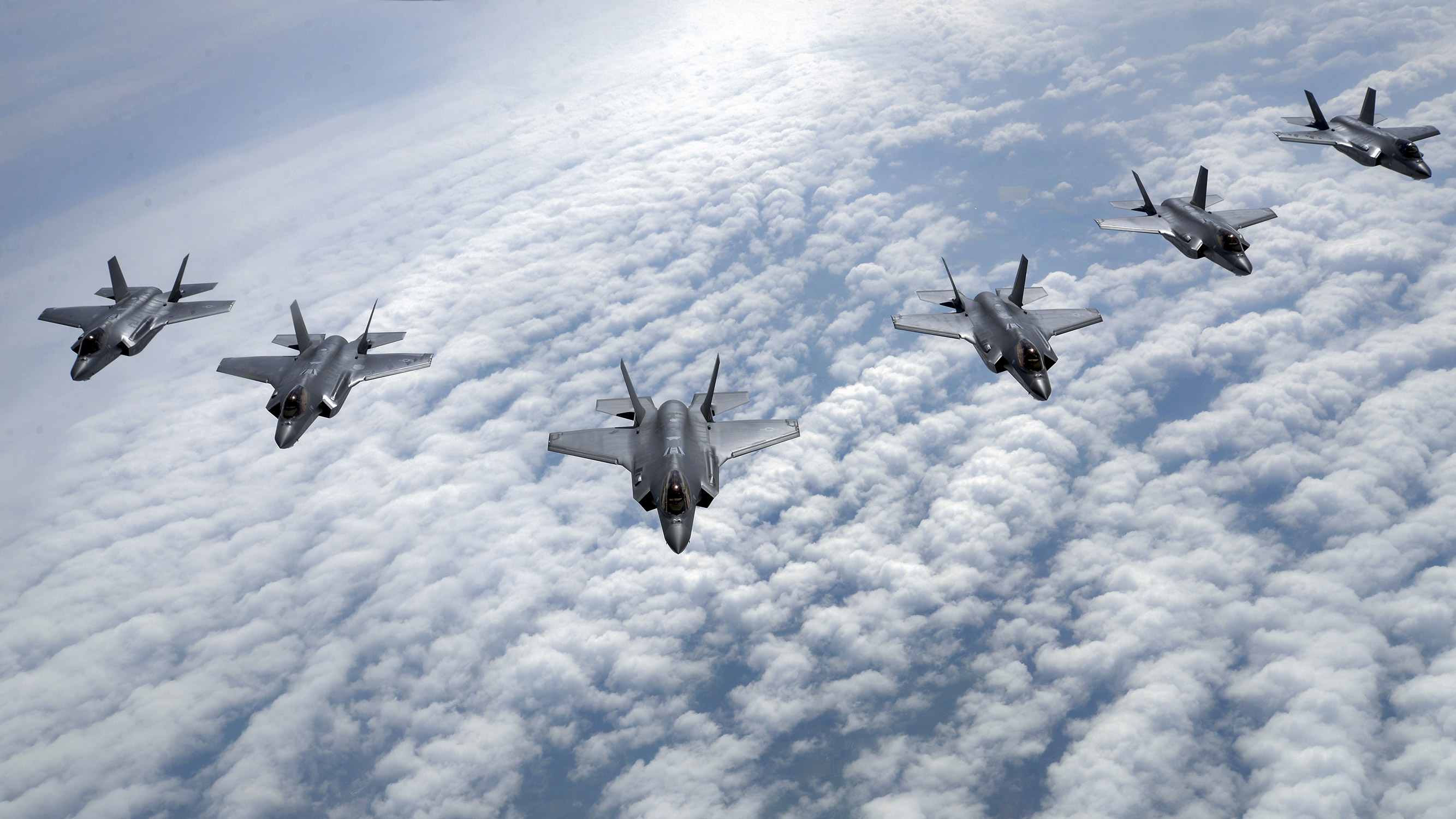
Lockheed Martin and the F-35 Joint Program Office have finalized an agreement for the production and delivery of up to 296 F-35 Lightning aircraft under lots 18 and 19.
With deliveries scheduled to begin in 2026, the order covers aircraft for US military services, international partners, and foreign military sales customers.
The new lots will add to the growing global F-35 fleet, which is operated by more than a dozen nations, including Germany, Denmark, and Poland.
F-35 Variants
The F-35 Lightning II is a multirole stealth fighter developed in several variants tailored to different operational needs.
As the conventional takeoff and landing version, the F-35A is built to operate from standard runways and is widely used by the US Air Force and international partners.
The F-35B variant features short takeoff and vertical landing capabilities, enabling it to operate from short or improvised runways, as well as from ships.
It is in service with the US Marine Corps, the UK, and Italy.
Designed for aircraft carrier operations, the F-35C version is equipped for catapult launches and arrested landings and serves exclusively with the US Navy as its first stealth fighter.
General Features
Powered by a single Pratt & Whitney F135-PW-100 turbofan engine, the F-35 Lightning II produces up to 43,000 pounds (19,500 kilograms) of thrust.
With a wingspan of 35 feet (10.7 meters), the aircraft measures 51 feet (15.7 meters) in length and 14 feet (4.3 meters) in height.
Its maximum takeoff weight is 70,000 pounds (31,750 kilograms).
The F-35 carries 18,498 pounds (8,390 kilograms) of internal fuel and can carry a payload of up to 18,000 pounds (8,160 kilograms).
It can reach speeds of up to Mach 1.6 (1,200 miles/1,930 kilometers per hour) and has a range of over 1,350 miles (2,175 kilometers) on internal fuel, with the range extending further with aerial refueling.
The aircraft is designed for single-pilot operation and can carry weapons internally or externally, depending on mission requirements.