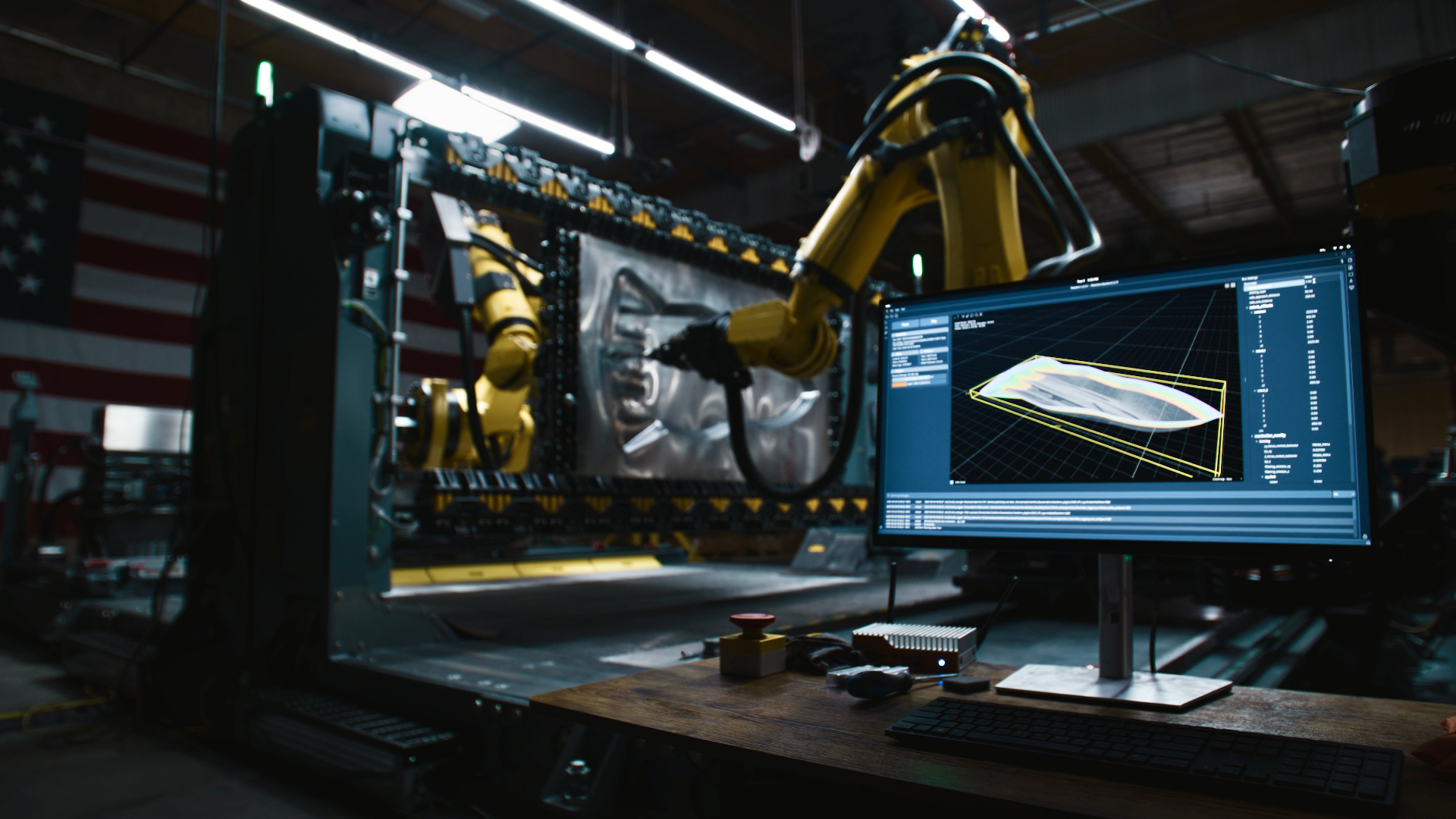
Machina Labs has received a multi-year contract from the US Air Force Research Laboratory to apply artificial intelligence (AI) in producing metal components for military aircraft.
The agreement will use the company’s proprietary RoboCraftsman, a robotic platform that combines AI and machine learning for manufacturing tasks.
The project will be facilitated in partnership with the Advanced Robotics for Manufacturing Institute, a US Department of Defense arm based in Pennsylvania.
Early work will focus on automating the process that programs machines to form and cut airframe skins and panels, which are key parts of an aircraft.
Automating this step is intended to make it faster and easier to maintain aircraft and keep them ready for missions.
Supporting Broader Sustainment Modernization Strategy
According to the California-based firm, the RoboCraftsman is positioned to serve as a flexible, mobile manufacturing system capable of producing structural parts for a wide range of defense equipment, including aircraft, missiles, vehicles, and other weapon systems, beyond its initial focus on airframe components.
“This award underscores RoboCraftsman’s role in the [Department of Defense’s] sustainment modernization strategy,” Machina Labs CEO and Co-Founder Edward Mehr stated.
“Our mission is to deliver a portable manufacturing solution that can operate closer to the point of need, even in contested logistics environments. This enables mission-critical components to be produced faster, more efficiently, and without dependency on traditional tooling.”
Machina Labs’ latest award followed its second RoboCraftsman order from the US Air Force, expanding the service’s AI-driven tools for maintenance operations.
The RoboCraftsman
Equipped with dual 7-axis robotic arms, a tool-changing system, and AI-driven process controls, the RoboCraftsman uses Machina Labs’ flagship RoboForming technology to shape large, complex components up to about 12 feet (4 meters) long and 4 feet (1 meter) deep with sub-millimeter precision.
It also integrates the company’s RoboScanning and RoboTrimming & Drilling for autonomous inspection, trimming, and drilling.
The platform handles steels, aluminum alloys, titanium alloys, and nickel-based superalloys and can be deployed in less than a day for on-site manufacturing at depots or forward locations.