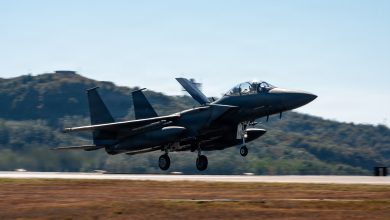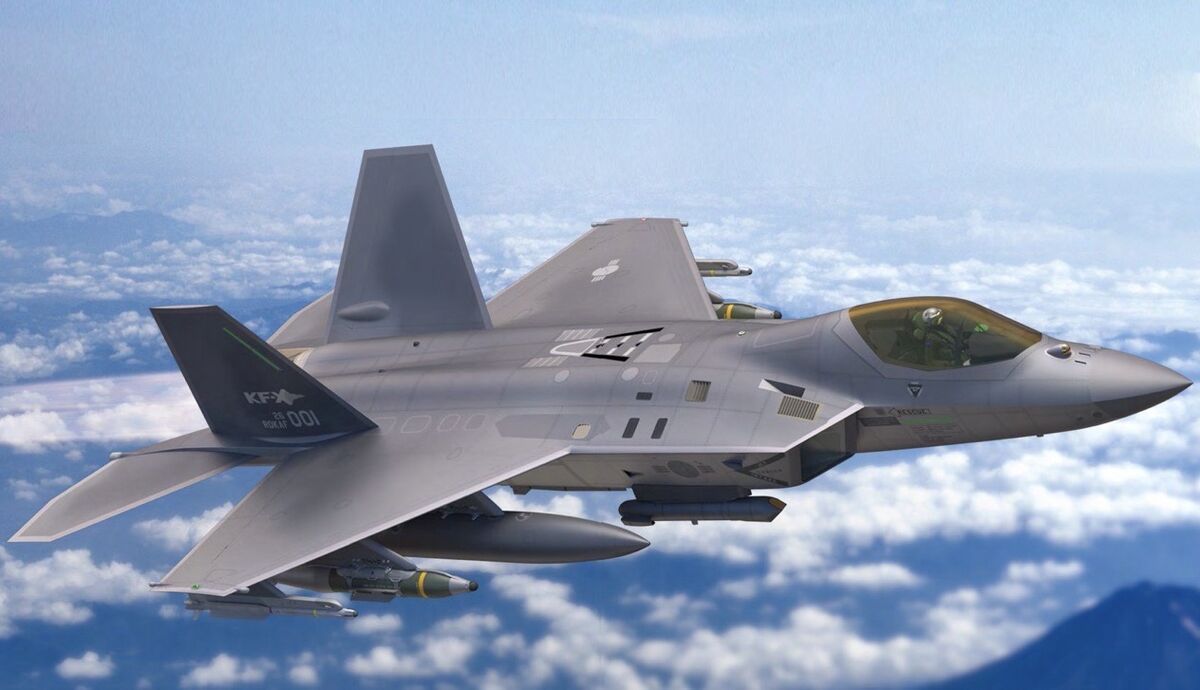
South Korea has announced a phased plan to future-proof its indigenous KF-21 Boramae fighter jet, including the integration of stealth features.
Designed from the ground up with semi-stealth characteristics, the KF-21 by Korea Aerospace Industries is expected to complete development in late 2026.
To enhance its stealth characteristics, the South Korean government plans to invest 630 billion won ($453 million) in Block III upgrades, including radar-absorbing materials and advanced sensor technologies, according to local media.
Internal Weapons Bay
The centerpiece of this enhancement, scheduled for the early 2030s, will be the internalization of the weapons bay, similar to that of the F-35.
The bay will reportedly be capable of carrying four Meteor air-to-air missiles or precision-guided bombs.
In addition, electronic-warfare sensors will be moved inside the aircraft to reduce detectability.
Balance Between Stealth and Payload
The Boramae’s inherent stealth design reportedly already provides space for an internal weapons bay, minimizing the extent of future design changes.
The aircraft was deliberately not made fully stealth-focused from the start, as this would have restricted its weapons-carrying capacity, according to Professor Chang Jo-won at Korea Aerospace University.
The KF-21 is intended to replace the aging third-generation F-4 Phantom and KF-5 fighters, while the F-35 will continue as the pinnacle of Seoul’s aerial capabilities.
“It’s inefficient for our air force to have a fleet that only consists of stealth fighters,” Korea JoongAng Daily quoted Jo-won as saying.
“Having the weapons bay inside the plane significantly limits the total number and weight of arms carried by each fighter.”
Block II Enhancements
Meanwhile, a slew of enhancements have been planned for the Block II, including an indigenous jet engine and air-to-ground attack capabilities.
To be developed for 86 billion won ($62 million), the new engine will replace the US-supplied GE F414 turbofan that powers the Block I.
The program expects the air-to-ground attack capabilities to be fully developed by early 2027.
Additional features include an Active Electronically Scanned Array radar by Hanwha Systems and loyal wingman unmanned aerial systems.