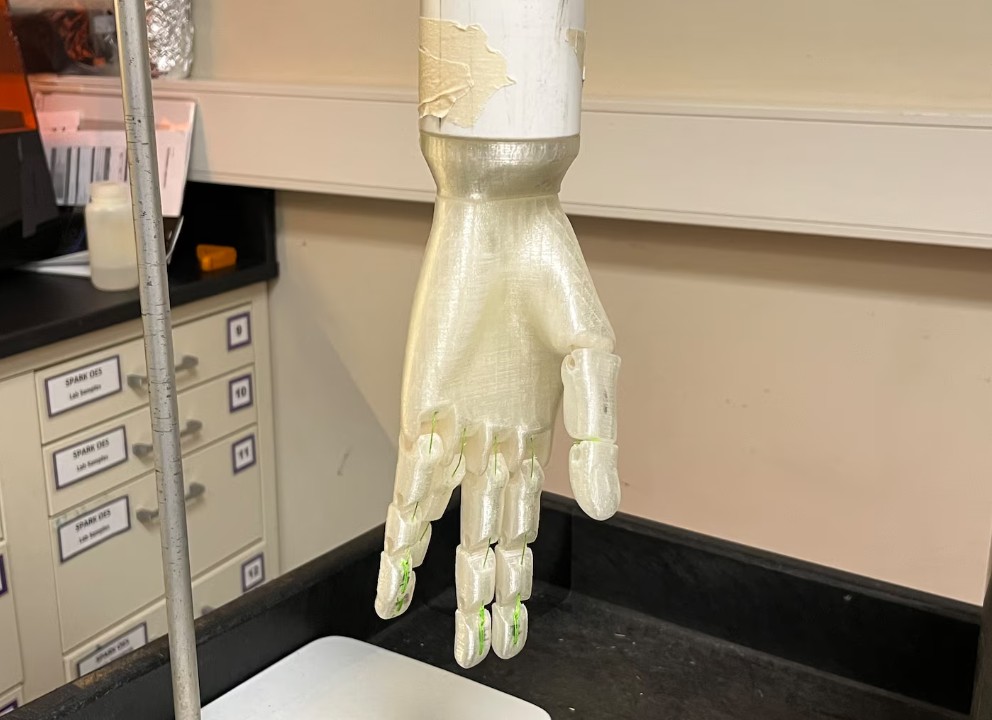
The US Defense Logistics Agency has developed a 3D-printed hand to improve glove safety for military testing.
The surrogate hand, developed by the Product Test Center Analytical, can flex its fingers and withstand hazardous materials, enabling researchers to evaluate protective gloves without exposing personnel to risks such as contact with jet fuel.
Previously, glove tests required human participation, with defective gloves resulting in direct exposure and contamination.
The 3D model eliminates this hazard, reduces decontamination time, and allows for scaling to different glove sizes and finger lengths, enabling more accurate assessments.
The team has completed initial trials and plans additional testing to expand applications across other protective equipment.
Developing 3D Printing Technology
Washington is pushing 3D-printing innovations aimed at safeguarding troops and improving combat readiness.
In June, the US Army partnered with the University of Hawaii to develop lab-grown tissues and organ-on-a-chip systems.
The collaboration aims to take bioprinting out of the lab and into the field, where 3D-printed skin and other tissue models could provide rapid treatment in remote and high-risk zones.
Researchers say the technology not only helps understand how the body responds to chemical and biological exposure but could also pave the way for deployable, life-saving tools.
Meanwhile, at Rock Island Arsenal Joint Manufacturing and Technology Center, efforts are underway to expand production of 3D-printed drones for the US Army.
The program places new systems directly into operational environments for field testing, with feedback from soldiers shaping technical requirements and future production.