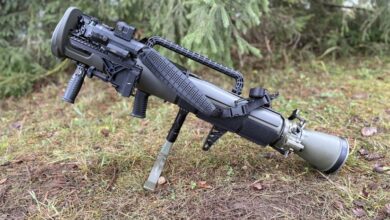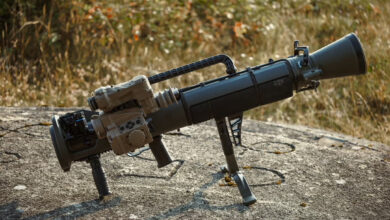
The Goose is Loose: Ultimate Guide to the Carl Gustaf, the Infantry’s Multi-Tool of Destruction

It was 2013 in northern Afghanistan, and the night was alive with the tension of an imminent mission.
For the men of the 3rd Ranger Battalion, the objective was a Taliban commander hiding in a valley village. The terrain was unforgiving.
Moving on foot, the Rangers reached a wadi, a treacherous gap they had to jump, as local bridges were likely booby-trapped.
For Sergeant Wayne Capacillo, laden with an M4 rifle, a full combat load, and a 20-pound Carl Gustaf 84mm recoilless rifle on his back, the leap was a calculated risk.
He cleared the gap, but as he landed, the heavy weapon tube swung forward, striking the back of his helmet with a loud “ping” that rattled his skull and sent him face-first into the dirt.
This jarring moment encapsulates the physical reality of the Carl Gustaf — a powerful but cumbersome burden that demands strength and resilience from the soldier who wields it.
Nearly a decade later and thousands of miles away, the same weapon system demonstrated its enduring strategic relevance in a vastly different conflict.
In the opening months of Russia’s 2022 invasion of Ukraine, Ukrainian forces used a Carl Gustaf to destroy a T-90M, Russia’s most advanced operational main battle tank.
This single event, contrasting sharply with the gritty counter-insurgency slog in Afghanistan, proved the weapon’s lethal effectiveness against near-peer adversaries and modern armor.
From the mountains of the Hindu Kush to the fields of the Donbas, the Carl Gustaf — known affectionately and irreverently by troops as the “Gus,” “Goose,” “Charlie G,” or “Charlie Swede” — has carved out a legendary, 75-year history on the battlefield.
Its longevity is no accident. It is a masterclass in evolutionary design, a fundamentally simple and robust platform that has remained at the apex of infantry firepower by consistently adapting to new threats through a continuously expanding arsenal of advanced ammunition and technology.
More than just a weapon, the Carl Gustaf is the infantry’s indispensable multi-tool of destruction.
Forged in Neutrality: The Genesis of a Giant Killer
The story of the Carl Gustaf begins in the strategic context of post-World War II Sweden.
A neutral power, Sweden had carefully observed the conflict and noted the profound impact of man-portable anti-tank weapons like the American M1 Bazooka and the German Panzerschreck.
These “stovepipe” launchers gave individual infantrymen the power to destroy tanks, fundamentally altering battlefield dynamics.
For a nation committed to self-defense, developing a domestic equivalent was a strategic imperative.
Sweden’s first attempt, however, was a cautionary tale. The Carl Gustaf 20mm Pansarvärnsgevär m/42 (pvg m/42) was the world’s first shoulder-fired recoilless weapon, but it was a flawed concept.
It was designed as an anti-tank rifle, firing a high-velocity, 20mm solid steel projectile. This approach was already obsolete upon its introduction in 1942.
The weapon’s projectile could only penetrate around 40mm of Rolled Homogeneous Armor, rendering it ineffective against the rapidly improving armor of late-war tanks like the German Panther and Soviet T-34.
Plagued with defects and insufficient power, only about 1,000 were ever produced, primarily for training purposes.
This failure provided the critical lesson that shaped what came next. The problem was not the recoilless principle but the kill mechanism. A small, solid shot could no longer do the job.
Designers Hugo Abramson and Harald Jentzen, at the state-run Carl Gustafs Stads Gevärsfaktori, pivoted from the anti-tank rifle concept to what was effectively a man-portable cannon.
They scaled up the caliber to 84mm, which was large enough to accommodate a powerful shaped-charge warhead, known as a High-Explosive Anti-Tank round.
This was the same chemical energy principle that made the Bazooka so deadly.
The weapon worked by venting a precise portion of the propellant gases out of the rear of the tube through a cone-shaped Venturi nozzle.
This created a counter-thrust that almost perfectly balanced the forward momentum of the projectile, eliminating the violent recoil that would otherwise make such a powerful weapon impossible for a person to fire from the shoulder.
The result, introduced in 1946 and adopted by the Swedish Army in 1948, was the 8,4 cm Granatgevär m/48 (Grg m/48), or “Grenade Rifle, model 1948.”
The M1 Carl Gustaf was born. It combined the accuracy of a rifled barrel with the destructive power of a light artillery piece, all in a package a soldier could carry into battle.
The Evolution of an Icon: From M1 to M4
The Carl Gustaf’s history is one of continuous, user-driven improvement. Each successive generation of the launcher has become lighter, more ergonomic, and more capable, directly addressing the physical and tactical challenges faced by soldiers in the field.
This evolutionary path demonstrates a remarkable feedback loop between the warfighter and the weapon’s designers.
The M1 (m/48): The Original (1948)
The first model, the Grg m/48, entered Swedish service in 1948 and established the core principles of the system.
It saw its first major combat deployment with Swedish soldiers serving as UN peacekeepers during the Congo Crisis of the early 1960s. It was here that the weapon proved its ruggedness and versatility.
In a famed incident on September 14, 1961, Swedish soldier Torsten Stålnacke‘s two squadmates were incapacitated during an attack.
Alone, Stålnacke advanced, operating the M1 by himself to destroy an enemy armored car and several enemy positions before taking a round that shattered his jaw.
Despite his horrific injury, he managed to clear his own airway and guide his shocked comrades to safety, all while still carrying the weapon.
This incredible feat cemented the Gustaf’s reputation for battlefield reliability.
The M2 (1964): The Export Workhorse
Introduced in 1964, the M2 was an improved and reinforced export version designed to withstand the higher pressures and temperatures of more powerful ammunition types.
Made entirely of steel, it was a heavy but durable weapon, weighing 14.2 kilograms (31 pounds) and measuring 1,130 milimeters (44.4 inches) in length.
The M2 became the global standard for decades. It was adopted by the British Army in 1962 as the L14A1, where it earned the nickname “Charlie G,” and was used with distinction in the 1982 Falklands War to neutralize the Argentine corvette ARA Guerrico and destroy heavily fortified Argentine bunkers.
Numerous other NATO and allied forces, including the Netherlands, also adopted it as their primary infantry anti-armor weapon.
The M3 (m/86 / 1991): The Lightweight Revolution
The weight of the M2 was its primary drawback. For dismounted infantry, every kilogram matters. Development in the 1980s focused on a radical solution.
Introduced in 1991, the M3 replaced the heavy forged steel tube with a revolutionary composite barrel: a thin, rifled steel liner wrapped in a carbon fiber outer sleeve. Other external steel parts were replaced with lightweight aluminum alloys and plastics.
This innovation slashed the weapon’s weight to approximately 10 kilograms (22 pounds) and shortened its length slightly to 1,065 millimeters (42 inches). This dramatic weight reduction made it an ideal weapon for highly mobile special operations forces.
The US Army’s 75th Ranger Regiment adopted it in 1988 as the Ranger Anti-Armor/Anti-Personnel Weapon System (RAAWS).
Soon after, it spread to US Army Special Forces and Navy SEALs, where it became known as the M3 Multi-Role Anti-Armor/Anti-Personnel Weapon System (MAAWS).
The M4 (M3E1 / 2014): The Smart, Agile Successor
Unveiled in 2014, the M4 represents the current pinnacle of the Gustaf’s design, a direct response to feedback from troops fighting in complex urban environments.
The primary goal was to make the weapon even lighter and more user-friendly. Weight was further reduced by using a titanium liner inside the carbon fiber wrap and redesigning the Venturi recoil damper.
The result was a weapon weighing less than 7 kilograms (15 pounds) and measuring under 1,000 millimeters (39 inches) in length, making it significantly more agile in the tight confines of urban warfare.
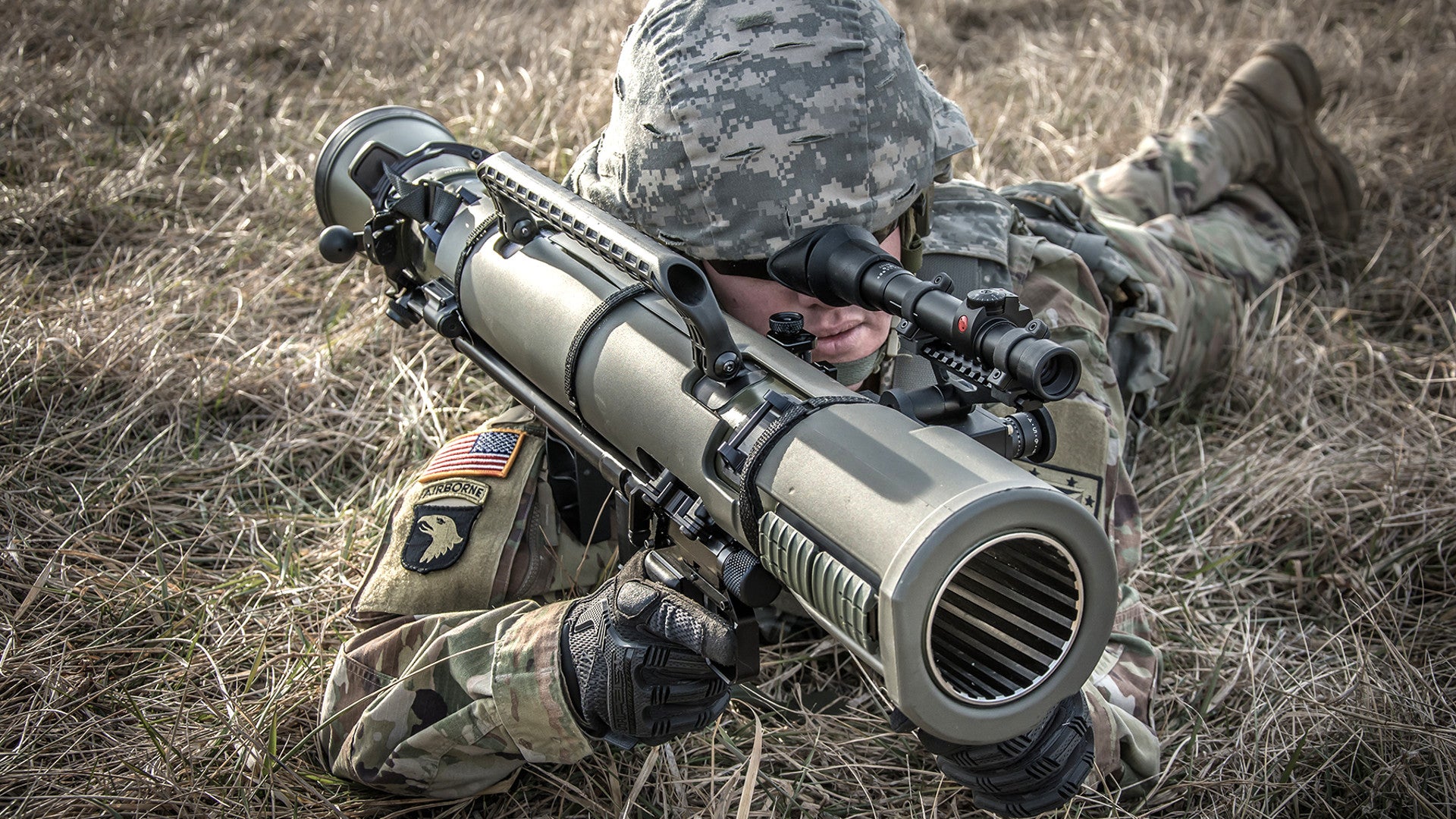
The M4 is not just lighter; it is smarter and more ergonomic. Responding to user feedback, designers enlarged the carrying handle’s aperture to better accommodate winter gloves and shaped it to be passed seamlessly between two soldiers.
It features adjustable shoulder rests and forward grips on Picatinny rails, allowing soldiers to customize the fit.
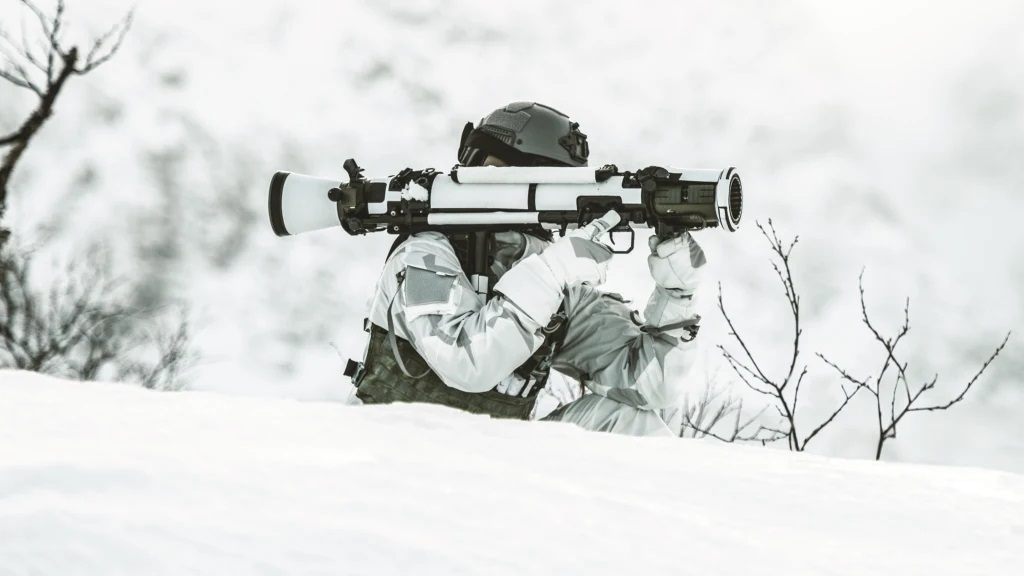
Most importantly, the M4 introduced a suite of “smart” features.
A “carry loaded” safety catch allows for faster reaction times. An integrated shot counter tracks barrel life to aid in maintenance. And a built-in communications interface allows the weapon to link with advanced Fire Control Devices and program the fuses of next-generation ammunition, transforming a direct-fire weapon into a precision instrument.
In US service, this variant is designated the M3E1 MAAWS.
Variant |
Year Introduced |
Weight (empty) |
Length |
Barrel/Body Materials |
Key Features & Innovations |
| M1 | 1948 | N/A | N/A | Steel | Original 84mm recoilless design with rifled barrel. |
| M2 | 1964 | 14.2 kg | 1,130 mm | Steel | Reinforced export version; became the global standard for decades. |
| M3 | 1991 | 10 kg | 1,065 mm | Carbon fiber-wrapped steel liner, aluminum alloys, plastics | Revolutionary weight reduction; adopted by special operations forces. |
| M4 | 2014 | < 7 kg | < 1,000 mm | Carbon fiber-wrapped titanium liner, redesigned components | Further weight reduction, improved ergonomics, “smart” features (shot counter, programmable ammo interface). |
The Kingmaker: A Universe of Ammunition
The true genius and enduring relevance of the Carl Gustaf system is not the launcher itself, but its vast and ever-expanding suite of 84mm ammunition. The launcher is merely the key; the ammunition is the toolkit.
A critical design philosophy from the outset was ensuring that all ammunition types are backward-compatible, meaning a modern round can be fired from a vintage launcher. This gives commanders unparalleled tactical flexibility, allowing a single weapon system to address nearly any threat on the battlefield.
The ammunition portfolio can be broken down by tactical function:
Anti-Armor
These rounds are designed to defeat armored vehicles.
- HEAT 551 / 551C RS: The workhorse anti-tank round. It is a Rocket-Assisted Projectile, meaning a small rocket motor ignites after the round leaves the barrel, extending its effective range to around 700 meters (2,296 feet). It can penetrate approximately 400mm of RHA.
- HEAT 751: A specialized round featuring a tandem warhead. A small initial charge defeats Explosive Reactive Armor (ERA) bricks, clearing the way for the main shaped charge to penetrate the vehicle’s primary armor. It is effective to 500 meters (1,640 feet) and can penetrate over 500mm of RHA behind ERA.
- HEAT 655 CS: A “Confined Space” round that uses a saltwater counter-mass instead of pure gas to mitigate the violent backblast. This allows the weapon to be fired more safely from within buildings and enclosures, a critical capability for urban combat.
Multi-Role / Anti-Structure
These rounds are optimized for destroying fortifications and enemy positions.
- HEDP 502: A High-Explosive Dual-Purpose round, the system’s jack-of-all-trades. It is effective against light armor, bunkers, and structures made of brick or wood. It features a fuse that can be set for instant detonation on impact or with a slight delay to penetrate a wall before exploding inside.
- ASM 509: A dedicated Anti-Structure Munition, designed specifically to breach buildings and fortifications.
- MT 756: The Multi-Target round uses a tandem charge designed to incapacitate enemies inside fortified positions.
Anti-Personnel
Designed to engage enemy troops in the open.
- HE 441D: A High-Explosive fragmentation round effective out to 1,100 meters (3,609 feet). Its ability to be set for airburst — detonating above a target — allows it to engage troops in trenches or behind cover, giving infantry squads a capability often described as “portable artillery.”
- ADM 401: The Area Defence Munition is effectively a massive shotgun shell. It fires 1,100 tiny, needle-like flechettes in a wide cone, designed to defend against massed infantry charges at close range (approximately 100 meters/328 feet).
Support
These rounds provide non-lethal tactical effects.
- SMOKE 469C: Lays down a smoke screen to obscure enemy vision or mark targets at ranges up to 1,300 meters (4,265 feet).
- ILLUM 545C: An illumination round that deploys a parachute flare. It can light up a 400-500 meter (1,312-1,640 feet) diameter area for 30 seconds, with a maximum range of 2,300 meters (7,546 feet), turning night into day for tactical operations.
The Next Generation: Guided and Programmable
- HE 448: This new programmable HE round represents a leap in capability. It communicates with the M4 launcher’s Fire Control Device (FCD 558) via a protocol called “Firebolt.” The gunner designates the target with a laser rangefinder, and the FCD automatically calculates the firing solution — factoring in range, ammunition type, propellant temperature, and air pressure — and wirelessly programs the round’s fuse for a precise airburst up to 1,500 meters (4,921 feet). This dramatically increases first-round hit probability and reduces the cognitive load on the gunner.
- Guided Multipurpose Munition (GMM): In a joint project, Saab and Raytheon are developing a laser-guided projectile for the Gustaf. This will transform it into a true precision-guided weapon, capable of hitting stationary and moving targets at ranges of 2,500 meters (8,202 feet) or more, far beyond the reach of its unguided counterparts.
Designation |
Tactical Role |
Key Features |
Effective Range |
|
HEAT 751 |
Anti-Armor |
Tandem warhead to defeat ERA |
500 m |
|
HEAT 655 CS |
Anti-Armor |
Confined Space (low backblast) |
N/A |
|
HEAT 551/C RS |
Anti-Armor |
Rocket-Assisted Projectile (RAP) |
700 m |
|
HEDP 502 |
Multi-Role / Anti-Structure |
Dual-purpose (impact/delay fuse) |
500 m (vehicles), 1,000 m (personnel) |
|
ASM 509 |
Anti-Structure |
Optimized for destroying buildings |
300 m |
|
MT 756 |
Anti-Structure |
Tandem charge for fortifications |
N/A |
|
HE 448 |
Anti-Personnel / Multi-Role |
Programmable airburst (with FCD 558) |
1,500 m |
|
HE 441D |
Anti-Personnel |
Airburst / Impact fuse |
1,100 m |
|
ADM 401 |
Anti-Personnel |
Close-range flechette round (1100 darts) |
100 m |
|
ILLUM 545C |
Support |
Illumination (parachute flare) |
300 – 2,100 m |
|
SMOKE 469C |
Support |
Smoke screen |
1,300 m |
|
GMM |
Multi-Role |
Laser-guided precision projectile |
~2,500 m |
A Global Footprint: Combat History and Proliferation
The Carl Gustaf’s long service life has seen it deployed in nearly every type of conflict imaginable, from peacekeeping missions and counter-insurgencies to high-intensity conventional warfare.
Its first taste of combat came in the early 1960s with Swedish UN forces in the Congo Crisis, where it proved its worth as a versatile infantry support weapon.
In the 1982 Falklands War, it was a key asset for the British Royal Marines. During the initial Argentine invasion, a small force of Royal Marines hit the Argentine corvette ARA Guerrico with a LAW rocket and two Carl Gustaf rounds, damaging the warship and knocking out its Exocet missile launchers.
Later, during the British counter-invasion, the “Charlie G” was used extensively to destroy Argentine bunkers and fortified positions, cementing its reputation as a premier bunker-buster.
The weapon found a new calling during the Global War on Terror.
While US Special Operations Forces had been using the lighter M3 variant since the late 1980s, its wider adoption was driven by a critical tactical problem in Afghanistan.
US conventional infantry units found themselves frequently out-ranged by Taliban and insurgent forces using RPGs and heavy machine guns from distances of 900 meters (2,953 feet) or more, while standard American squad weapons like the M4 carbine and M249 SAW had effective ranges of only 500-600 meters (1,640-1,969 feet). This range overmatch was costing lives.
In response, the US Army began an urgent fielding of the M3 MAAWS to conventional units like the 25th Infantry Division, 10th Mountain Division, and 82nd Airborne Division around 2011.
The Gustaf’s ability to deliver accurate high-explosive fire out to 1,000 meters (3,281 feet) and beyond was hailed as a “game changer.”
It allowed platoons to break ambushes, destroy enemy fighting positions, and engage targets hiding in caves or behind ridgelines that were previously untouchable by organic infantry weapons.
In one 33-hour firefight with ISIS fighters, a Ranger anti-tank team was witnessed firing a single HE round that “vaporized” an enemy bunker.
The 2022 Russian invasion of Ukraine has brought the Gustaf back into the spotlight for peer warfare. Supplied to Ukrainian forces by Canada and other allies, it has proven its mettle against modern Russian forces, most famously being credited with the destruction of a T-90M tank.
Today, the Carl Gustaf system is in service with the armed forces of more than 40 countries. Key operators include its native Sweden, the United States, the United Kingdom, Canada (“Carl G”), Australia (“Charlie Swede” or “Charlie Gutsache”), Japan, the Netherlands, Denmark (“Dysekanon”), and Norway (“Rekylfri kanon”).
A new wave of major procurement has come from NATO’s eastern flank, with Poland, Lithuania, Latvia, Estonia, Slovakia, Slovenia, and Hungary all acquiring the latest M4 variant.
Its proliferation has also extended to the black market, with reports of its use by the Provisional IRA, Nordic biker gangs, and Mexican drug cartels, a grim testament to its effectiveness and global reach.
The Business of the Boom: Pricing, Contracts, and Market Position
The Carl Gustaf’s enduring success is reflected in a booming global market, with a clear pricing structure and a recent surge in major government contracts.
Cost Analysis
- Launcher Unit Cost: The latest Carl Gustaf M4 launcher has a consistent unit price of approximately $20,000. For comparison, a non-functional replica of the older M2 model used for training costs over $2,100, underscoring the value of the live system’s technology.
- Ammunition Cost: The price per round varies significantly based on complexity, ranging from $500 to $3,000 for most standard unguided munitions. Analysis of large procurement contracts provides a more precise estimate. A 2021 US Army order for various ammunition types, valued at 64 million euros for over 25,000 rounds, implies an average cost of up to 2,500 euros (approximately $2,700 USD) per round. The forthcoming Guided Multipurpose Munition is expected to be far more expensive, with a per-shot cost that could rival that of a Javelin missile, which can be $80,000 or more.
Recent Major Contracts
The demand for the Carl Gustaf system, particularly the M4 variant, has skyrocketed since 2022.
- Poland: In March 2024, Poland signed a landmark contract with Saab valued at 12.9 billion Swedish kronor (approximately $1.2 billion) for M4 launchers, a comprehensive suite of ammunition, and training equipment. Deliveries are scheduled between 2024 and 2027. This single deal represents a massive recapitalization of Poland’s ground-level anti-armor and direct-fire support capabilities.
- United States: The US military is a cornerstone customer across multiple branches. A multi-year framework contract signed in 2020 for the Army’s M3E1 (M4) program is valued at up to $87 million. In 2023, the Department of Defense extended a framework agreement for Gustaf ammunition and AT4 systems with a $104.9 million order. In a significant development, the US Air Force became a new customer in August 2024, placing a $7.8 million order for M4 systems to equip its security forces.
- NATO: The NATO Support and Procurement Agency facilitates multinational buys. In March 2024, it finalized a framework agreement on behalf of four member nations for Carl Gustaf systems and ammunition valued at approximately 60 million euros ($65 million).
This pattern of procurement serves as a geopolitical barometer. The surge in large-scale orders from Poland and the Baltic states of Lithuania, Latvia, and Estonia is not coincidental.
It is a direct reaction to the full-scale Russian invasion of Ukraine and a strategic effort to bolster defensive capabilities against a conventional armored threat.
The UK’s 2023 decision to re-order the system was explicitly to replenish stocks donated to Ukraine.
The sales chart for the Carl Gustaf effectively maps the front lines of perceived geopolitical risk in Europe.
Global Production Strategy
To meet this surging demand, Saab is expanding its manufacturing base.
A new production facility is being established in India — the first for the M4 outside of Sweden — to supply the Indian Armed Forces and the global export market.
In the US, Saab is building a new munitions facility in Grayling, Michigan, to better support its largest single customer.
The Modern Infantryman’s Dilemma: Gustaf vs. the World
The Carl Gustaf occupies a unique and highly valuable space in the modern infantry arsenal, but it is not without limitations or competitors. Its place on the battlefield is best understood by comparing it to the other direct-fire assets available to a platoon.
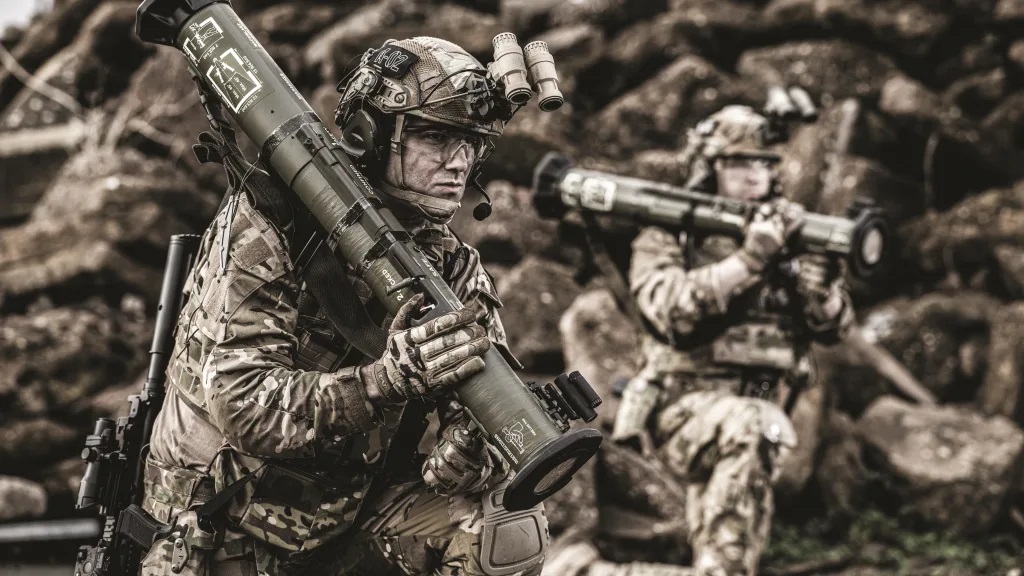
Carl Gustaf vs. Disposable Launchers (e.g., AT4)
The primary alternative for squad-level anti-armor capability is the disposable, single-shot launcher like the Saab AT4.
- Gustaf’s Advantages: The Gustaf is reusable, has a much greater effective range (700-1,500 meters versus the AT4’s ~300 meters), and offers a far wider ammunition selection, including support rounds like smoke and illumination that disposables lack. One Gustaf team can engage multiple, varied targets in succession.
- Disposable’s Advantages: The AT4 is lighter, significantly cheaper per shot, requires less training, and has no maintenance requirements. Its “confined space” capability, which uses a saltwater counter-mass to dampen the backblast, is a major advantage over most standard Gustaf rounds, making it safer for urban combat. Their low cost and simplicity allow for wide distribution, potentially equipping every soldier in a squad with a basic anti-armor weapon.
- The Verdict: The two systems are complementary, not mutually exclusive. The Gustaf is a platoon- or company-level support weapon, while the AT4 is a squad-level emergency tool.
Carl Gustaf vs. Advanced ATGMs (e.g., Javelin, NLAW)
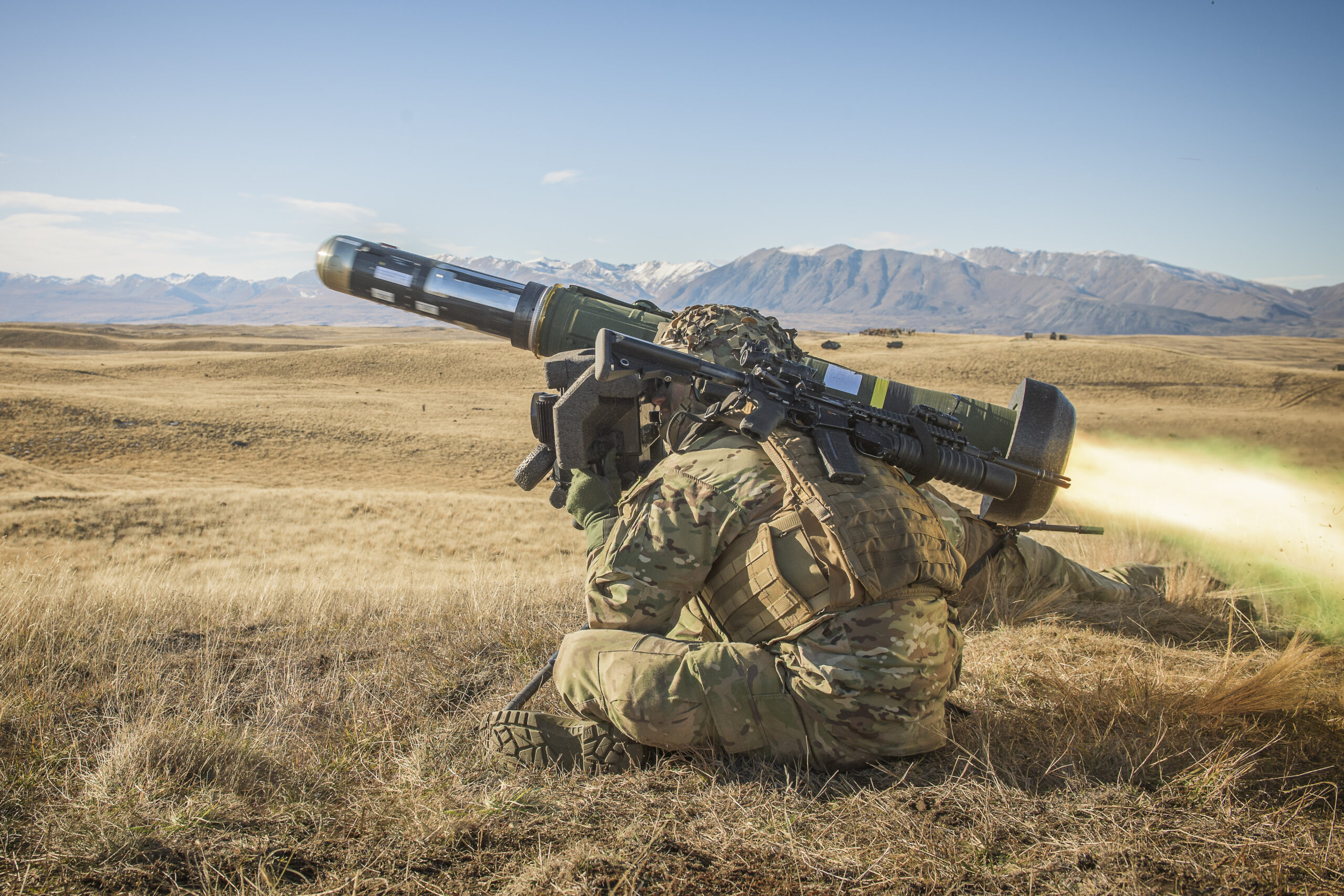
Against dedicated tank-killers like the FGM-148 Javelin, the Gustaf’s trade-offs become even clearer.
- Cost-Effectiveness: This is the Gustaf’s single greatest advantage. A single Javelin missile can cost anywhere from $80,000 to over $175,000, plus the cost of the reusable Command Launch Unit. A high-end Gustaf round costs around $3,000. During the war in Afghanistan, the US military realized it was firing extraordinarily expensive Javelins at bunkers, buildings, or single insurgents — targets that a Gustaf could service for a tiny fraction of the cost.
- Versatility vs. Specialization: The Gustaf is a multi-tool; the Javelin is a scalpel. The Javelin is a fire-and-forget, top-attack missile designed for one purpose: killing modern tanks with maximum efficiency. The Gustaf can engage tanks but is also used for bunker-busting, structure-clearing, anti-personnel suppression, and battlefield support.
- Guidance and Logistics: The Javelin’s sophisticated guidance system allows the operator to fire and immediately take cover, increasing survivability. The Gustaf is an unguided weapon that requires a skilled gunner to remain exposed while aiming and firing. However, a Gustaf team can carry significantly more ammunition for the same weight as a Javelin team, and its rate of fire of up to six rounds per minute allows for rapid suppression or follow-up shots.
System Limitations
Despite its strengths, the Carl Gustaf has inherent drawbacks.
- The Backblast: The weapon’s signature is its greatest weakness. The rearward blast of hot gas is extremely dangerous, creating a large danger zone (up to 60 meters to the rear) that can injure or kill friendly personnel. This makes firing from unprepared or confined positions hazardous (unless using specialized CS rounds) and instantly gives away the firing team’s position to the enemy.
- Physiological Toll: Firing the Gustaf is a violent experience. The overpressure wave generated by the blast is physically punishing, with soldiers reporting nosebleeds, dizziness, and the feeling of being “smacked in the chest with a piece of 2×4 lumber.” There are serious concerns about the cumulative effect of this blast exposure leading to Traumatic Brain Injuries, and many armies institute strict peacetime limits on the number of rounds a single soldier can fire per day.
- Effectiveness vs. Modern MBTs: While it can destroy a T-90M, doctrine in many armies advises against engaging modern MBTs from the front, as its HEAT rounds may not reliably defeat the latest composite armor and advanced ERA systems. It is most effective when used for flank, rear, or top attacks on tanks, or as a primary weapon against lighter armored vehicles like IFVs and APCs. It is also vulnerable to modern Active Protection Systems that can intercept incoming projectiles.
75 Years and Counting
The Carl Gustaf’s unparalleled longevity is the direct result of a brilliant, fundamentally simple, and robust core design that has proven to be endlessly adaptable.
Its history is a powerful lesson in the strategic value of a modular platform philosophy. By focusing innovation on what matters most — ammunition and sighting systems — Saab has kept a weapon system conceived in the 1940s not just relevant, but dominant on the 21st-century battlefield.
The system thrives in the vast tactical and economic middle ground between cheap, disposable launchers and expensive, highly specialized guided missiles. It provides platoon and company commanders with their own organic, on-call fire support — a pocket artillery piece capable of solving almost any problem an infantryman might face.
The Carl Gustaf is not approaching retirement. With the fielding of the ultralight M4 launcher, the introduction of smart, programmable ammunition like the HE 448, and the near-future promise of the laser-guided GMM, the system is more capable than ever.
It is poised to remain a central and formidable component of infantry firepower for decades to come, continuing its legacy as the ultimate battlefield multi-tool.