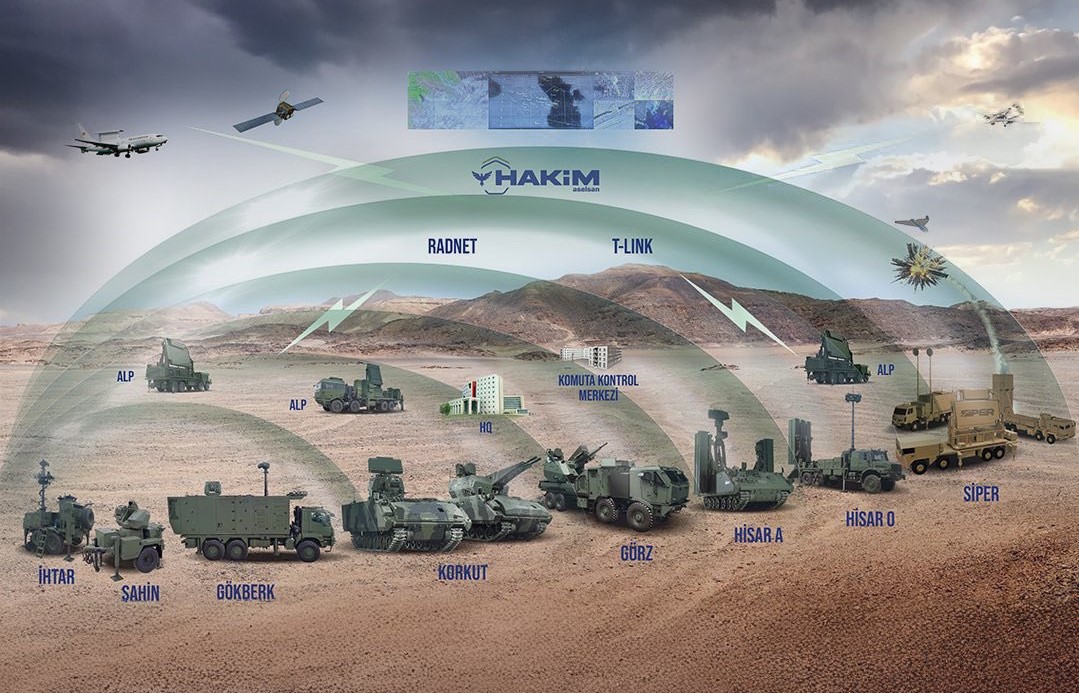
Turkey’s Siper missile has passed serial production acceptance tests, paving the way for its induction as the long‑range layer of the country’s multi‑layered “Steel Dome” air defense shield.
Part of the Siper project launched in 2018, the missile can intercept aerial targets such as jets, ballistic missiles, cruise missiles, and drones at a range of up to 150 kilometers (93 miles).
Developed by Turkish defense firms Aselsan, Roketsan, and Turkish Scientific and Technological Research Institution (TUBITAK), the Siper features a K-Band radio frequency seeker.
“Siper, which undertakes high-altitude air defense missions, has further solidified its place in the inventory with successful tests,” Defense Industry Agency President Haluk Görgün announced on Turkey’s NeXT Sosyal social media platform.
“This development represents a critical milestone in Türkiye’s layered air defense architecture.”
Steel Dome
Designed to protect against a wide range of aerial threats, the Steel Dome includes the 35mm Korkut self-propelled anti-aircraft gun for very short-range defense, as well as the Hisar-A and Hisar-O missile systems for short- and medium-range coverage, respectively.
Other elements of the network-based and artificial intelligence-supported air defense shield are domestic radars such as the ERALP long-range surveillance radar and the vehicle-mounted MAR (Mobil Arama Radarı), and the AKR fire control radar.
Additional components for the shield are being developed, such as the satellite positioning system Kasif, the KKS antenna, and the Atlas inertial measurement unit.
In December 2024, the Turkish Armed Forces launched a cloud computing system project to provide essential infrastructure for the project.