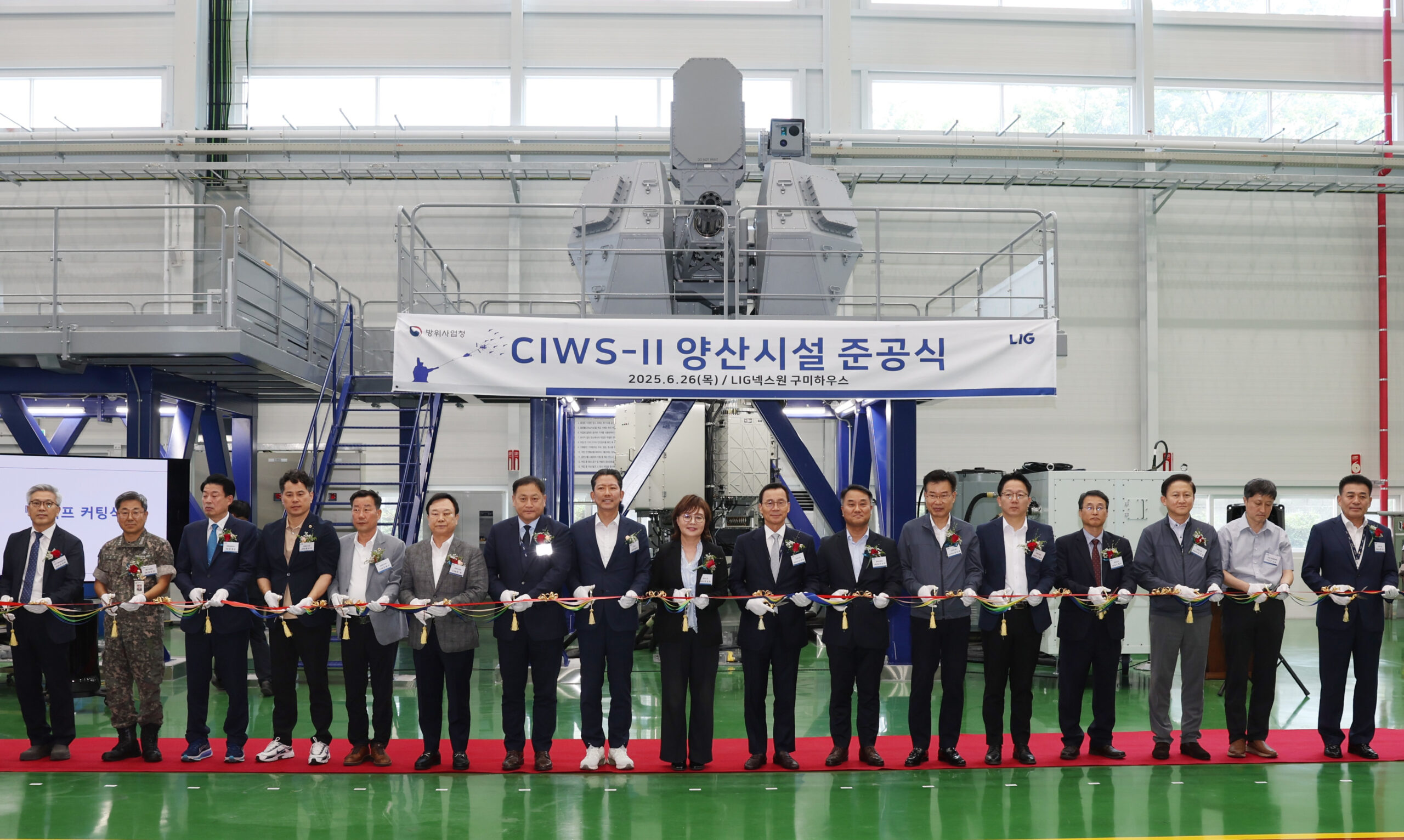
South Korean firm LIG Nex1 has launched a new facility to expand advanced Close-In Weapon System (CIWS-II) manufacturing in support of the country’s air defense capabilities.
The site, located in the eastern Gyeongsangbuk-do province, houses an assembly building, a proximity evaluations laboratory, and the company’s third primary radar system proving area.
Work at the complex will encompass mass production cycles, system integrations, live simulation tests, and performance verification.
Investment to construct the complex is valued at 21 billion won ($15.3 million), according to the company.
Once operational, the center is expected to play a vital role in the full-scale development of the CIWS-II until the technology’s completion in 2027, as well as further upgrades to match evolving requirements.
“Based on the CIWS-II mass production facility, we will do our best to achieve successful research and development and mass production, as well as expanded ground-use evolution and development, and overseas exports,” LIG Nex1 CEO Shin Ik-hyun stated.
The CIWS
LIG Nex1’s CIWS was introduced in the 1990s to serve as the last line of defense against close-range threats such as anti-ship missiles, unmanned aerial systems, aircraft, and small boats.
It was first mounted on South Korean warships and will protect critical military infrastructure, power plants, and airports in the future.
The system’s latest version, the CIWS-II, features an upgraded phased-array radar for enhanced detection, precision, and range.
The weapon can also engage multiple threats compared to the legacy manual intervention of the CIWS-I.
CIWS-II is fitted with a 30-millimeter Gatling-style rotary gun that can fire up to 6,000 rounds per minute. It scans for enemies at 360 degrees and intercepts them at an estimated range of 500 meters (1,640 feet).
The platform is programmed with targeting software that allows autonomous identification and firing while minimizing false positives.