Few modern air-to-air weapons have influenced beyond-visual-range combat in Europe as significantly as the Meteor missile.
Designed to dominate beyond-visual-range engagements, the Meteor is not just faster or longer-ranged than its peers; it fundamentally changes how air forces control the battlespace.
This missile has become a benchmark for next-generation air combat, and this guide explains why it matters and how it could impact global skies and high-stakes regions.
Meet the Meteor Missile
Meteor is a beyond-visual-range air-to-air missile developed by MBDA, a European multinational missile manufacturer jointly owned by Airbus, BAE Systems, and Leonardo.
The program was launched in the late 1990s to replace legacy radar-guided missiles that struggled against fast, maneuvering targets at long distances.
The core purpose behind Meteor’s creation was simple but ambitious: give fighter aircraft a decisive first-shot, first-kill advantage at long range — without the energy loss that plagues traditional rocket-powered missiles.
As potential adversaries fielded advanced fighters, electronic warfare systems, and long-range weapons of their own, European air forces needed a missile that could maintain high speed and maneuverability all the way to the target.
Meteor was built to meet that challenge.
What the Meteor Missile Does
At its heart, the Meteor stands apart because of its propulsion system.
Instead of a conventional solid-fuel rocket motor, the missile uses a throttleable solid-fuel ramjet engine. This allows the Meteor to sustain powered flight throughout much of its engagement, rather than burning out early and coasting.
Key Specifications and Features
The missile’s defining advantage is its no-escape zone — the area within which a target aircraft cannot evade, even with high-G maneuvers.
Because Meteor retains energy late into flight, it is far more lethal against agile fighters, cruise missiles, and high-value airborne targets like tankers and airborne early warning and control systems.
Here’s a breakdown of the Meteor missile:
| Category | Description |
| Missile Type | Beyond-visual-range air-to-air missile |
| Developer | MBDA |
| Program Origin | Multinational European development (UK, France, Germany, Italy, Spain, Sweden) |
| Primary Role | Long-range air superiority and interception |
| Intended Targets | Fighter aircraft, bombers, cruise missiles, high-value airborne assets |
| Length | ~3.65 meters (12 feet) |
| Diameter | ~17.8 centimeters (7 inches) |
| Weight | ~190 kilograms (419 pounds) |
| Range | Officially undisclosed; widely assessed to exceed 100 kilometers (62 miles) |
| Speed | Greater than Mach 4 (4,939 kilometers/3,045 miles per hour) |
| Propulsion | Throttleable solid-fuel ramjet |
| Guidance System | Inertial navigation with two-way datalink and active radar homing |
| Warhead Type | High-explosive fragmentation |
| Fuzing | Proximity fuze |
| Launch Platform | Fighter aircraft |
| Key Feature | Extremely large “no-escape zone” due to sustained powered flight |
| Countermeasure Resistance | High (energy retention and mid-course updates reduce evasive effectiveness) |
| Integration Status | In service or integrated on Rafale, Eurofighter Typhoon, JAS 39 Gripen; ongoing integration for F-35 |
| Operational Advantage | Maintains speed and maneuverability deep into engagement, unlike traditional rocket-powered missiles |
Variants and Integration
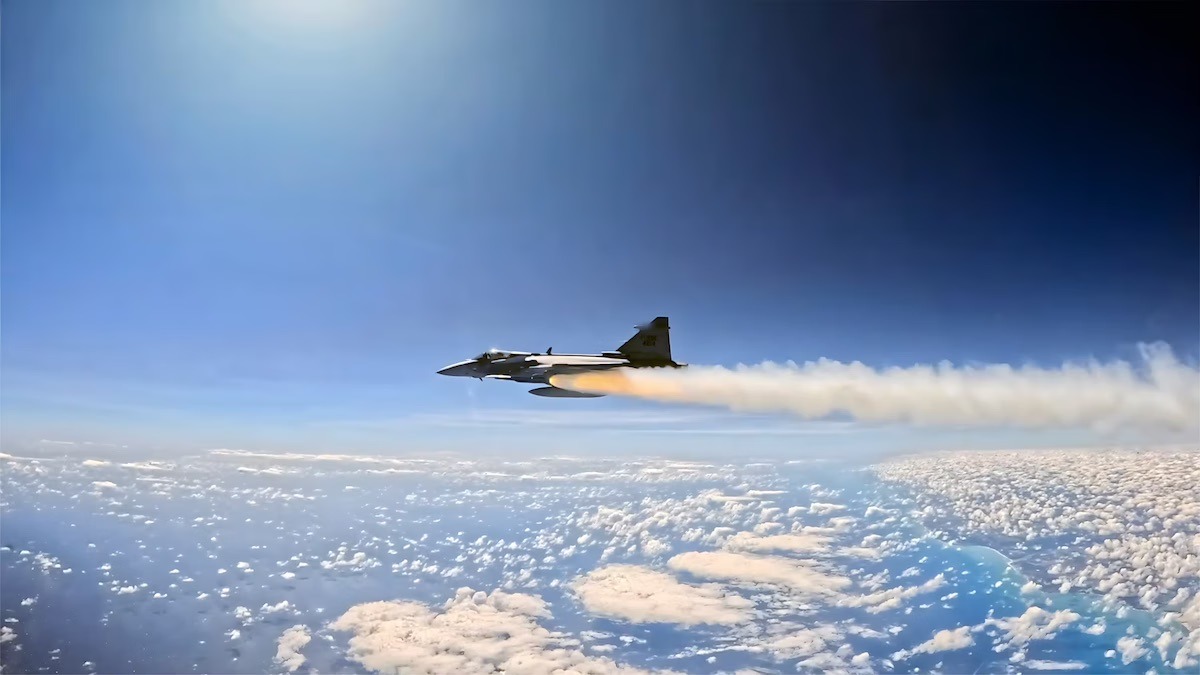
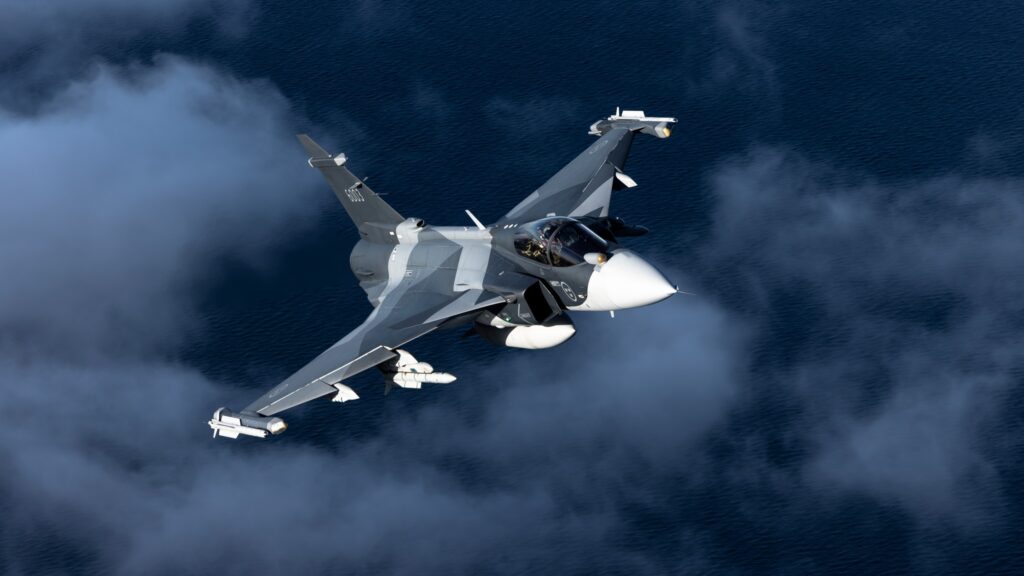
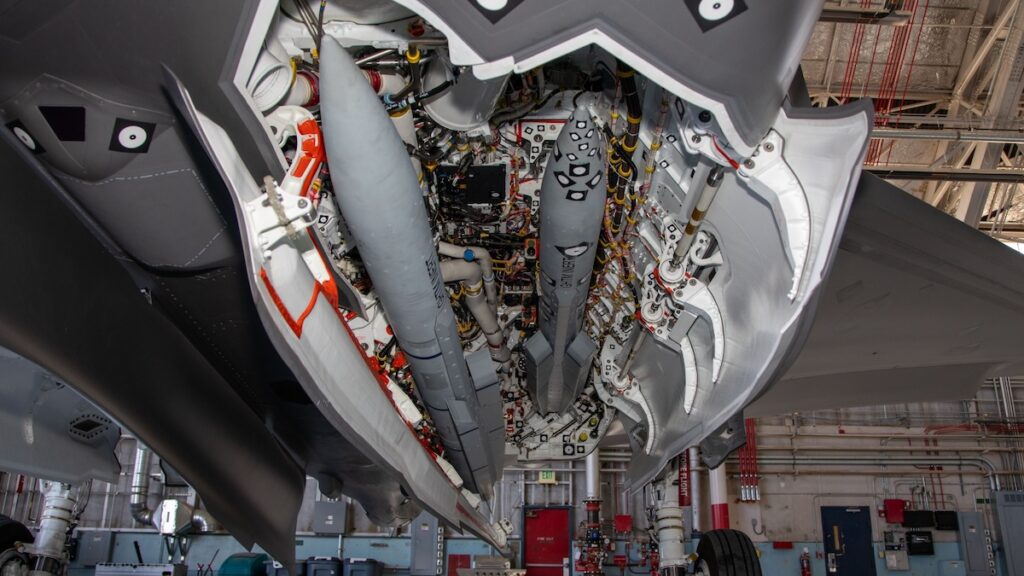
The Meteor has been integrated on several frontline fighters, including the Rafale, Eurofighter Typhoon, and JAS 39 Gripen, with integration underway for the F-35.
While the missile itself has not spawned radically different variants, ongoing software and datalink upgrades continue to enhance performance and networked combat capability.
This has pushed countries such as Brazil and Germany to conduct test firings to witness the missile’s actual capabilities.
Limitations
Despite its advantages, the Meteor is not without constraints. Its advanced propulsion and electronics make it more expensive than older beyond-visual-range air-to-air missiles.
Integration is complex, requiring deep access to aircraft mission systems — one reason it is not universally available.
Additionally, like all radar-guided missiles, the Meteor’s effectiveness can be degraded by sophisticated electronic countermeasures, though its energy advantage helps mitigate this risk.
Operational Role and Global Impact
Operationally, the Meteor shifts air combat doctrine. Pilots armed with the missile can engage earlier, from farther away, and with higher confidence of a kill, forcing adversaries into defensive postures before they can launch their own weapons.
This has profound implications for air superiority, deterrence, and escalation control. The Meteor’s deployment is already reshaping regional air power calculations.
European NATO members gained a qualitative edge in beyond-visual-range combat, while export customers such as India have leveraged the Meteor to significantly enhance their air dominance capabilities.