Taiwanese Navy Seeks High-Speed Kamikaze Drone Boat for Contested Domains

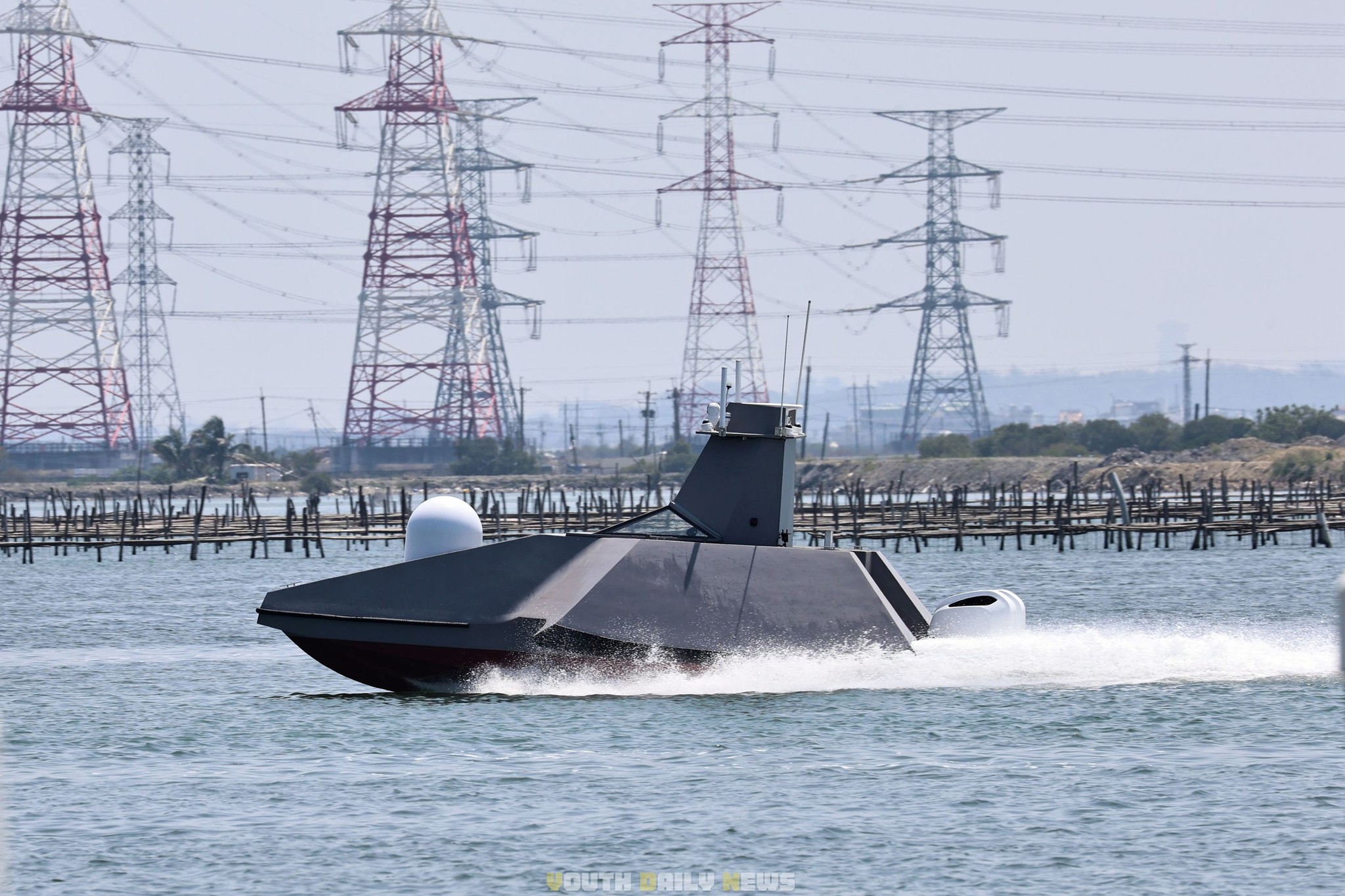
The Republic of China Navy has published a request for information on a suicide unmanned surface vessel (USV), outlining requirements for a high-speed, long-range capability designed for hostile maritime environments.
Alongside the one-way USV platform, Taipei specified supporting components for the project, including a portable control station, a mobile command vehicle, and a relay station.
The notice emphasized that the request is a public solicitation rather than a tender and is intended to “enhance asymmetric warfare capabilities.”
USV Specifications
The drone boat must have a speed of 35 knots (66 kilometers/40 miles per hour) and a maximum range of 250 nautical miles (463 kilometers/288 miles).
Its hull assembly must weigh no more than 2 tons (4,000 pounds) and measure 6 meters (20 feet) or less.
For cargo, the autonomous vessel must have a minimum payload capacity of 250 kilograms (551 pounds) and be capable of operating in sea states corresponding to Beaufort scale 4 or higher, which includes wind speeds of up to 16 knots (30 kilometers/18 miles per hour) and a wave height of around 1 meter (3.2 feet).
Integrations Needed
Required features for the tactical USV include autonomous obstacle avoidance, smooth acceleration, GPS and inertial navigation kits, a ruggedized exterior, and resistance to satellite navigation disruption and radio jamming.
The boat should be equipped with electrooptical and infrared solutions capable of providing real-time video streaming beyond 24 nautical miles (44 kilometers/28 miles).
Meanwhile, the USV’s dedicated control station must be compatible with satellite links, 4G and 5G networks, and encrypted radio frequency with backup channels, as well as swarming control support during deployments.
Connections of the movable dashboard should allow data sharing with command vehicles and permit transfer of control between operators.
Additionally, the USV’s mobile command vehicle should incorporate satellite equipment, jamming-resistant radios, onboard power, interior lighting and temperature control, as well as an independent generator capable of supporting 12 hours of operability.