How South Korea’s Nuclear-Powered Submarines Could Reshape Indo-Pacific Security
Seoul’s push for an SSN isn’t symbolism, it’s a strategic shift with ripple effects from Tokyo to Taipei.

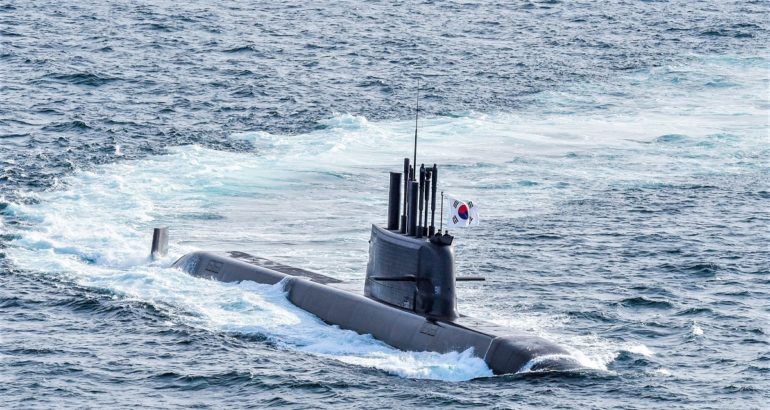
President Donald Trump’s recent decision to allow South Korea to develop a nuclear-powered submarine marks a turning point in allied defense cooperation.
If Seoul succeeds, it could rewrite deterrence dynamics in an era when crises in the Taiwan Strait and on the Korean Peninsula may unfold at the same time.
The plan reportedly centers on construction at Hanwha Ocean’s Philadelphia shipyard, a striking mix of US industrial revival and South Korean technological ambition.
Details on fuel supply and non-proliferation safeguards are still being negotiated under the 123 Agreement, but the strategic message is already clear: South Korea is preparing to join the very small group of nations that operate submarines capable of staying submerged for months, crossing oceans at speed, and operating far beyond coastal waters.
Strategic and Operational Payoff
For Seoul, the advantages are immediate. A nuclear-powered submarine would vastly expand the South Korean navy’s reach, allowing patrols across the East Sea, Yellow Sea, and even the Philippine Sea without surfacing.
In a dual-contingency scenario — a Taiwan crisis erupting alongside a peninsula conflict — an SSN would let South Korea contribute meaningfully to operations in the south while maintaining constant undersea coverage at home.
The endurance and stealth of an SSN unlock capabilities diesel-electric submarines cannot sustain: long-term intelligence gathering, seabed surveillance, special operation forces insertion, and precision strike from hidden positions.
Deterrence isn’t just operational, it’s psychological too. Even a single South Korean SSN operating undetected near Chinese or North Korean facilities would force adversaries to spread limited anti-submarine assets over wider areas, raising their costs and complicating their planning.
Politically, an SSN would give Seoul greater influence within the US-ROK alliance. Taking on heavier underwater responsibilities strengthens South Korea’s role in combined planning and reinforces the credibility of extended deterrence.
It could also reframe domestic debates on nuclear fuel rights, shifting them from abstract policy discussions to practical operational needs.
Washington benefits as well. More allied SSNs in Korean waters reduce pressure on the overstretched US attack-submarine fleet, letting American boats focus on tracking China’s ballistic-missile submarines.
Building the lead hull in Philadelphia injects allied investment into a long-dormant shipyard and revives specialized maritime labor networks.
It also demonstrates that responsible cooperation on nuclear-powered submarines can extend beyond AUKUS.
Japan gains indirectly, too. South Korean SSNs moving through the Tsushima and Miyako Straits would naturally integrate with Japan’s maritime patrol aircraft and surface combatants, creating a near-continuous anti-submarine defense arc from the Yellow Sea to the Philippine Sea.
In a Taiwan contingency, South Korea covering the northern approach frees Japanese assets for the south — an emerging trilateral division of labor.
Shifting Costs for Adversaries
For Pyongyang, the implications are stark. North Korea’s early SLBM force relies on coastal sanctuaries, yet South Korean SSNs could sit off these areas for weeks. That forces Pyongyang to disperse scarce resources and accept greater vulnerability.
Beijing faces even heavier burdens. Each additional allied SSN increases the probability of contact with Chinese submarines transiting the first island chain, compelling costly investments in new sonar systems, anti-submarine warfare aircraft, and quieter hull designs.
Over time, those demands strain China’s ability to conduct simultaneous operations in Taiwan and the East China Sea. Russia’s Pacific Fleet would face similar constraints under strengthened surveillance in the Sea of Japan.
In any future dual contingency, underwater speed and endurance may decide outcomes. Even one South Korean SSN could maintain constant patrols within a decade, deter North Korean provocations, and free US and Japanese assets to focus on southern missions.
As more South Korean and US SSNs operate together, a networked system of seabed sensors and unmanned underwater platforms could eventually form a permanent surveillance grid across key straits, dramatically raising the cost of coordinated aggression.
Industrial and Political Impact
Economically, the SSN program could elevate all three allies.
South Korea would gain nuclear-grade metallurgy and quality-assurance skills that spill over into civilian nuclear power, hydrogen technologies, and robotics. The US supply chain would receive renewed orders for valves, pumps, and nuclear-grade steel. Japan — already a leader in sonar and battery technology — would benefit from rising regional demand.
But major hurdles remain. Fuel policy is the most sensitive. Under current agreements, Seoul cannot enrich or reprocess nuclear material without US consent. Unless a leasing model using low-enriched uranium is created, South Korean SSN operations will depend on US fuel schedules.
Converting a commercial shipyard to nuclear certification will take years, and the program’s high cost must not squeeze out essential investments in fixed sonar networks, maritime patrol aircraft, and unmanned underwater systems.
Transparent safety measures and tight coordination with the IAEA will be essential to counter expected Chinese claims of escalation.

The Bottom Line
The logic is clear: in a region where warning times are shrinking and crises may overlap, underwater endurance could prove more decisive than the size of a surface fleet.
South Korea’s push for a nuclear-powered submarine is not a prestige project; it is a pragmatic response to a harsher strategic environment.
If Washington and Seoul align on fuel policy, industrial standards, and budgetary priorities, the payoff is far larger than a single platform.
It could redefine the Indo-Pacific deterrence architecture itself — quietly, steadily, and at exactly the moment when time, flexibility, and persistence matter most.

Dr. Ju Hyung Kim currently serves as the President at the Security Management Institute, a defense think tank affiliated with the South Korean National Assembly.
He has been involved in numerous defense projects and has provided consultation to several key organizations, including the Republic of Korea Joint Chiefs of Staff, the Defense Acquisition Program Administration, the Ministry of National Defense, the Korea Institute for Defense Analysis, the Agency for Defense Development, and the Korea Research Institute for Defense Technology Planning and Advancement.
He holds a doctoral degree in international relations from the National Graduate Institute for Policy Studies in Japan, a master’s degree in conflict management from the Johns Hopkins University School of Advanced International Studies, and a degree in public policy from Seoul National University’s Graduate School of Public Administration.
Dr. Kim has published extensively across leading international security and defense platforms, including The Diplomat, War on the Rocks, the Modern War Institute, 38 North, Asia Times, Small Wars Journal, RealClearDefense, Modern Diplomacy, the Lowy Institute, Global Security Review, the Geopolitics, and Global Defense Insight, among others.
The views and opinions expressed here are those of the author and do not necessarily reflect the editorial position of The Defense Post.
The Defense Post aims to publish a wide range of high-quality opinion and analysis from a diverse array of people – do you want to send us yours? Click here to submit an op-ed.