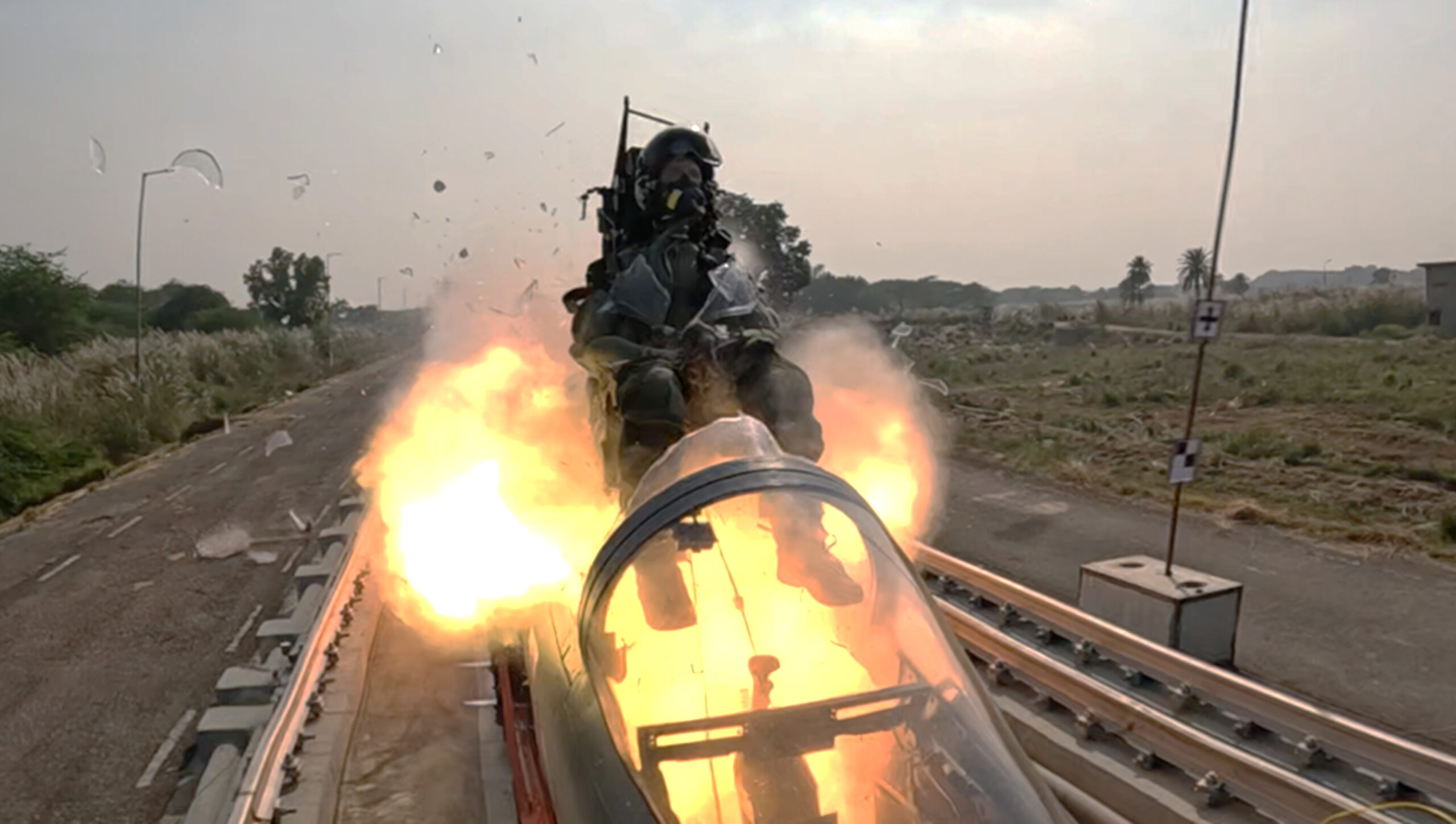
India has validated its indigenous fighter aircraft escape system through a successful high-speed rocket sled test, showcasing advanced in-house ejection capabilities.
The Defence Research and Development Organisation (DRDO) conducted the test at the Rail Track Rocket Sled facility of the Terminal Ballistics Research Laboratory in Chandigarh, in collaboration with the Aeronautical Development Agency and Hindustan Aeronautics Limited.
The experiment evaluated canopy severance, ejection sequencing, and full aircrew recovery using an instrumented anthropomorphic test dummy.
Phased solid-propellant rocket motors propelled the aircraft forebody at controlled velocity, simulating real ejection conditions far beyond static tests such as the net test or zero-zero test.
Onboard and ground-based imaging captured the sequence, while sensors measured critical loads, moments, and accelerations to assess pilot safety during ejection.
Defence Minister Rajnath Singh described the test as a significant milestone for India’s indigenous defense capabilities.
Testing Indian Defense Equipment
India has conducted several notable defense tests over the past year, reflecting ongoing modernization efforts.
The DRDO successfully conducted the maiden flight of the Astra Mk-1 air-to-air missile in April 2025 from an Su-30 fighter, validating its long-range engagement capability.
The Indian Army recently launched the BrahMos supersonic cruise missile from a test range in the Bay of Bengal.
Meanwhile, in September 2025, DRDO tested the indigenously developed Akash-NG surface-to-air missile for enhanced interception accuracy, further strengthening India’s layered air defense.